MCP Catalog: Enterprise-Grade Resource
Software Development Redmond, Washington
MCP Catalog for enterprise connects agents to Copilot Studio, GitHub Copilot, Azure AI Foundry and Dataverse
Key insights
-
MCP and MCP server: MCP is an open protocol that lets AI agents call external tools and services in a consistent way.
An MCP server translates natural-language requests into precise API calls and returns structured, human-readable responses. -
MCP Catalog: a curated collection of 60+ pre-certified MCP servers built around common enterprise systems like productivity, ERP, and CRM.
It works across Microsoft 365 Copilot, Copilot Studio, Azure AI Foundry, GitHub Copilot, and other MCP-compatible platforms. -
Start faster with ready-to-use servers: organizations can connect agents to familiar business systems in minutes instead of building custom connectors.
This reduces integration time and speeds AI deployment. -
Unified standard: one consistent connection model removes the need for multiple integration frameworks and improves interoperability across tools.
Agents use the same protocol to access different systems, simplifying development and maintenance. -
Enterprise-grade security and governance: catalog servers are pre-certified with authentication flows, audit trails, and role-based access controls.
These controls help ensure agents operate within existing security and compliance policies. -
Extensibility and cost: choose pre-built servers, certify existing MCPs, or develop custom MCPs inside your tenant.
There is no separate catalog fee; you only need the appropriate licenses for the data sources you access, and agents discover MCP servers automatically via standard endpoints.
Overview of the Video
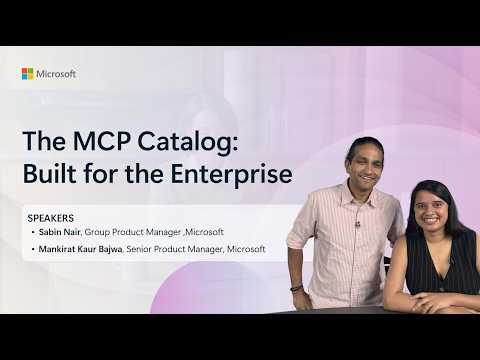
Microsoft released a YouTube video that introduces the new MCP Catalog, a governed collection of pre-built servers based on the Model Context Protocol. In the clip, product managers Sabin Nair and Mankirat Kaur Bajwa explain how the catalog aims to make AI agents discover and use enterprise tools more consistently. Consequently, the video positions the catalog as a way to reduce custom connector work and speed deployments across familiar systems.
How the MCP Catalog Works
The video describes MCP servers as translators that convert natural language requests into API calls for systems like Microsoft Graph, SAP, Salesforce, and Dynamics 365. Therefore, an agent can call a single protocol and let the server handle the specifics of each backend. Moreover, the catalog lists more than 60 ready-to-use servers that are pre-validated and governed to simplify enterprise rollout.
Key Benefits Highlighted
First, the presenters emphasize that organizations can start faster because they do not need to build every connector from scratch; pre-certified servers reduce integration time. In addition, the catalog provides a unified standard so the same MCP model can power experiences across Microsoft 365 Copilot, Copilot Studio, Azure AI Foundry, and GitHub Copilot, which improves interoperability. Finally, the video stresses enterprise-grade governance, noting that each server supports authentication flows, audit trails, and role-based access to align with existing security policies.
Tradeoffs and Challenges
While the catalog reduces development time, the video acknowledges tradeoffs between speed and customization, because pre-built servers may not match every unique process out of the box. Consequently, enterprises that need fine-grained workflows may still build custom MCP servers, which increases engineering effort and testing overhead. In addition, the team notes that balancing governance with agility can be difficult, since stricter controls improve safety but can slow feature delivery and iteration.
Security, Governance, and Compliance
The presenters stress that governance is a core design goal, so each catalog entry is pre-certified to work within common enterprise controls and permission models. As a result, organizations can rely on audit logs and built-in authentication to meet compliance needs while allowing agents to access data. Nevertheless, the video makes clear that enterprises must still align licensing and data policies, for example when accessing privileged information through Entra ID or other protected systems.
Paths to Adoption
The video outlines three main adoption paths: use pre-built catalog entries, certify an existing MCP, or build a custom server for internal uses. Therefore, organizations can choose the path that fits their timeline and resources, and they can mix approaches across different systems. Moreover, Microsoft positions the catalog as an extensible platform where partners and ISVs can certify servers to reach more customers.
Operational and Technical Considerations
Technically, the team discusses discovery and endpoint patterns that let agents find MCP servers automatically, which simplifies deployment at scale. However, they also raise concerns about versioning and lifecycle management, since APIs and business systems evolve and servers must stay compatible. Consequently, effective testing, change management, and clear governance models remain essential to avoid unexpected breaks in agent behavior.
Developer Experience and Ecosystem
The video shows Microsoft’s intent to integrate the catalog across developer tools and platforms, making it easier for teams to reuse integrations and combine services. Thus, developers benefit from consistent interfaces and reduced boilerplate, yet they must still understand mapping rules and the limits of natural language interpretation. Furthermore, Microsoft encourages certification to ensure quality, while leaving room for tenant-level customizations for unique business needs.
Cost and Licensing Notes
Importantly, the presenters state there is no separate fee for the catalog itself, though access to certain data still requires appropriate licenses. As a result, organizations should review their existing agreements to ensure compliance when agents access protected resources. In practice, this means that the catalog can lower integration costs but does not eliminate the need for correct licensing of underlying services.
Final Takeaways and Next Steps
In summary, the YouTube video frames the MCP Catalog as a pragmatic step toward standardizing how AI agents interact with enterprise systems, by providing pre-built, governed servers and clear paths for extension. However, adoption will require careful planning around governance, customization, and lifecycle management to balance speed and control. Moving forward, teams should evaluate their most critical integrations, test pre-built MCPs in pilot scenarios, and plan governance processes before wide rollout.

Keywords
MCP Catalog enterprise, enterprise catalog software, B2B catalog management, scalable catalog platform, digital product catalog, catalog integration ERP, enterprise PIM solution, MCP Catalog security compliance