Microsoft Sentinel: Graph & AI Security
Software Development Redmond, Washington
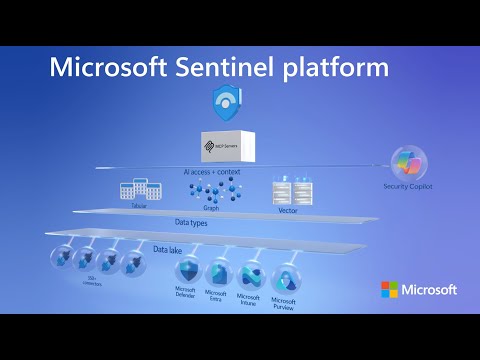
Microsoft Sentinel unifies SIEM, Microsoft Graph and AI to map attack paths, build identity graphs and secure multicloud
Key insights
- Microsoft Sentinel is now a unified, AI-ready security platform that reasons across your entire digital estate.
It combines detection, investigation, and response in a single cloud-native experience. - The platform stores telemetry in a centralized data lake to optimize cost and performance for large-scale analytics and AI workloads.
This central store brings identities, device activity, and threat intelligence into one searchable repository. - The Microsoft Sentinel graph (preview) models relationships between users, devices, and resources to map attack paths and highlight high-risk assets.
Custom graphs let teams extend context to multicloud systems and tailored identity models. - The MCP server (preview) enables investigators to use natural language queries and AI-assisted reasoning to explore incidents without deep schema knowledge.
That speeds up advanced hunting and reduces the need to write complex queries. - Agentic AI, integrated SOAR, and automated playbooks help analysts triage and remediate faster.
Automation reduces manual work and improves response consistency across incidents. - The platform supports multicloud, multitenant operations and broad integrations to enrich detections and streamline SOC collaboration.
These integrations improve context, prioritization, and coordinated response across environments.
The Microsoft-produced YouTube video summarizes major updates to Microsoft Sentinel, positioning it as a unified, graph-enabled and AI-ready security platform. In the recording, Vandana Mahtani, Principal Program Manager for Microsoft Sentinel, walks viewers through new capabilities that aim to speed detection, investigation, and response across complex environments. Moreover, the video emphasizes how relationships among users, devices, and resources help teams spot attack paths and prioritize response where it matters most across multicloud and hybrid estates.
Importantly, the presentation is practical and demo-driven, and it highlights features such as the security data lake, the Sentinel graph, and the Model Context Protocol (MCP) server for natural language investigation. Consequently, the narration frames these additions as evolutionary steps away from traditional SIEM toward a platform that fuses AI, graph-based analytics, and automation. As a result, security operations centers (SOCs) gain new tools to reason about threats across multicloud and hybrid estates.
What the Video Explains
The video begins by framing Sentinel as a cloud-native SIEM that now includes a purpose-built security data lake to centralize telemetry at scale. Then, it demonstrates how the platform models relationships using the Sentinel graph so analysts can visualize and follow paths attackers might take. Next, the MCP server is shown accepting natural language queries, allowing investigators to ask questions and get context without writing complex queries.
Furthermore, the demo highlights workflows for mapping blast radius and for building custom graphs that extend to multicloud systems, such as third-party SaaS identities. In this way, the platform tries to reduce friction when teams must correlate signals from many sources. Consequently, the video paints a picture of enriched context and faster investigations enabled by tighter data unification.
Key Capabilities and Tradeoffs
The platform’s main strengths include unified telemetry storage, graph-based analytics, and AI-assisted investigation, which together can reduce time-to-detect and time-to-respond. However, these gains come with tradeoffs: centralizing large volumes of data into a security data lake improves analytic power but raises cost and governance considerations. Therefore, organizations must balance retention and ingest policies against budget and compliance requirements.
Likewise, graph modeling enhances understanding of relationships, yet building and maintaining accurate entity graphs requires careful design and ongoing curation. As a result, teams may need to invest in mapping identity sources, normalizing attributes, and validating linkages to avoid noisy or misleading insights. Thus, the video implicitly suggests that operational discipline matters as much as technology.
AI, Automation, and Practical Challenges
The video shows how AI can be used to ask natural language questions and to surface context without requiring deep query language expertise from analysts. Consequently, this lowers the barrier for newer team members and speeds routine investigations, while enabling experienced practitioners to focus on higher-value work. However, reliance on AI and natural language introduces challenges such as the need to validate model outputs and to manage false positives or overconfident suggestions.
Moreover, automations and SOAR playbooks can accelerate responses, but they demand rigorous testing and governance to avoid unintended actions. Therefore, teams must design safeguards, implement approval workflows, and monitor automated outcomes closely. In short, automation can free time and improve consistency, but it must be handled carefully to prevent new risks.
Integration, Extensibility, and Multicloud Considerations
The video also covers the ability to extend Sentinel with custom graphs and to ingest identity and telemetry from multicloud environments. As a result, organizations gain a more complete view of attack surfaces that span cloud providers and SaaS applications. Nevertheless, integrating diverse sources can be technically complex and may surface incompatibilities, thus requiring mapping work and sometimes custom connectors.
Additionally, extending graphs to include third-party systems raises questions about data sovereignty, API limits, and latency. Consequently, teams should evaluate which sources provide the most security value and prioritize integrations that deliver actionable context. Ultimately, a pragmatic, phased approach helps balance breadth of coverage against implementation effort.
Implications for Security Teams
Overall, the YouTube video by Microsoft presents Microsoft Sentinel as a maturing platform designed to combine large-scale data, graph reasoning, and AI to improve SOC outcomes. For organizations, the benefits are clear: faster investigations, richer context, and increased automation. Yet, the video is also realistic about the work required to operate the system effectively, from data governance to tuning graphs and validating AI outputs.
Therefore, security leaders should weigh capability gains against costs, staffing needs, and governance controls. In practice, a phased rollout that focuses first on high-value data sources and validated automations will likely deliver the best balance between risk reduction and operational overhead. Finally, the video concludes by positioning these capabilities as part of an ongoing evolution in security operations rather than a single turnkey solution.

Keywords
Microsoft Sentinel, cloud SIEM, SIEM SOAR, Microsoft Graph Security, AI-driven threat detection, unified security platform, security analytics, extended detection and response