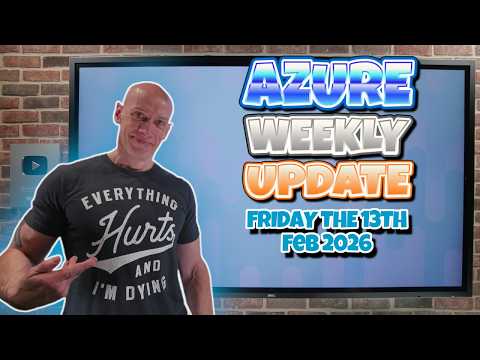
Azure Update: Feb 13, 2026 Highlights
Principal Cloud Solutions Architect
Microsoft Azure update covering Monitor pipelines, disk vault backups, AKS App Gateway add on, Databricks, Azure SQL, Entra
Key insights
- AKS and Kubernetes 1.34 — AKS now supports upstream Kubernetes 1.34, giving clusters access to newer scheduling, security, and performance fixes.
Preview add-ons include the Application Gateway for Containers and namespace-scoped placements via Fleet Manager, enabling tighter network control and simpler multi-cluster placement. - Azure Databricks and Claude Opus 4.6 — Claude Opus 4.6 is generally available on Databricks, speeding AI workloads and model testing.
Serverless workspaces and the GA Supervisor Agent reduce infrastructure overhead and simplify runtime management for data and AI jobs. - Application Gateway WAF and X-Forwarded-For — The WAF Default Ruleset 2.2 improves threat coverage and adds X-Forwarded-For grouping for better rate-limiting and client identification.
These changes tighten web defenses and ease compliance with security policies. - Networking notices — Azure Front Door added new origin options in some regions and announced the removal of older DHE ciphers on April 1, 2026.
Action: review TLS settings and update any clients or endpoints that rely on deprecated ciphers. - Storage and backups — Azure Container Storage v2.1.0 now integrates with Elastic SAN for on-demand provisioning, lowering storage cost and complexity.
Azure also highlighted improvements for disk vaulted backups, making snapshot and restore workflows more resilient. - Observability, regional expansion, and governance — Azure Monitor pipelines (preview) add data transformation features for cleaner telemetry and routing.
New regions (for example, Thailand South) expand deployment options, while features like Azure SQL DB 1–4 secondaries and updates to Entra governance improve availability and identity management; apply recent security rollups and patches promptly.
Overview of the Video
On February 13, 2026, John Savill's [MVP] released a concise Azure Update video that walks through a wide range of platform changes and announcements. The video is organized with chapter markers, which makes it easy to scan for topics like Kubernetes, storage, networking, monitoring, and AI on Azure. Moreover, the presenter highlights which items are general availability releases, which are previews, and which are notices or retirements. Consequently, the clip serves as a practical briefing for cloud operators and architects who need to track fast-moving platform changes.
Key Platform Updates
First, the video spotlights updates to the Azure Kubernetes Service (AKS), including support for Kubernetes 1.34 and a managed Application Gateway for containers add-on in preview. These moves push AKS toward the latest upstream Kubernetes features, which can improve scheduling, security, and performance. However, adopting new Kubernetes releases often requires careful testing because API changes and deprecated features can affect workloads.
Second, the update highlights enhancements in observability and monitoring, such as transformations in Azure Monitor pipelines and a newer Application Insights SDK for .NET. These tools aim to give teams better telemetry and diagnostics out of the box, which speeds troubleshooting and root-cause analysis. Yet, teams must weigh the benefits against migration effort and potential changes to data ingestion costs when transforming pipelines.
Storage and Networking Advances
The video notes that Azure Container Storage v2.1.0 reached general availability and now integrates with Elastic SAN for on-demand provisioning. This integration can reduce overprovisioning and lower storage costs by aligning capacity with actual use, but it also introduces new operational patterns and potential vendor lock-in for SAN-backed services. In addition, operators should plan testing of performance characteristics to ensure workloads meet I/O and latency needs under elastic provisioning.
In networking, the presenter covers updates to the Application Gateway WAF, including Default Ruleset 2.2 and improved X-Forwarded-For grouping for rate limiting. These changes strengthen web protection and make rate-limiting more accurate in complex traffic scenarios, which helps prevent false positives. On the flip side, tighter rules and grouping behaviors require more detailed rule tuning and monitoring to avoid disrupting legitimate traffic.
Databricks, AI Models, and Serverless
John Savill emphasizes advances within Azure Databricks, including general availability of serverless workspaces and the GA of Claude Opus 4.6 on the platform. These features lower the operational burden by offering pay-per-use compute and accelerate model deployment workflows for data teams. Nevertheless, adopting serverless environments can complicate cost predictability and may require new guardrails to control runaway charges during heavy AI workloads.
Moreover, the video mentions the Databricks Supervisor Agent reaching GA, which simplifies management and observability for Databricks clusters. This agent can streamline routine tasks, though it introduces another component to manage and secure in hybrid or air-gapped environments. Therefore, teams should consider the balance between managed convenience and the need for direct control over sensitive operations.
Security, Compliance, and Notices
The update covers several security and compliance items, including new WAF rules and notices about retiring certain ciphers and features. For instance, some components will stop supporting older ciphers, which improves security posture but forces teams to update legacy clients and integrations. As a result, organizations must schedule compatibility testing and plan communication to application teams to avoid service disruptions.
Additionally, Microsoft released security rollups earlier in the month that addressed vulnerabilities across Azure services. While these patches reduce exposure to exploits, they can also change system behavior or require reconfiguration after deployment. Thus, administrators must find a tradeoff between applying updates quickly to mitigate risk and validating them to preserve operational stability.
Operational Tradeoffs and Challenges
Throughout the video, a recurring theme is the tension between adopting new features quickly and maintaining a stable production environment. On one hand, new releases like AKS 1.34 and serverless Databricks offer performance and cost benefits, but on the other hand, they demand testing, automation updates, and staff training. Consequently, teams should adopt a staged roll-out approach that balances innovation with controlled validation.
Finally, the video underscores the importance of clear observability and governance when integrating these updates into existing cloud estates. Better telemetry and managed agents can speed recovery and decision-making, yet they require consistent configuration and cost monitoring to deliver value. In summary, John Savill's update provides a practical roundup for cloud practitioners, while also reminding them of the tradeoffs and preparation needed to adopt new platform capabilities safely.

Keywords
Azure update February 2026, Azure update Feb 13 2026, Azure update Friday the 13th 2026, Azure new features 2026, Azure security updates Feb 2026, Azure service changes Feb 2026, Azure roadmap 2026, Azure pricing updates 2026