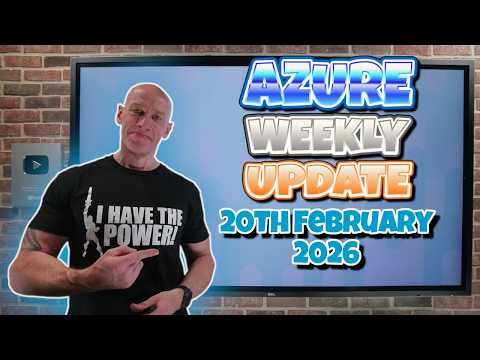
Azure Update 20th February 2026
Principal Cloud Solutions Architect
Azure: AKS autoprovision, encryption at host and LocalDNS, Prem SSD v two Ultra, Azure Functions dotNET, Agent Monitor
Key insights
- Azure Update (20 Feb 2026): Summary of the short update video covering cloud, AI, Kubernetes, storage, monitoring, and notices.
I am reporting the highlights for editorial use, not as the original author. - Claude Sonnet 4.6: Now generally available on Azure Databricks, offering faster reasoning and better multimodal performance for generative AI workloads.
Expect improved throughput and lower inference cost for large AI tasks. - AKS auto-provisioning: Expanded to Azure Government and private cloud with GA support for encryption-at-host and LocalDNS.
A new AKS MCP server preview and an agentic CLI aim to simplify cluster management and scaling. - Instant snapshot access: Premium SSDv2 and Ultra Disk now support instant access for incremental snapshots, speeding restores and reducing downtime.
Azure Container Storage v2.1.0 adds Elastic SAN integration and on-demand installs to improve storage agility. - Azure Functions .NET 10: Platform adds .NET 10 support and enhanced Flex Consumption tools to simplify serverless development and cost scaling.
These updates help developers run modern .NET apps with flexible billing options. - Monitoring and security notices: Azure Monitor pipeline transformations and a Fleet Manager preview improve observability and multi-cluster control.
Preview features include WAF X-Forwarded-For grouping for rate limiting; also note planned cipher retirements and DevOps policy changes that require attention.
Overview of the Video
In a concise update posted on February 20, 2026, John Savill's [MVP] walks viewers through the latest Azure changes and previews. The video organizes its content into short chapters, and the presenter highlights updates that span AI models, Kubernetes, storage, networking, and monitoring. Accordingly, this article summarizes those highlights and explains their practical impact for IT teams and cloud architects. It aims to remain objective while pointing out tradeoffs and operational considerations.
Key Service Announcements
First, the video notes that Anthropic models such as Claude Sonnet 4.6 are now available on managed platforms, improving support for reasoning and multimodal tasks. Next, Kubernetes-related improvements appear frequently, including advances in AKS tooling like the MCP server preview and expanded Node auto-provisioning support for government and private clouds. On the storage side, the video reports instant incremental snapshot access for Premium SSDv2 and Ultra Disk, along with integration of Elastic SAN into container storage. Finally, monitoring and security features such as enhancements in Azure Monitor and deprecation notices for weak ciphers were also covered.
Benefits and Practical Upsides
These releases primarily aim to reduce friction for teams that run large-scale production workloads. For example, access to newer AI models can speed development cycles while reducing inference cost, and the AKS improvements simplify cluster lifecycle tasks in regulated environments. In addition, faster snapshot access and on-demand storage integrations can lower provisioning time and cost, which directly benefits CI/CD pipelines and backup strategies. Therefore, organizations can expect smoother deployments and tighter compliance alignment when they adopt these features.
Tradeoffs and Performance Considerations
However, adopting new features requires weighing tradeoffs between agility and stability. Enabling advanced AI models often increases complexity in governance, since model upgrades and tuning vary across workloads; consequently, teams must invest in testing and cost monitoring. Similarly, although Node auto-provisioning reduces manual scaling, it may complicate capacity planning and forecasting if autoscale settings are not tuned carefully. Thus, while these features bring clear gains, they also demand stronger operational practices to avoid unexpected costs or performance issues.
Operational Challenges and Risks
The video also highlights a few notable challenges that operators should not ignore. For instance, expanding support into government and private clouds requires stricter compliance checks and often different networking or identity integrations, which can delay rollouts. Security notices, such as the planned removal of DHE cipher suites, force teams to update legacy clients and appliances, which may be time-consuming in heterogeneous environments. Therefore, the path to modernization is not only technical but also organizational, demanding coordination across security, networking, and application teams.
Monitoring, Troubleshooting, and Management
On the observability front, previews such as pipeline data transformations in Azure Monitor promise more flexible data handling and lower ingestion costs when used correctly. At the same time, increased tooling like fleet managers and agent dashboards adds layers of telemetry that teams must manage to avoid alert noise and data sprawl. In practice, teams will need to define clear logging and retention policies while automating routine responses to keep operational overhead under control. Consequently, better observability can reduce incident time-to-resolution but requires upfront design and ongoing maintenance.
Implications for Security and Compliance
Security-related updates in the video emphasize both proactive hardening and necessary retirements of legacy protocols. Removing weaker cipher suites and offering encryption-at-host improvements help raise baseline protection, yet they may trigger compatibility work across long-lived systems. For organizations in regulated sectors, the new AKS encryption and private cloud support appear particularly useful, but they also demand proof and testing to meet audit requirements. Thus, security gains are achievable, but teams must plan migration windows to avoid service disruptions.
What Teams Should Do Next
Practically, the video suggests a staged approach to adopting these updates: evaluate the preview features in non-production environments, validate cost and performance impacts, and then plan controlled rollouts. Teams should also prioritize governance: set budgets, define alerting thresholds, and run compatibility tests for deprecated ciphers or client integrations. Finally, engage cross-functional stakeholders early, because changes that affect storage, networking, or identity often require approvals and testing across multiple groups.
Closing Perspective
Overall, John Savill's [MVP] delivers a compact and actionable roundup of Azure changes that matter to practitioners. While the new capabilities promise improved speed, security, and manageability, they also bring tradeoffs in complexity and migration effort. Therefore, organizations should balance quick wins with careful planning to capture benefits without introducing new risks. In short, the update serves as a useful checklist for teams preparing their next cloud roadmap.

Keywords
Azure February 2026 update, Azure updates Feb 2026, Azure new features 2026, Azure AI updates February 2026, Azure security update Feb 2026, Azure pricing changes February 2026, Azure Kubernetes Service update Feb 2026, Azure governance and compliance update Feb 2026