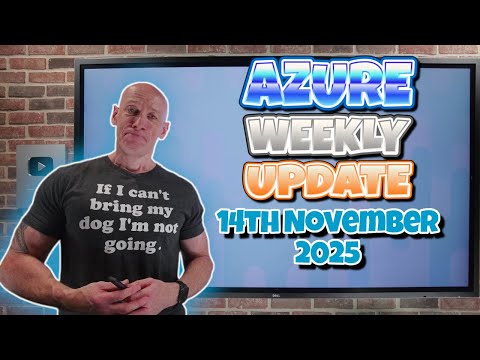
Azure Update - 14th November 2025
Principal Cloud Solutions Architect
Azure update: AKS Linux DNS, WAF for App Gateway containers, Azure Firewall, ADLS backups, PostgreSQL MySQL, KQL .NET AI
Key insights
- From the Nov 14, 2025 Azure Update video: key highlights and prep for Ignite 2025.
These notes summarize product changes, security fixes, and platform improvements mentioned in the video. - AKS and container platform updates: Linux OS Guard for node hardening, support for Flatcar Container Linux, LocalDNS improvements, an agentic CLI preview, and schedule-profile options for cost and performance tuning.
WAF protections for App Gateway and container scenarios plus an AFD WAF JavaScript challenge were also covered. - Storage and replication advances: rollout of Object priority replication and priority behavior for GRS/GZRS, plus an ADLS Gen2 vaulted backup option and planned failover procedures to improve disaster recovery.
- Networking and observability: new packet-capture and DNS flow trace logs for Azure Firewall, enhanced ExpressRoute resiliency with Connection Monitor for end-to-end checks, and updates that improve Front Door and App Gateway WAF diagnostics.
These steps aim to speed troubleshooting and reduce downtime. - Database and query improvements: MySQL Flexible Server supports lower_case_table_names and new Azure Function triggers; PostgreSQL Flexible added 3-AZ in Japan West; Cosmos DB added ORDER BY ST_DISTANCE and Query Advisor updates; KQL graph semantics gained openCypher support and labels() enhancements for graph queries.
- Security, AI, and reliability: Windows Server cumulative update KB5068787 and the November security rollup fixed endpoint and registry issues; Azure cut storage recovery times significantly and improved Service Health alerts; Microsoft also highlighted GPT-5.1, partner AI programs, and ongoing infrastructure investments supporting large AI workloads.
Overview
This article summarizes a YouTube update video published by John Savill's [MVP] on November 14, 2025, which surveys a broad set of Azure changes ahead of Ignite. The video runs through platform improvements, container and networking updates, storage and replication tweaks, database features, AI developments, and security fixes. Moreover, the presenter notes channel growth and indicates he can no longer respond to all viewer questions, directing viewers to community sites for help.
Platform and service highlights
First, the video lists several general availability items and previews that affect core Azure services, including database and query improvements. For example, Azure Database for MySQL Flexible Server adds support for lower_case_table_names while Azure Cosmos DB gains ORDER BY ST_DISTANCE for geospatial queries and an improved Query Advisor. These changes aim to improve developer productivity and query performance, but they also create a tradeoff between introducing new capabilities quickly and ensuring long-term stability for enterprise workloads.
In addition, network and platform tooling saw notable enhancements such as expanded ExpressRoute resiliency insights and a Connection Monitor for end-to-end checks. The release of an Azure NetApp Files Object REST API in preview and better Kafka lag tracking in Azure Event Hubs show a focus on scale and observability. However, organizations must balance adopting preview APIs with the risk of future breaking changes and the operational cost of integrating new telemetry into existing monitoring stacks.
Containers, networking and security
The video covers many container and networking updates for AKS, including Azure Linux OS Guard, continued support for Flatcar Container Linux, LocalDNS improvements, an agentic CLI, and schedule profile configuration. Also discussed are web application firewall features for Application Gateway and JavaScript challenge support for Azure Front Door WAF, which aim to harden container-hosted apps. While these features raise security posture, they increase configuration complexity and can impact latency or operational overhead if not tuned carefully.
Furthermore, Microsoft updated packet capture and DNS flow trace logging for Azure Firewall, which provides deeper forensic and troubleshooting capability. These logs help teams investigate incidents more quickly, yet they also enlarge log volumes and require thoughtful retention and cost controls. Consequently, teams must weigh the benefits of richer telemetry against storage, processing costs, and privacy considerations when enabling detailed packet or flow capture at scale.
Storage, replication and backups
Storage updates include object priority replication, changes to GRS and GZRS priority replication behavior, and a preview of ADLSGen2 vaulted backup capabilities. In addition, service health improvements reduced recovery times for affected storage clusters and added better alerting for customers. These measures improve resilience, but tradeoffs persist between replication modes: stronger durability and geographic redundancy usually mean higher cost and potential latency impacts for writes and reads.
The video also discusses ongoing work to make failover procedures and throttling more predictable, which helps large customers with disaster planning. Although improved failovers shorten recovery windows, they can involve complex operational coordination and testing to ensure application consistency. Therefore, organizations should adopt staged validation and exercise runbooks frequently to reduce surprises during real incidents.
Databases, query languages and data tooling
On data platforms, the update highlights PostgreSQL Flexible Server adding three availability zones in Japan West and additional features across MySQL flexible instances and triggers. The video also describes progress in graph querying: openCypher support and new KQL graph semantics like labels() that aim to make graph analytics more expressive. These enhancements help customers run richer workloads in Azure, though teams face migration challenges when moving between SQL, NoSQL, or graph paradigms and must plan for compatibility and performance tradeoffs.
Moreover, the presenter flagged integration points such as MySQL support for Azure Function triggers, which reduce glue code for event-driven patterns. While this simplifies architectures, it also demands careful attention to scaling characteristics and cold-start behavior in serverless contexts. As a result, architects should validate throughput and latency under realistic load to avoid surprises in production.
AI, partner programs and platform reliability
Finally, the video touches on broader themes: Microsoft’s push to move AI from experimentation to scale through partner programs and infrastructure investments, including references to GPT-5.1 models and a new AI “superfactory” in Atlanta. The company also released platform releases like .NET 10 and a security cumulative update for Windows Server that includes fixes for Defender and cloud communication. These moves accelerate AI workloads, but they also increase operational and energy demands and require partners to manage training, governance, and compliance tradeoffs.
Service health work is another focal point, as Microsoft described improvements to caching, throttling and alerting which together cut data plane recovery time significantly. While these reliability gains benefit customers, they underscore the continuing need for robust operational practices, staged testing, and clear communication with stakeholders during incidents. In short, the video presents a broad set of practical updates and tradeoffs that organizations should consider before adopting new features, and it recommends careful planning to balance innovation, cost, and operational risk.

Keywords
Azure update November 2025, Azure November 14 2025, Azure service updates 2025, Azure new features 2025, Azure security update November 2025, Azure AI services update 2025, Azure pricing and SLA changes 2025, Azure governance and compliance update 2025