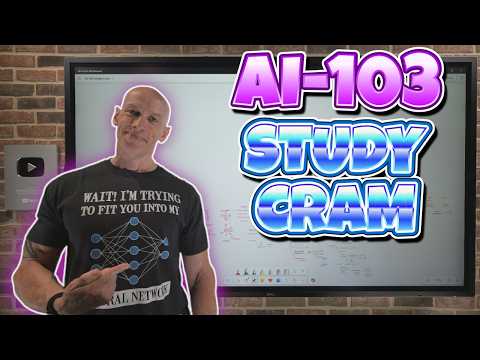
AI-103: Azure AI Apps and Agents Cram
Principal Cloud Solutions Architect
Azure AI cram featuring Foundry OpenAI tools Responses API Agent Framework model deployment responsible AI speech vision
Key insights
-
The video gives a focused study cram for the AI-103 exam, highlighting Microsoft’s shift toward Microsoft Foundry and practical, hands-on learning to build generative AI apps and agents.
-
It explains agent development essentials, including agent types (prompt, hosted, published), the Microsoft Agent Framework, and the Foundry Agent Service for orchestrating agent workflows.
-
Coverage of model work includes selecting and testing models, options for model deployment, model routing, and using playgrounds for experiments and evaluations to measure quality.
-
The video compares APIs and SDKs, showing when to use the Responses API vs ChatCompletions, and contrasts OpenAI and Foundry SDK patterns for integration and tooling.
-
It emphasizes connecting knowledge and external tools—knowledge sources, the toolbox, and multimodal inputs (speech, vision, translation) to build grounded, useful agent behaviors.
-
The presenter stresses best practices: Responsible AI, applying guardrails, continuous evaluations, and monitoring metrics to optimize solutions and ensure safe, reliable deployments.
Overview of the video
John Savill's [MVP] published a comprehensive YouTube video that serves as a study cram for Microsoft’s AI-103 exam, titled "Develop AI Apps and Agents on Azure." The presenter walks viewers through a long, chaptered session that maps directly to practical topics such as model deployment, agent design, and Foundry tooling, and he structures the presentation so learners can jump to specific areas by timestamp. Consequently, the video functions both as a guided tour of current Microsoft exam focus areas and as a hands-on primer for developers preparing to build production solutions on Azure.
Core topics and tools covered
The video covers a broad set of technical themes, including the role of Microsoft Foundry, model deployment options, playground experimentation, and model routing, which together highlight how Microsoft is framing modern AI development. In addition, the presenter reviews APIs and SDKs such as the Responses API and ChatCompletions, compares SDK approaches, and shows practical examples for toolboxes, skills, and knowledge connectors that power agentic workflows. Therefore, viewers get a clear picture of the stack: from models and services to the agent harness and publishing models for production.
Exam-focused guidance and hands‑on emphasis
Importantly, the video emphasizes that AI-103 now centers on building with Foundry and designing agentic applications rather than treating Azure AI as a loosely connected set of services. The presenter recommends a build-first study approach, practicing Foundry project setup, model orchestration, and RAG-style knowledge grounding to reflect the practical nature of the exam. As a result, learners are encouraged to combine reading the official learning path with hands-on projects to internalize how the services behave in real scenarios.
Tradeoffs: design, tools, and deployment choices
The video also explores tradeoffs that developers must manage, such as choosing between managed Foundry services and direct API integration, where cost, latency, and control pull in different directions. For instance, using Foundry-managed deployments can simplify orchestration and governance but may limit low-level customization and increase expense, while direct SDK or API usage can lower costs and increase flexibility at the cost of operational overhead. Moreover, the choice between the Responses API and ChatCompletions illustrates functional tradeoffs: one surface may favor structured multi-tool responses and the other straightforward chat-style flows, so development teams must weigh maintainability against feature richness.
Challenges in agent and multimodal solutions
Beyond tool selection, the video honestly addresses challenges in building agents and multimodal apps, including prompt and instruction design, tool integration, and knowledge retrieval quality. Guardrails and responsible AI are emphasized, because increasing agent autonomy raises safety, explainability, and compliance concerns that must be balanced against agent usefulness and user experience. Thus, teams should plan for testing, evaluation, and monitoring to keep models honest while retaining the flexible behavior that agents provide.
Practical evaluation and optimization strategies
Savill highlights evaluation strategies such as using playgrounds, model routing for A/B testing, and telemetry to view metrics and optimize solutions, which together create an iterative tuning cycle for production systems. He notes that operational optimization requires deciding between latency, throughput, and cost targets, and that measuring user outcomes is often more meaningful than raw model scores. Therefore, engineers should instrument end-to-end flows and compare model behavior under representative load and multimodal content to make informed tradeoffs.
Conclusions and next steps for learners
In conclusion, the video is a practical roadmap for anyone preparing for AI-103 or building AI apps on Azure, with the strongest signal that Microsoft expects developers to be fluent in Foundry and agent design. Viewers should combine the official Learn materials with hands-on Foundry projects, test model routing and guardrails, and practice publishing and monitoring agents to meet both exam and production expectations. Ultimately, the session offers a balanced view: while the new agent-first direction raises complexity, it also delivers capabilities that are essential for modern generative and multimodal applications.
Related resources
Keywords
AI-103 Develop AI Apps and Agents on Azure study cram,AI-103 exam practice questions,AI-103 study guide 2026,Azure AI developer certification AI-103,Build AI agents on Azure tutorial,AI-103 practice test and answers,Prepare for AI-103 fast track,AI-103 exam tips and cheat sheet