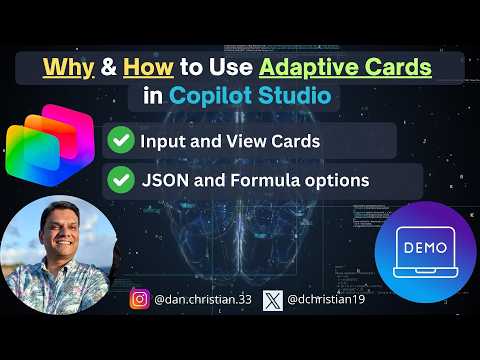
Copilot Studio: Build Adaptive Cards
Lead Infrastructure Engineer / Vice President | Microsoft MCT & MVP | Speaker & Blogger
Microsoft pro shows why and how to use Adaptive Cards in Copilot Studio for conversational AI and Power Platform
Key insights
- Adaptive Cards are lightweight JSON UI components that render as native, responsive content across hosts (Teams, Outlook, web).
They adapt to themes and device sizes so you don’t need separate UI for each platform. - Copilot Studio uses cards to move beyond text replies, improving engagement with buttons, forms, images, and richer layouts.
Cards make conversations clearer and more interactive for users. - Interactive Adaptive Card Node collects user input directly in the flow, letting agents process form fields, selections, and button actions.
Use non-interactive message or question nodes when you only need to display information. - Adaptive Card Designer lets you visually build cards inside Copilot Studio without hand-editing JSON.
Drag inputs, set IDs and labels, save, and preview to speed design and reduce errors. - output variables are created automatically from card inputs so the agent can reuse user responses in the workflow.
Map these variables to validation, branching, or backend calls to make the flow data-driven. - Input Adaptive Card vs view cards: use input cards for data collection and view cards for polished results or confirmations.
Leverage the Adaptive Cards schema when you need advanced layout or to share templates across channels.
Introduction
The YouTube video by Daniel Christian [MVP] walks viewers through why and how to use Adaptive Cards inside Copilot Studio, and it aims to make the subject approachable for makers and IT pros. The presenter organizes the content with clear timestamps, starting from the rationale and moving into concrete implementation steps and demonstrations. As a result, viewers can choose whether to watch a short segment or follow the full walkthrough depending on their needs. Overall, the video balances theory with hands-on examples to help teams adopt interactive card experiences.
Why Adaptive Cards Matter
Daniel explains that Adaptive Cards let agents deliver rich, interactive content in a platform-agnostic format, which means one design adapts across different hosts like chat surfaces and email. Consequently, organizations can present forms, buttons, and information consistently without building separate UI for each environment. Moreover, the video highlights how cards improve engagement by turning text-based exchanges into interactive tasks that guide users through workflows.
Core Benefits and Tradeoffs
The presenter emphasizes benefits such as structured data collection, improved validation, and polished presentation that respects host styling automatically. However, he also discusses tradeoffs: while visual designers accelerate development, they can obscure complex JSON customizations that power advanced behaviors. Therefore, teams must weigh speed and accessibility of the designer against the control and precision of editing card JSON directly.
How to Add Adaptive Cards in Copilot Studio
Daniel demonstrates adding an Adaptive Card node to a topic workflow and choosing the "Ask with Adaptive Card" option, then editing the card in the built-in designer. He walks through dragging input controls, assigning IDs and titles, and saving so that Copilot Studio generates output variables automatically. This step-by-step approach shows how user responses become accessible to the agent logic, and it clarifies how to wire card inputs into subsequent decision or message nodes.
Design, Customization, and Practical Challenges
The video contrasts using the Adaptive Card Designer with hand-editing JSON, noting that the designer speeds up common tasks while JSON provides deeper control. At the same time, Daniel points out practical challenges such as cross-host rendering differences, accessibility considerations, and versioning of card schemas, which can affect how a card appears to end users. Thus, teams face a balancing act: favor rapid design for standard forms but reserve JSON edits for cases that require precise layouts or advanced behaviors.
Implementation Tips and Troubleshooting
Daniel shares useful tips like naming inputs clearly so output variables remain intuitive and testing cards in the target host to confirm visual and functional behavior. He also recommends validating input client-side when possible and adding clear labels and defaults to reduce user errors during data entry. Finally, he addresses debugging techniques, such as inspecting generated variables within the agent workflow and iterating on the card in small steps to isolate rendering or logic issues.
When to Use Interactive Versus Informational Cards
The video distinguishes between interactive cards, which collect user responses, and informational cards, which display results or confirmations without expecting input. This decision affects conversation flow and agent design because interactive cards introduce state that must be handled by downstream nodes, whereas informational cards simplify interactions but limit user control. Hence, designers must decide based on the task complexity and the need for structured data versus simple presentation.
Balancing User Experience and Maintenance
Throughout the demonstration, Daniel highlights the importance of consistent naming, schema awareness, and documentation to reduce long-term maintenance costs. He also stresses that while rich cards can improve user experience, they add a layer of complexity in testing and version management across channels. Therefore, organizations should plan for governance and testing strategies that keep card designs reliable as agents evolve.
Conclusion
The video by Daniel Christian [MVP] offers a practical, paced introduction to applying Adaptive Cards in Copilot Studio and balances hands-on steps with strategic considerations. In addition, it calls attention to the tradeoffs between rapid visual design and the precision of JSON, and it outlines common challenges like rendering differences and debugging. Ultimately, the presentation equips makers with a clear path to start building interactive experiences while pointing out the governance and testing practices needed for scaled deployments.

Keywords
Adaptive Cards Copilot Studio, How to use Adaptive Cards Copilot Studio, Adaptive Cards tutorial Copilot Studio, Copilot Studio adaptive card examples, Adaptive Cards design best practices, Microsoft Copilot Studio Adaptive Cards guide, Adaptive Cards JSON examples Copilot Studio, Dynamic UI with Adaptive Cards Copilot Studio