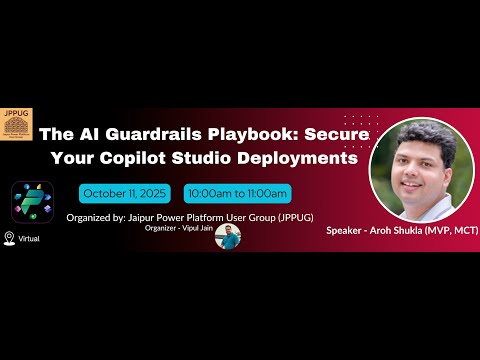
Copilot Studio: Secure AI Deployments
Consultant - M365, Power Platform, SharePoint, Azure, React JS | Speaker | Author | Trainer | C# Corner MVP
Secure and govern Microsoft Copilot Studio at enterprise scale with Power Platform controls, auditing and maker safety.
Key insights
- AI Guardrails Playbook: A practical framework from Microsoft for securing Copilot Studio agents at enterprise scale.
It shows how to build, test, and publish agents while keeping data and workflows safe. - Governance pillars: Focus on auditing, maker protection, Power Platform controls, tenant inventory, and managed environment policies.
These pillars help teams enforce consistent rules and reduce risk across the organization. - Real-time protection during agent runtime: Integrate external security systems to evaluate and stop unsafe agent actions as they run.
This prevents oversharing, unauthorized operations, and other live threats beyond static checks. - Secure-by-default controls: Built-in features include data loss prevention (DLP), encryption, geographic data residency, and support for customer-managed keys.
Use these to meet compliance and data protection requirements. - Platform and developer tools: The Microsoft 365 Agents SDK (preview) and Azure AI Foundry enable scalable agent development and access to a large model catalog.
They let teams move from low-code designs to custom, code-first agents safely. - Operational best practices: Combine built-in guardrails with Microsoft Purview and Sentinel auditing, use the Power Platform Admin Center for governance, and test agents before publishing.
Follow security-by-design steps and monitor agent behavior continuously.
- Author: Vipul Jain [MVP]
- Event: Jaipur Power Platform User Group (JPPUG) Meetup, October 2025
- Format: YouTube video summary
Overview of the Presentation
The video titled "The AI Guardrails Playbook: Secure Your Copilot Studio Deployments" explains how organizations can secure AI agents built with Copilot Studio. The presenter walks viewers through governance pillars, real-time protections, and auditing capabilities used by enterprises. Moreover, the session highlights live demos of auditing, maker protection, and Power Platform controls to illustrate practical application. Consequently, the talk aims to help IT teams prepare agents for enterprise-grade use.
Core Security Controls and Architecture
The playbook emphasizes layered safeguards, beginning with platform defaults that enforce encryption, data residency, and data loss prevention. It also describes integration with tools such as Microsoft Purview and Sentinel for end-user activity auditing and incident investigation. Additionally, the video outlines support for customer-managed keys to meet strict compliance requirements. Therefore, the architecture combines built-in protections with extensible monitoring for stronger enterprise control.
Real-time Protection and Monitoring
A key innovation covered in the video is the ability to attach external, real-time protection to agents so that safety checks become part of the decision flow. For example, organizations can connect systems like Microsoft Defender or other monitoring platforms to intercept and block risky actions during runtime. This approach reduces the chance of sensitive data leaks or unauthorized actions by evaluating agent behavior dynamically. However, it also introduces tradeoffs such as potential latency and the need for high-availability monitoring pipelines.
Scaling Agents: From Low-Code to Code-First
The presentation highlights the expanding lifecycle for agents, where teams may start with low-code designs in Copilot Studio and evolve into code-first deployments using the Microsoft 365 Agents SDK. In addition, integration with Azure AI Foundry gives access to a broad model catalog and enterprise knowledge sources to improve agent capabilities. As a result, teams gain flexibility to scale capabilities while preserving governance. On the other hand, the shift to custom code increases testing and maintenance responsibilities, which management must account for.
Governance, Tradeoffs, and Operational Challenges
The video explains that governance must balance security, usability, and speed of innovation to be effective in practice. For instance, strict controls reduce risk but may slow deployment and frustrate makers, while lax policies speed adoption but raise compliance exposure. Furthermore, the playbook points out challenges such as detecting prompt injection attacks, maintaining tenant-wide inventory, and ensuring consistent DLP coverage across channels. Thus, organizations must weigh these tradeoffs and invest in automation and training to keep both security and productivity aligned.
Recommendations and Practical Considerations
The presenter recommends embedding security early and validating agent behavior with staged rollouts and auditing. He also advises integrating enterprise monitoring and telemetry to maintain visibility and to tune guardrails based on real usage patterns. Moreover, teams should plan for key operational tasks like key management, incident response, and maker education to sustain secure operations. Ultimately, the playbook advocates a pragmatic approach that pairs default protections with custom controls where necessary.
Conclusion
In summary, the video offers a pragmatic framework for securing AI agents built with Copilot Studio, blending platform protections with external monitoring and governance. It makes clear that while technology provides strong defenses, organizational choices about policies, tooling, and process determine real-world outcomes. Therefore, enterprises should treat guardrails as living controls that evolve with usage and threats. Finally, teams that invest in both technical and operational measures will better balance safety and innovation for AI deployments.

Keywords
AI guardrails playbook, secure Copilot Studio, Copilot Studio security best practices, Copilot deployments security, AI governance and compliance, enterprise AI deployment security, JPPUG Meetup Oct 2025, securing Copilot Studio deployments