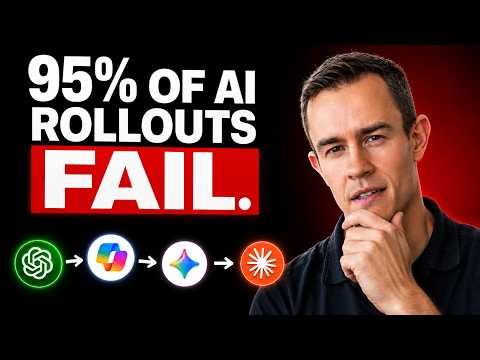
AI: 4-Stage Rollout Blueprint
Expert four-stage AI rollout for secure governed adoption and ROI using Microsoft Copilot and Microsoft three sixty five
Key insights
- In this YouTube video the presenter outlines an exact four-stage AI rollout to move from simple productivity gains to secure enterprise automation.
Land → Ground → Build → Connect maps to Microsoft’s similar model: Plan • Ready • Govern • Secure. - Many rollouts fail because companies buy tools before they define how to adopt and measure results.
Focus first on clear adoption paths, strong governance, and a plan for measurable ROI. - Follow a progression that builds value and capability: start by boosting employee productivity, then connect AI to trusted data, next automate repeatable departmental work, and only then tackle cross-business transformation.
- Make governance and security explicit early stages, not afterthoughts.
Define policies, monitor risks, and protect data before large-scale deployment to lower implementation risk. - Use practical readiness checks: translate business problems into use cases, confirm tasks occur often enough to justify automation, and assess data readiness, infrastructure, and skills first.
- Scale in phases and measure value at each step.
Include change management, reskilling, and clear decision rights to ensure adoption and sustainable growth through a disciplined phased rollout and strong workforce readiness.
Overview: Nick Ross lays out a practical AI rollout
Nick Ross [MVP] (T-Minus365) published a YouTube video titled "How I'd Roll Out AI in Any Business (Exact 4-Stage Framework)" that reframes AI adoption as a staged, measurable program rather than a single massive project. In clear terms, he argues most rollouts fail not because tools are weak but because organizations jump to purchase without a plan for adoption, governance, security, and return on investment. Consequently, Ross recommends a progressive path that begins with productivity gains and ends with enterprise-scale automation, ensuring each phase delivers measurable value.
Rather than touting a single technical silver bullet, Ross emphasizes practical steps that IT teams and business leaders can take together. He presents a four-stage sequence—Land, Ground, Build, and Connect—that maps to everyday operational choices. Moreover, each stage is designed to reduce risk while improving readiness for the next level.
The four-stage framework explained
First, Ross describes Land as the phase where organizations focus on immediate productivity wins for employees. By contrast, many companies start with ambitious transformation projects that are difficult to deliver, so Ross suggests beginning with tools and use cases that provide quick, measurable improvements in everyday work. As a result, teams build confidence and generate early metrics that justify further investment.
Next, Ground connects AI to trusted data and builds the foundations for secure use, and then Build moves toward automating repeatable departmental processes. Finally, Connect addresses cross-business coordination and larger-scale automation once governance, security, and data readiness exist. Each stage is intended to both produce value and prepare the organization for the increased complexity of the following stage.
How this approach compares to vendor guidance
For example, Microsoft guidance often frames adoption as a phased adoption model or uses a four-part structure such as Plan, Ready, Govern, Secure, which aligns with Ross’s intent but places explicit emphasis on governance and security as early, distinct steps. Therefore, organizations can map Ross’s pragmatic stages to vendor frameworks while preserving local priorities.
The practical value of comparing these models lies in tradeoffs between speed and control, since vendor frameworks tend to offer prescriptive technical checklists while Ross focuses on business-first sequencing. Consequently, leaders can combine the two views—use Ross’s progression to pick early use cases and adopt vendor guidance for architecture, compliance, and security checks—to reduce the chance of scaling fragile solutions.
Tradeoffs and implementation challenges
Rolling out AI touches people, data, and process, so tradeoffs are inevitable. For instance, moving quickly to realize productivity gains favors bottom-up adoption by teams, but that approach can produce shadow IT and governance gaps, which then require centralized controls; conversely, top-down programs reduce risk but slow adoption and diminish early ROI. Thus, organizations must balance speed, control, and measurable outcomes while managing expectations across stakeholders.
Additionally, challenges include data quality, integration complexity, skills and reskilling, and defining measurable success. Even with a staged plan, teams face decisions about vendor choice, hosting, and potential vendor lock-in, and they must weigh the cost of building bespoke solutions against the speed of using packaged intelligence features. Hence, a disciplined approach to use-case selection and clear metrics is essential to avoid wasted spend and stalled projects.
Practical recommendations and next steps
Ross recommends concrete steps that leaders and IT teams can take immediately: identify frequent, repeatable workflows, prioritize use cases with clear ROI, and invest in data hygiene and identity controls early. Moreover, he advises creating small pilots that deliver measurable outcomes and then using those results to secure broader funding and governance support. This approach helps to convert AI curiosity into accountable programs tied to business outcomes.
Finally, organizations should embed governance and security into every stage rather than treating them as afterthoughts, while also preparing the workforce through change management and training. By doing so, teams can expand from productivity enhancements to departmental automation and, ultimately, cross-business transformation with reduced risk and clearer measurement of value.

Keywords
AI implementation framework, AI rollout strategy, Deploy AI in business, AI adoption roadmap, 4-stage AI framework, Scale AI in enterprise, AI integration best practices, Business AI deployment guide