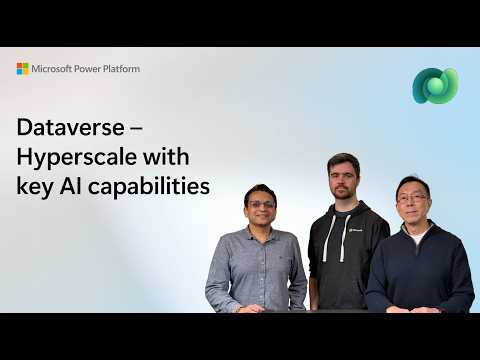
Dataverse: Hyperscale with AI Power
Software Development Redmond, Washington
Microsoft Dataverse powers hyperscale apps and agents with Power Apps, AI, MCP, Prompt Column and SDK for Python
Key insights
- Dataverse hyperscale: A cloud data platform built for enterprise apps and AI agents that scales to handle very large data volumes and many users.
It uses elastic tables and high-performance APIs to keep queries and imports fast as data grows. - Model Context Protocol (MCP): A standard that lets large language models read and write Dataverse records using natural language.
MCP helps agents find the right tables and map fields so LLMs can act on live business data safely. - Prompt Columns: Table columns that attach AI prompts to specific records so responses stay grounded in current data.
They reduce hallucinations by ensuring copilots cite and use organization-specific information. - Dataverse SDK for Python: A developer toolkit to query and update Dataverse from Python-based agents and apps.
It makes Dataverse a programmable knowledge source for custom automation and AI workflows. - AI-assisted dataflows: Automated suggestions for column mappings and transformations that speed up imports and improve data quality.
Combined with bulk operations, they cut manual steps and shorten data preparation time for analytics and agents. - Enterprise security and governance: Built-in controls, identity integration, and compliance features protect data used by apps and agents.
Admins can enforce policies so AI features work within corporate rules and privacy requirements.
A recent YouTube video by Microsoft outlines how Dataverse has grown into a hyperscale platform that brings core data management together with new AI features for enterprise apps and agents. In the recording, the presenter walks viewers through key components such as the Model Context Protocol (MCP), Prompt Columns, and the Dataverse SDK for Python, explaining how these elements help agents read and act on business data. Overall, the talk frames Dataverse as a secure, scalable foundation for integrating large language models and copilots into real-world workflows.
Overview of Dataverse Hyperscale
The video begins by defining hyperscale in the context of enterprise data, stressing the need to handle large volumes and many concurrent users without performance loss. Furthermore, it presents hyperscale as a combination of storage elasticity and smart data access, which together support both low-code apps and AI agents. The presenters emphasize that the platform is designed to work with Microsoft identity and governance systems to meet enterprise compliance needs.
Importantly, the session links hyperscale to practical features that developers and admins can enable, noting that some functions are available in preview and require explicit activation. Consequently, teams must plan for staged adoption and testing to avoid surprises when moving to production. The narrative sets expectations that while Dataverse adds AI capabilities, organizations still control deployment, privacy, and compliance settings.
Core Technologies Highlighted
The video spotlights a few headline technologies that extend Dataverse for AI-driven use cases. For example, the MCP standardizes how models query and update Dataverse, enabling natural language agents to create, read, update, and delete records while remaining grounded in the platform's data model. Likewise, Prompt Columns link prompts directly to table fields so model outputs reflect current, contextual business information.
Additionally, the session covers development tools such as the Dataverse SDK for Python, which simplifies building agents and scripts that treat Dataverse as a knowledge source. The presenters also describe AI-assisted dataflows that reduce manual mapping and improve import quality, thereby speeding time to insight. Together, these technologies aim to make agents more useful without requiring extensive custom engineering.
How It Works in Practice
In practical demos, the video shows agents using MCP to locate relevant tables and map fields based on natural language prompts, which streamlines routine tasks like record creation and summary generation. Furthermore, the platform supports high-throughput operations and bulk APIs such as CreateMultiple and UpsertMultiple to handle large imports and updates efficiently. These capabilities help reduce latency and save development time when handling enterprise-scale datasets.
The presenters also explain integration points with analytics tools and connectors, enabling Power BI and other services to query Dataverse at scale. Therefore, teams can build end-to-end pipelines from ingestion to insight while preserving security and governance. However, the video stresses that administrators must configure settings like Dataverse intelligence and MCP servers to match their operational policies.
Tradeoffs and Challenges
While the video promotes strong benefits, it also acknowledges tradeoffs that organizations should weigh when adopting Dataverse hyperscale. For instance, scaling for high throughput often means higher cloud costs and more complex monitoring, so teams must balance performance goals with budget constraints. Additionally, enabling AI features increases integration points, which can complicate governance and lifecycle management if not planned carefully.
Another challenge involves maintaining data accuracy and preventing hallucinations when models generate content; therefore, grounding via features like Prompt Columns helps but does not eliminate the need for validation. Moreover, preview features require careful testing and staged rollout, and developers must learn new patterns such as MCP-based interactions, which can slow initial adoption. Consequently, organizations will need a mix of technical skill building, policy design, and ongoing monitoring to realize the full benefits.
Business Implications and Next Steps
For business leaders, the video presents Dataverse hyperscale as a way to make agents and copilots more operationally useful by tying AI outputs to live business data. Therefore, teams that invest in governance, cost controls, and developer enablement can unlock faster automation, better decision support, and improved productivity across customer-facing and internal workflows. The session suggests starting with pilot scenarios that have clear success metrics to validate both technical fit and business value.
In closing, the YouTube presentation by Microsoft offers a practical look at how a hyperscale Dataverse can power AI-enabled apps and agents, while also signaling real-world tradeoffs around cost, complexity, and governance. Consequently, organizations should approach adoption with a measured plan that includes testing, role-based controls, and monitoring to ensure the platform scales responsibly. Overall, the video provides a balanced roadmap for teams considering Dataverse as the foundation for large-scale, AI-driven enterprise workflows.

Keywords
Dataverse hyperscale, Dataverse AI capabilities, Dataverse for AI, Microsoft Dataverse hyperscale, Scalable Dataverse data platform, Dataverse performance optimization, Generative AI on Dataverse, Hyperscale data store for AI