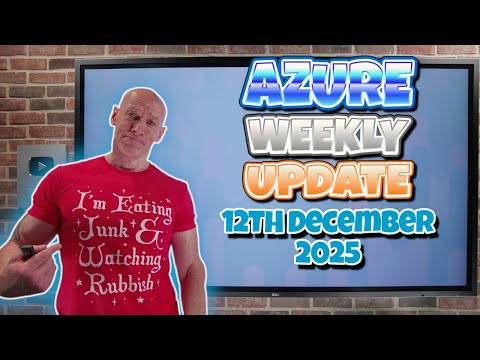
Azure Update - 12th December 2025
Principal Cloud Solutions Architect
Microsoft Azure update on Batch outbound retirement, App Gateway FIPS, Azure Files zonal premium and GPT five point two
Key insights
- Azure Batch default outbound retirement: Microsoft ends default internet egress for Batch on March 31, 2026, so Batch jobs will no longer have automatic outbound access.
Plan explicit outbound paths such as a NAT Gateway or user-defined routes to keep connectivity and control egress costs. - Application Gateway v2 now meets FIPS compliance, making it suitable for regulated and government workloads.
This brings approved cryptographic standards and stronger transport security for sensitive traffic. - Azure Files Premium LRS gains zonal placement in select regions to improve resilience against single-zone failures.
Choose zonal placement to reduce data loss risk and improve availability for critical storage workloads. - Azure Databricks adds Dashboard Teams support and serverless workspace updates to streamline analytics sharing inside Microsoft Teams.
Dashboard subscriptions help teams receive updates faster and collaborate on insights without extra setup. - Azure Sphere OS 25.12 delivers security and platform updates for IoT devices.
Apply this release to keep devices patched and minimize exposure at the edge. - GPT-5.2 shows improved handling of long documents, multi-step workflows, and large codebases, boosting developer productivity.
Expect better large-context assistance when used through Azure AI integrations and services.
Introduction
On December 12, 2025, John Savill's [MVP] published a concise weekly video update that highlights several important Azure service changes and platform improvements. The clip, designed as a quick briefing, outlines recent feature rollouts, compliance milestones, and a notable retirement timeline for a default networking behavior. Consequently, this article summarizes those points, explains practical tradeoffs, and flags the operational challenges organizations should expect as they plan updates and migrations.
Core Service Changes Covered
First, the video calls attention to the retirement of default outbound internet access for Azure Batch, with a final removal date set for March 31, 2026. This change forces teams to choose explicit outbound routes such as a NAT Gateway or user-defined routing, and thus it tightens network controls while requiring action to avoid outages. In addition, the update notes that Application Gateway v2 now supports FIPS cryptographic standards, which helps regulated customers meet federal compliance requirements but can restrict available cipher suites and require additional validation.
Moreover, the update highlights that Azure Files Premium LRS has begun offering zonal placement in some regions, improving the resilience of file shares by reducing cross-zone failover exposure. Likewise, Azure Databricks has extended dashboard support into collaboration channels, enabling teams to surface analytics more directly to business stakeholders. Finally, the video briefly mentions a new Azure Sphere OS 25.12 release and the general availability of a voice service named VibeVoice, reflecting the ongoing attention to IoT security and communications features.
AI and Analytics Developments
John Savill also spotlights the arrival of GPT-5.2 in the broader Azure and AI ecosystem, emphasizing its strength at handling long documents, complex codebases, and multi-step projects. This model addition gives developers more powerful tooling for code generation, summarization, and research tasks, yet it increases pressures on governance and cost control. For example, higher model capability often brings higher inference costs and a greater need for prompt engineering and robust validation to limit hallucinations.
Furthermore, the Databricks integration for dashboards into collaboration platforms promises productivity gains but raises questions about data governance and access controls. Seamless sharing speeds decision cycles, while at the same time it can blur boundaries between production analytics and exploratory work, so teams must balance ease of access with secure, auditable controls. Therefore, combining strong role-based access and monitoring is essential before exposing production metrics widely.
Operational Tradeoffs and Challenges
Retiring default outbound access for Azure Batch exemplifies a broader balancing act between security and operational cost. On one hand, forcing explicit egress routes reduces accidental data exposure and simplifies compliance assessments. On the other hand, implementing scalable NAT Gateway solutions or network virtual appliances may increase monthly costs and add management complexity, particularly for highly dynamic batch workloads that create many short-lived compute instances.
Similarly, achieving FIPS compliance with Application Gateway v2 improves trust for regulated workloads but can present compatibility work for legacy clients and tooling that rely on non-FIPS ciphers. Zonal placement for storage strengthens resilience, yet it can affect capacity choices, pricing, and replication strategies. For IoT fleets, applying Azure Sphere OS 25.12 updates means better security but also means device lifecycle planning and testing to avoid brick or behavior changes on constrained hardware.
Recommendations and Next Steps
Administrators should first inventory workloads that rely on implicit outbound access and then plan explicit egress solutions ahead of the March 31, 2026 retirement date to avoid last-minute risk. At the same time, teams should test Application Gateway v2 under expected traffic patterns when enabling FIPS to ensure performance and compatibility meet service-level expectations. For storage and analytics, pilot zonal Azure Files Premium LRS and Databricks dashboard integrations in nonproduction spaces to validate latency and governance before wider rollout.
Finally, organizations adopting GPT-5.2 or other advanced models should pair technical evaluation with updated governance, cost monitoring, and safety testing to limit hallucinations and misuse. In sum, John Savill's brief update highlights practical, nontrivial changes that require planning: the benefits include stronger security and better collaboration, while the tradeoffs involve cost, compatibility, and operational complexity. Teams that plan early, test thoroughly, and align security with usability will navigate these updates most effectively.

Keywords
Azure update December 2025, Azure December 12 2025 release notes, Azure new features Dec 2025, Azure AI services update 2025, Azure security updates December 2025, Azure pricing and licensing changes 2025, Azure governance and compliance updates 2025, Azure hybrid multi-cloud updates Dec 2025