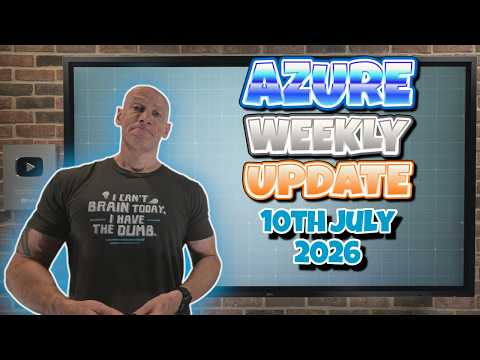
Azure Update 10th July 2026
Principal Cloud Solutions Architect
Azure update: OpenShift region, WAF, Blob SFTP Entra ID, Event Hubs security, Chaos Studio, OpenAI GPT, AVD
Key insights
- Azure Foundry now hosts large models like Claude Sonnet 5 and supports open-weight models such as Kimi K2.7 to run inside Microsoft’s governance boundary.
These integrations keep data and model execution on Azure and improve coding and agent capabilities for developers. - Client-side CRC64-NVME adds byte-level integrity checks for Azure Blob Storage to ensure data written is exactly what was sent.
Use this to detect corruption early and to strengthen end-to-end data reliability during transfers. - Azure Storage Mover gained support for migrating from Google Cloud Storage using S3-compatible endpoints and private network options.
This simplifies moving large buckets to Azure Blob Storage without exposing data to the public internet. - Entra ID SFTP replaces legacy SFTP access for Blob Storage, centralizing authentication and improving auditability.
At the same time, the Quantum Safe Program advances TLS 1.3 and modern cryptography to future-proof data protection. - Event Hubs Dedicated Confidential Computing and Network Security Perimeter support protect high-throughput streaming with hardware-backed isolation and tighter network controls.
These features suit regulated or high-security real-time ingestion scenarios. - Developer and security controls include WAF rule exceptions (Preview), a GA PostgreSQL PowerShell module, and new Chaos Studio workspaces and CLI tooling.
Together they improve operational flexibility, testing, and automation for cloud apps and infrastructure.
Overview of the weekly Azure update
In a compact YouTube roundup published on 10 July 2026, John Savill's [MVP] walked viewers through a set of notable Azure developments spanning AI, storage, security, and tooling. The video is structured with clear chapters and timestamps, and the host notes that channel growth has limited his ability to answer questions directly, asking viewers to use other community forums instead. Consequently, the update serves primarily as a curated briefing rather than an interactive Q&A session for subscribers.
Throughout the clip, Savill emphasizes practical implications for cloud teams and highlights preview and general availability changes that can influence short‑term projects and longer strategic plans. Importantly, this video does not replace official Microsoft communications, but it aggregates recent capabilities and frames them for IT practitioners. Therefore, architects and administrators can use the summary as a starting point for evaluation and planning.
AI and model integration advances
The update spotlights tighter AI integration on Azure, including the hosting of models such as Claude Sonnet 5 within Azure Foundry, and the introduction of the lower‑cost open model Kimi K2.7 into developer tooling like GitHub Copilot. Savill explains that these moves aim to combine strong model performance with Microsoft’s governance controls, which helps keep data and model execution inside the vendor boundary for security and compliance. However, teams must weigh the benefits of managed governance against the desire for open experimentation with external models.
Furthermore, the video discusses how deployment zones and data residency options in Azure Foundry affect compliance and latency choices, particularly for regulated industries. While tighter integration simplifies operations and auditing, it can also limit flexibility for teams seeking multi‑cloud or heterogeneous model strategies. Therefore, organizations will need to weigh predictable governance and security against potential vendor lock‑in and constrained model choices.
Storage updates and data integrity
Savill calls attention to client‑side integrity features like CRC64‑NVME added to Azure SDKs, which improve end‑to‑end assurance that bytes written are identical to bytes sent. Alongside integrity tooling, the update covers migration enhancements with Azure Storage Mover supporting migrations from competing cloud storage endpoints, plus the move to allow Entra ID access for Blob SFTP, modernizing authentication and auditability. These capabilities can reduce operational risk, yet they introduce overhead in implementing new SDKs and updating client workflows.
Moreover, the video highlights Microsoft’s push toward a Quantum Safe Program with accelerated TLS 1.3 adoption and modernized trust chains, which aims to future‑proof encryption against emerging threats. While such upgrades strengthen security posture, they also require planning for compatibility testing and staged rollouts to avoid disruptions. Consequently, organizations must balance immediate security gains against the cost and effort of migration, especially for legacy systems.
Security, networking, and developer tooling
On the networking and security front, Savill covers preview features like WAF rule exceptions for Application Gateway and Front Door that allow fine‑grained exclusions for edge cases, together with general availability for Event Hubs Dedicated confidential computing and network security perimeter support. He also reviews operational features such as Log Analytics export jobs, updates to Chaos Studio workspaces and CLI, and a new PowerShell module for PostgreSQL, which improve observability and resilience testing. Nevertheless, preview features offer flexibility at the cost of potential instability and limited SLA guarantees, so adopting them early requires careful testing.
The video also mentions client connectivity improvements, including redundant TCP multipath for Windows 365 and AVD, as well as enhanced backup and restore for Entra identities, which boost reliability for remote work and identity protection. These additions reduce single‑point failure risks, but they can increase configuration complexity and operational overhead for administrators. In short, the new tools improve security and uptime while raising the need for disciplined change control and monitoring.
Practical guidance and tradeoffs for IT teams
Savill’s practical framing encourages teams to phase adoption: pilot critical features in nonproduction, measure cost and performance impacts, and maintain rollback plans where previews are involved. He points out that although managed AI and storage features reduce some operational burden, they can increase dependency on platform upgrades and vendor roadmaps, which calls for clear governance and procurement alignment. Thus, balancing agility, cost, and long‑term portability becomes central to any migration or modernization plan.
In conclusion, the YouTube update provides a succinct snapshot of Azure’s direction in mid‑2026 and is useful for architects, security leads, and cloud engineers who need a rapid orientation. Savill’s summary weaves technical detail with practical caveats, and viewers should follow with deeper testing and vendor documentation before production adoption. Overall, the video is a helpful weekly briefing that highlights both opportunities and tradeoffs as teams evaluate these new Azure capabilities.

Keywords
Azure update July 10 2026, Azure July 2026 release notes, Azure new features July 2026, Azure security updates July 2026, Azure AI updates July 2026, Azure service updates July 2026, Azure pricing changes July 2026, Azure roadmap July 2026