- All of Microsoft
Copilot Studio + Power Platform Cases
Software Development Redmond, Washington
Microsoft Copilot Studio, Power Platform and Dynamics drive governed AI adoption with champions and ROI
Key insights
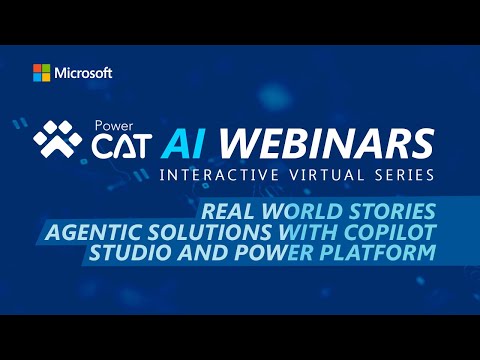
- Power CAT AI Webinars: A Microsoft series that showcases customer stories using AI agents built with Copilot Studio and the Power Platform, aimed at speeding adoption and practical learning.
Speakers share real deployments and lessons learned to help other organizations apply agentic solutions. - Agentic AI and Copilot Studio: Agentic AI lets agents plan, act, reflect, and collaborate with minimal human instruction, while Copilot Studio provides the workspace to design and deploy those agents.
This enables AI to perform complex tasks like drafting messages, summarizing opportunities, and automating workflows. - Power Platform and Dataverse: The Power Platform connects data, apps, and workflows with Dataverse as the unified data layer, simplifying integration with Microsoft 365, Dynamics 365, and Azure AI services.
Low-code tools make it easier for business users and developers to build and scale AI solutions. - Champion programs and adoption strategies: Customers like T‑Mobile and State Farm use licensing, open office hours, and grassroots champion networks to grow usage and lower barriers to entry.
These community-driven tactics accelerate learning and increase measurable ROI. - Governance: Successful deployments pair innovation with strong governance, risk controls, and alignment to business goals to ensure safe, compliant, and valuable AI use.
Teams emphasized continuous learning, documentation, and clear ownership for agent behaviors and data access. - Multi-agent support and business impact: New platform features include multi-agent orchestration, refined retrieval controls, and tighter Azure integrations, which drive productivity and customer experience improvements.
Enterprises report gains in automation, real-time insights, and scalable, repeatable AI solutions.
[BEGIN HTMLDOC]
Overview of the Webinar
The YouTube video, published by Microsoft, presents the "Real World Stories: Agentic Solutions with Copilot Studio and Power Platform" webinar from the Power CAT AI series. It gathers customer speakers and Microsoft experts to show how organizations are deploying agentic AI to solve real problems and measure impact. The session focuses on practical lessons rather than theory, and it highlights concrete outcomes from named customers. Consequently, the video serves as a playbook for teams that want to move from experimentation to scaled use.
Core Technologies and Capabilities
At the heart of the presentation is agentic AI, which the speakers describe as AI agents that can plan, act, reflect and collaborate across tasks. Also central are Copilot Studio and the Power Platform, a low-code environment that connects data, workflows and agents so organizations can build solutions faster. Moreover, the webinar emphasizes how these agents can span simple retrieval tasks to multi-step autonomous workflows, enabling users to delegate routine work while retaining human oversight.
In addition, the video highlights integrations that make those agents practical at scale. For example, organizations leverage Dataverse and Dynamics 365 for unified data, and connect to Azure AI Foundry for model orchestration and compute. These integrations reduce duplication and support enterprise governance, yet they introduce technical choices about where logic, data and controls should live. Therefore, teams must design pipelines and role boundaries carefully to balance speed with security.
Customer Stories and Measurable Outcomes
Speakers from T‑Mobile, State Farm, UKG and PeopleCert share how they applied agentic solutions and what they learned. For instance, T‑Mobile scaled adoption by combining AI-driven automation with community engagement to lower barriers and boost usage. Meanwhile, State Farm democratized AI by licensing tools broadly, running open office hours and building a champion program to surface grassroots innovations that deliver measurable ROI.
Other examples illustrate different value paths: UKG’s Applied AI team paired no-code and pro-code approaches to deliver a brand communicator agent and a pipeline of high-impact use cases, while PeopleCert reworked its stack around Dynamics 365, Power Platform and Copilot Studio to support both internal and customer-facing agents. Consequently, these stories show that measurable value emerges when technology aligns closely with business processes and when teams invest in people as much as in code.
Governance, Community and Adoption Strategies
Across the talks, governance and community-building stood out as essential enablers of safe, scalable adoption. Presenters recommended clear guardrails for data access, agent permissions and model use, paired with hands-on programs like champion networks and office hours to build trust and skills. Furthermore, a governance framework that includes continuous learning and risk management helps organizations keep pace with new agent capabilities while protecting sensitive data.
In practice, organizations balance centralized policy with decentralized innovation by allowing teams to prototype while enforcing core compliance rules. This approach reduces friction and empowers domain experts to own solutions, yet it requires ongoing oversight to prevent drift and to ensure consistency. Therefore, meta-governance—policies, telemetry and periodic reviews—becomes part of operational routines.
Tradeoffs and Challenges
The webinar also addresses tradeoffs that teams face when adopting agentic AI. On one hand, low-code tools accelerate delivery and empower non-developers; on the other hand, complex use cases still need pro-code work and deeper engineering. As a result, organizations must decide when to favor rapid prototyping and when to invest in robust engineering to ensure reliability and scale.
Other challenges include model reliability, data quality, and integration complexity. For example, agents that act autonomously can surface hallucinations or make poor decisions if their training and context are incomplete. Moreover, scaling agents raises operational considerations like cost, monitoring and lifecycle management. To mitigate these risks, teams should adopt phased rollouts, strong validation pipelines and active monitoring to catch drift and measure outcomes against business metrics.
Looking Ahead
Finally, the video underlines that the technology continues to evolve, with new features such as multi-agent support and finer-grained retrieval controls emerging from recent releases. Consequently, organizations that invest in people, governance and modular architecture will be better positioned to adopt new capabilities safely and quickly. In short, the webinar offers a pragmatic road map: combine technical building blocks with governance, community programs and continuous measurement to turn agentic AI into sustained business value.
[END HTMLDOC]

Keywords
Copilot Studio agentic solutions, Power Platform Copilot integration, Power CAT AI webinars, real-world Copilot case studies, agentic AI solutions for enterprise, Copilot Studio tutorials and demos, low-code AI copilots, automation with Power Platform and Copilot