- All of Microsoft
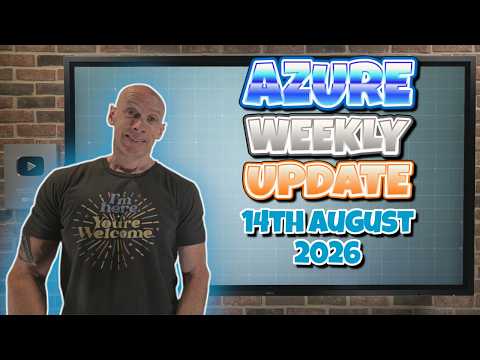
Azure Update 14th August 2026
Principal Cloud Solutions Architect
Azure milestone update covering App Service markdown, AKS metrics, ExpressRoute resiliency, Firewall, Copilot Gemini
Key insights
-
This is a concise summary of an Azure Update YouTube video (14 Aug 2026), not the channel author.
The host hit a 500K milestone and notes the growing audience means many questions go into the moderation queue and won’t be answered on the channel. -
Key AI model moves: Azure and partners added new models and integrations.
Databricks and platforms now support Gemini 3.7 Flash, GitHub Copilot gets the same flash model, and Microsoft Foundry added GPT-5.6 and Claude family updates. -
Security and patching updates matter this month.
Microsoft’s August Patch Tuesday covered hundreds of vulnerabilities, and Defender for Cloud launched on-demand malware scanning for specific blobs and file shares.
Azure also moved new servers to the latest security-hardened builds for Azure PostgreSQL starting 5 Aug 2026. -
Networking and platform previews and GA items to note.
New network capabilities include ExpressRoute resiliency guard (preview) and improved AKS control plane metrics.
Azure Front Door published batch rule updates as GA and Firewall Premium received higher-performance options. -
Storage and platform productivity updates.
App hosting gained App Service markdown support, disks gained Shared Premium SSDv2 and Ultra dynamic resize, and Fabric turned on item-level recovery by default for specific scenarios.
Azure Container Apps Sandboxes also appeared in preview. -
Practical takeaways and actions for teams.
Read official release notes, test previews in nonproduction first, schedule around announced maintenance windows, and watch for CLI breaking changes before automating.
If you need help, use community forums and official docs rather than relying on the video creator for one-on-one support.
Introduction
In a concise YouTube update, John Savill's [MVP] reviewed a batch of recent platform changes and milestones for Azure on 14 August 2026. The video served as a quick roundup, noting a channel milestone and several service updates that span networking, storage, databases, and AI. Savill presented the items in short chapters, which helped viewers scan what matters to them without long deep dives. Consequently, the update functions as a practical briefing for cloud architects and operators who need to stay current.
Video Overview and Milestone
The host began by celebrating a significant subscriber milestone, acknowledging community support and growth. He then explained that the channel’s expansion has increased the volume of incoming questions, and that moderation limits mean he cannot personally answer all queries. Therefore, he encouraged viewers to seek community forums when needing detailed help, while also pointing to subtitles and auto-translate features to broaden accessibility. Overall, the tone combined gratitude with a pragmatic note about support limits.
Savill proceeded to list short topic chapters, which ranged from small feature additions to AI model rollouts and performance improvements. This structure made it easy to jump directly to items like control plane metrics for AKS or mutual TLS for AFD. He emphasized brevity and clarity, aiming to inform rather than to provide full operational guidance in this single clip. As a result, viewers receive a useful status snapshot while knowing that deeper research will be required for implementation.
Platform and Networking Updates
Among networking highlights, Savill noted the arrival of a public preview for ExpressRoute resiliency guard, which aims to improve path robustness for private connections. He also covered performance improvements announced for Firewall Premium, suggesting that organizations dependent on high-throughput inspection may see tangible benefits. Moreover, updates to AKS included new control plane metrics, which should help operators monitor cluster health more closely. These changes emphasize measurable operations, but they also demand attention to configuration and cost tradeoffs when enabling extra telemetry.
In addition, updates to Azure Front Door (referred to as AFD) included GA deployment of batch rule updates and support for mutual TLS in certain scenarios. These enhancements improve edge control and security posture for web-facing applications, yet they increase configuration complexity for teams new to secure edge routing. Consequently, organizations must balance the advantage of stronger control with the need for testing and policy governance. Transitioning these features into production will require planning across networking and security teams.
Storage, Database, and Recovery
Savill discussed storage improvements such as the availability of Shared Premium SSDv2 and dynamic resize for Ultra disks, both of which offer greater flexibility for performance-sensitive workloads. He also noted that Fabric item-level recovery has been set to sensible defaults, which helps protect data while reducing manual configuration. Regarding databases, the update referenced automatic onboarding to newer versions for PostgreSQL flexible servers, which simplifies patch management but can introduce timing concerns for applications with strict compatibility needs. Therefore, administrators will need to test application behavior against upgraded engines before relying on automated rollouts.
These storage and database changes reduce operational toil, yet they introduce tradeoffs between automation and control. For instance, dynamic disk resizing supports bursty workloads but can increase costs if not monitored. Likewise, automated database updates close security gaps quickly but may interfere with bespoke extensions or legacy drivers. Thus, teams should couple these platform features with robust change windows and rollback plans to manage risk effectively.
AI Models and Developer Tools
The update also touched on AI and developer tooling advances, including references to new model support and hosted model options that reflect the industry’s rapid pace. Savill mentioned specific model names such as M-Code-1.1-Flash, MAI-Image-2.6, MAI-Thinking-1, and Gemini 3.7 Flash, including integration points like model hosting and support in developer services. He highlighted how these models can accelerate development of intelligent features, but he also stressed that cost, latency, and governance remain key considerations when adopting hosted models. Therefore, teams must weigh performance benefits against budget and control policies when choosing model placements.
Additionally, the video noted examples where advanced models reach production tooling, such as a model appearing in code-assist scenarios. This trend underscores the practical benefits for developers but raises questions about model interpretation, reliability, and dependency. Consequently, organizations should adopt testing practices that validate outputs and monitor for drift or unexpected behavior. In short, the arrival of powerful models provides opportunity, yet it demands disciplined evaluation and runtime safeguards.
Tradeoffs, Security, and Operational Considerations
Finally, Savill summarized the broader context by mentioning ongoing security updates and the general pattern of Microsoft rolling out both previews and GA features across services. He pointed out that while frequent updates deliver capability and fixes, they also create a continuous patch and compatibility lifecycle that teams must manage. Hence, balancing innovation with stability becomes a recurring challenge: teams must adopt automation where safe but preserve manual controls where necessary to avoid disruption. This balance requires clear policies, test environments, and close alignment between development and operations.
Overall, the video serves as a compact status brief for cloud professionals who remain accountable for platform health and feature adoption. While the update does not replace formal release notes or hands-on validation, it effectively highlights what to investigate next and which teams should be notified. As a result, viewers can prioritize follow-up actions and prepare for the tradeoffs that accompany migrating features from preview into production. Consequently, the clip is a practical starting point for planning and risk assessment across cloud initiatives.

Keywords
Azure update 14 August 2026, Azure August 2026 release notes, Azure new features 2026, Azure security updates August 2026, Azure AI announcements 2026, Azure pricing changes 2026, Azure region expansions 2026, Azure service health August 2026