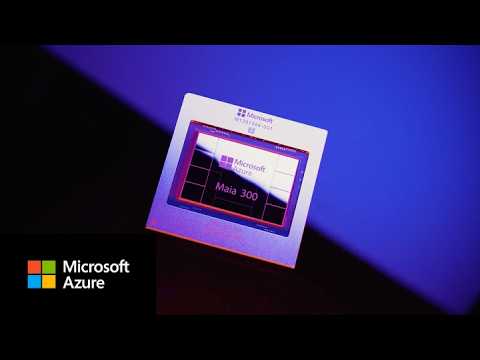
Azure Maia 300 shows Microsoft’s AI system approach
Microsoft Azure’s short highlights Maia 300, a full AI inference system built for large-scale reasoning, chat, and agents.
Key insights
- Microsoft Azure’s short introduces Azure Maia 300 as next-generation AI inference infrastructure.
- Maia 300 is described as a complete system, not just a chip.
- Microsoft says it targets long-context reasoning, conversations, and multi-step agents.
- A full rack is designed to hold 96 AI accelerators.
- Microsoft reports up to 40% more tokens per watt than leading GPU-based systems.
Microsoft Azure recently published a YouTube Short about Azure Maia 300, its next-generation custom AI accelerator system. The takeaway is simple: Microsoft is positioning Maia 300 as a full platform for AI inference, not just a standalone processor.
The short itself is very brief, and the published description contains little detail. The supporting research notes say Maia 300 is intended for large-scale inference workloads such as long-context reasoning, conversational applications, and multi-step AI agents. That makes it relevant for readers tracking how Microsoft plans to run its own AI services and infrastructure.
What's new
Microsoft describes Azure Maia 300 as a complete intelligent system made up of custom AI accelerator silicon, high-bandwidth memory, rack infrastructure, networking, software, and datacenter design and operations. The parts are co-designed to work together as one platform for cloud-scale AI inference.
The system is presented as the successor to Maia 200. Microsoft also says it plans to begin expanding Maia deployments to multi-gigawatt scale in 2027, with Maia 300 becoming the primary inference system for Microsoft products and services.
Why it matters
This matters most for teams following Azure infrastructure, AI services, and the compute layer behind Copilot-style experiences. Inference is the stage where a trained model generates answers, predictions, code, images, or actions, so improvements here can affect how much AI Microsoft can serve and how efficiently it can do it.
Microsoft’s focus on token throughput and efficiency suggests it is optimizing for production AI workloads rather than training. That is useful context for admins, architects, and developers who want to understand where Azure’s AI capacity strategy is heading.
How it works
According to the research notes, the Maia 300 design centers on rack-scale coordination. A full rack is designed to contain 96 AI accelerators, and the larger system can scale up to 12,288 accelerators in a superpod configuration.
- Each accelerator includes eight HBM4 memory stacks.
- Peak memory bandwidth is reported at up to 18 TB/s.
- The system is tuned for long-context, latency-sensitive, and multi-step agent workloads.
Microsoft also reports performance and efficiency figures at the system level rather than only at chip level. Those figures include up to 40% more tokens per watt than leading GPU-based systems, up to seven times the rack-scale token throughput of Maia 200 in a full 96-accelerator configuration, and more than 2.5 times the performance per watt compared with Maia 200.
Limitations and open questions
The published Short does not provide technical walkthroughs, deployment details, or customer guidance. The research notes provide Microsoft’s reported figures, but they do not show independent validation or workload-specific results.
We also could not verify general availability, regional rollout, or licensing details from the source material. The information here is best read as Microsoft’s own description of where Maia 300 fits in its AI infrastructure plans.
Sources
Frequently asked questions
What is Azure Maia 300?
Microsoft describes it as a next-generation custom AI accelerator system and a complete intelligent platform for AI inference.
What workloads is Maia 300 meant for?
The research notes say it is aimed at long-context reasoning, latency-sensitive conversations, and sustained multi-step agent tasks.
Did Microsoft publish rollout or availability details?
No. The source material does not confirm general availability, regions, or licensing.