- All of Microsoft
Entra ID: Gov, ECMA & Provisioning
Product Manager @ Microsoft 👉 Sign up to Entra.News my weekly newsletter on all things Microsoft Entra | Creator of cmd.ms & idPowerToys.com
Microsoft expert on Entra ID, identity governance, Entra provisioning, ECMA connectors and PowerShell for Zero Trust
Key insights
- Identity Governance & ECMA connectors: This episode summarizes how modern identity teams use governance tools and ECMA-style connectors to manage accounts and access.
Darren Robinson shares practical lessons from decades of projects to help architects plan reliable identity systems. - FIM/MIM to Entra ID: Identity platforms moved from legacy FIM/MIM architectures to cloud-first Entra ID, changing sync models and lifecycle patterns.
Understanding sync engines and the metaverse concept helps teams map on-prem accounts to cloud identities with fewer errors. - Entra provisioning & PowerShell ECMA connectors: Entra provisioning automates account creation and updates across apps, and teams can build custom PowerShell ECMA connectors for unsupported systems.
New PowerShell modules further simplify automation and reduce manual provisioning tasks. - Guest governance & Source of Authority conversion: Guest governance now ties to an Azure subscription requirement for full feature use, and Source of Authority conversion is GA to move users from on-prem to cloud without disruptive migrations.
These changes enable cleaner lifecycle management, especially during mergers or cloud-first moves. - Continuous Access Evaluation (CAE) & Authentication Strength Policies: CAE is becoming standard to enforce access in real time, and Authentication Strength Policies let organizations require specific MFA types per app or scenario.
Additional protections include QR code sign-in for frontline workers, real-time password spray detection, and jailbreak detection in mobile authenticators. - Model Context Protocol (MCP) & Local AI for identity: The conversation highlights architectural patterns to solve disconnected apps and introduces MCP as a way to standardize models across systems.
Teams also explore local AI and LLMs to automate identity tasks while keeping data control and reducing latency.
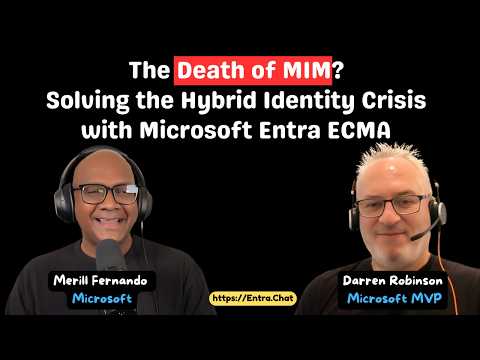
In a recent YouTube episode presented by Merill Fernando, identity expert Darren Robinson walks viewers through a detailed tour of modern identity management. The conversation focuses on practical architecture, provisioning, and governance for Microsoft Entra ID, while drawing on Darren’s three decades of hands-on experience. As a result, the video balances technical depth with operational lessons that architects can apply immediately to real environments.
Episode Summary and Key Themes
The episode opens by tracing the evolution from legacy directory systems to today’s cloud-first identity models, and then highlights core themes such as provisioning, connectors, and governance. Darren explains how older platforms shaped current thinking, while Merill frames questions from the perspective of practitioners facing hybrid landscapes. Consequently, the discussion sets the stage for practical demonstrations and conceptual tradeoffs that follow.
Moreover, the video organizes content into clear chapters that help viewers jump to topics like sync engines, custom connectors, and automation. This structure improves learning because listeners can revisit segments focused on specific problems, such as disconnected apps or model-driven APIs. Therefore, the episode serves both newcomers and seasoned administrators looking to refine their strategy.
ECMA Connectors and Modern Provisioning
Darren gives notable attention to ECMA connectors and explains why they remain relevant for integrating nonstandard systems into modern workflows. He demonstrates how custom PowerShell-based connectors can bridge gaps where built-in connectors fall short, while also noting the maintenance burden that custom code introduces. Thus, organizations face a tradeoff between flexibility and long-term operational cost when choosing custom connectors.
In addition, the episode explores how Entra provisioning works behind the scenes, including sync engines and the concept of a metaverse for identity data. Darren emphasizes automation using new PowerShell modules to reduce manual errors and speed provisioning cycles, yet he cautions that automation requires governance controls to avoid cascading mistakes. Ultimately, teams must balance speed with controls to avoid creating identity chaos.
Identity Governance and Hybrid Challenges
The discussion then moves to identity governance, where Darren highlights the persistent challenge of managing identities that span on-premises systems and cloud directories. He contrasts approaches like full cloud conversion against maintaining on-prem authority for certain users, and he explains how selective conversion can reduce disruption during mergers or restructures. Consequently, architects must weigh migration risk against the benefit of centralized governance.
Furthermore, Darren outlines how governance features can be constrained by licensing or platform dependencies, which complicates guest user management and lifecycle controls. He stresses the importance of clear source-of-truth decisions and automated lifecycle actions to prevent stale access. Therefore, implementing governance means choosing where authority lives and designing processes that keep that choice consistent.
Real-World Architecture Patterns and Tradeoffs
Throughout the video, real-world architecture patterns emerge, especially for environments with many disconnected applications. Darren walks through patterns for handling legacy apps, synchronizing attributes, and reconciling identities across systems. These patterns illustrate tradeoffs such as adding synchronization layers versus moving applications to support modern protocols.
Additionally, Darren points out operational tradeoffs like using out-of-the-box connectors to reduce maintenance or building custom integrations to preserve business logic. He also discusses how monitoring and alerting can catch provisioning errors early, although those systems add their own cost and complexity. Thus, teams must weigh immediate needs against long-term maintainability when selecting patterns.
MCP, AI, and the Future of Identity
The video closes by examining emerging ideas such as the MCP (Model Context Protocol) and local AI or LLMs to support identity tasks, including access reviews and anomaly detection. Darren explains that AI can speed decision-making and surface risky entitlements, but he also warns about explainability and data privacy risks when models operate on identity data. Consequently, teams should pilot AI with clear guardrails before broad deployment.
Finally, Merill and Darren touch on practical next steps, including developing modular automation, documenting connector logic, and investing in governance workflows that scale. They recommend small, iterative projects to validate approaches and reduce blast radius, while keeping stakeholders aligned on sources of truth. In short, the episode provides a pragmatic roadmap that balances innovation with the operational realities of identity management.
Related resources

Keywords
Entra ID identity governance, Microsoft Entra ID, Entra ID ECMA connectors, ECMA connector provisioning, modern provisioning Entra ID, Azure identity provisioning, identity governance best practices, Entra ID deep dive