- All of Microsoft
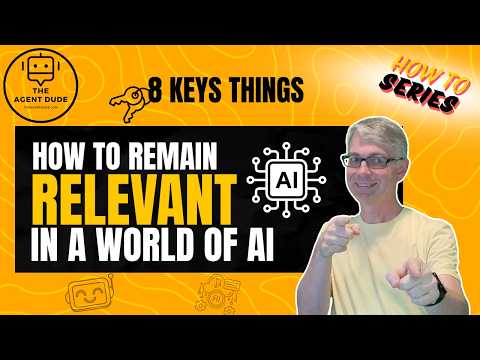
How to Remain Relevant in a world of AI
Harness AI with Microsoft Copilot, Azure AI and Power Platform to accelerate value, boost skills and stay relevant
Key insights
-
This YouTube video outlines eight clear actions to stay relevant in an AI-driven world.
Focus: learn to work with AI instead of competing with it, and use AI to amplify your strengths.
AI mindset -
Practice by building real mini-projects and experiments to turn theory into results.
Try short prototypes, reuse templates, and show outcomes to stakeholders.
hands-on practice -
Embed continuous improvement using AI agents and automation to speed workflows.
Shift from one-off tools to repeatable, monitored processes that improve over time.
agentic workflows -
Make trust and safeguards central: fairness, safety, privacy, transparency, and accountability.
Use governance and review steps so AI augments decisions without creating new risks.
responsible AI -
Build a compact, adaptable skill stack that pairs technical basics with creativity, communication, and problem framing.
Prioritize learning plans, short courses, and regular practice to stay current and visible. -
Accelerate your value by delivering small wins fast and documenting impact.
Publish prototypes, measure benefits, and iterate to prove AI-led improvements to your team.
value acceleration
Dewain Robinson's recent YouTube video lays out a clear playbook for professionals who want to remain relevant as artificial intelligence reshapes work. In the video, he summarizes eight practical actions and emphasizes that success depends less on competing with machines and more on learning to harness them as partners. Drawing on themes echoed by technology leaders, the presentation mixes mindset, hands-on practice, and governance to help individuals and teams adapt. Consequently, this article summarizes the main points, considers tradeoffs, and highlights the challenges of putting those ideas into practice.
Key Themes from the Video
First, Robinson stresses an enduring focus on an AI mindset rather than only technical credentials, and he recommends continuous curiosity as the foundation for staying useful. He also highlights the need for hands-on projects and regular experimentation to translate theory into value, urging viewers to build small solutions rather than chase certifications alone. Moreover, responsible use and governance appear as central themes, with the speaker noting that trust and safety must be part of everyday workflows. Together, these themes form a people-first approach that balances speed with caution.
Practical Steps and Skills
Robinson offers concrete steps such as weekly technology scouting, structured learning paths, and short, focused projects to build fluency quickly. For example, he suggests using free cloud resources to prototype assistants, document pipelines, or security queries so that learning becomes productive, not just theoretical. He also encourages deliberate practice in communication and decision-making skills, which remain difficult to automate and therefore crucial for long-term career resilience. As a result, learners can combine technical confidence with the human strengths that amplify AI.
Tools and Governance Considerations
The video references common enterprise tools and governance practices as part of a broader implementation story, stressing that tools alone do not solve governance challenges. Robinson points to observability, access controls, and policy guardrails as necessary complements to automation, and he suggests that teams adopt clear accountability models to reduce the risk of unintended outcomes. In addition, he notes that responsible AI principles—like fairness, privacy, and transparency—require both technical controls and operational change. Therefore, balancing innovation with robust governance becomes a continuous operational concern. Common enterprise tools referenced include Teams, Power Automate, Power BI, Azure DataCenter, and Microsoft Purview.
Benefits and Tradeoffs
Robinson describes clear benefits: higher productivity, faster decision cycles, and new opportunities to deliver value by combining human judgment with machine speed. However, he also acknowledges tradeoffs, such as the cost of upskilling, the potential for over-reliance on automation, and the need to manage ethical risk, which can slow deployment. Consequently, organizations must weigh short-term efficiency gains against long-term trust and sustainability, since rushing can create technical debt and governance gaps. Ultimately, he recommends phased adoption where teams measure impact and adjust policies iteratively.
Challenges to Adoption
Despite optimism, the video does not downplay significant challenges, including skills gaps, change resistance, and the risk of shadow deployments that bypass IT oversight. Robinson warns that many well-intentioned teams unintentionally create security and compliance risks if they lack clear guidance and monitoring. Furthermore, aligning incentives across departments remains difficult because productivity gains often appear in different parts of an organization than where costs for transformation occur. As a result, leaders must coordinate budgeting, training, and metrics to ensure adoption delivers sustainable value.
Implications for Professionals
For individual professionals, the advice is to invest in adaptable human skills—such as creativity, communication, and domain expertise—while also gaining practical experience with AI tools. Robinson emphasizes short, focused learning cycles that produce tangible outcomes, arguing that building a portfolio of small projects demonstrates impact more clearly than certificates alone. He also encourages a mindset shift: view AI as a collaborator that amplifies work rather than a competitor that replaces it. Therefore, people who combine technical curiosity with strong interpersonal skills are best positioned for the transition.
In conclusion, Dewain Robinson's video offers a pragmatic roadmap for staying relevant in an AI-driven world by combining an experimental mindset, hands-on practice, and responsible governance. While the benefits are compelling, successful adoption requires balancing speed with oversight, investing in skills, and aligning organizational incentives to avoid common pitfalls. Consequently, individuals and leaders who take a measured, people-centered approach can harness AI to extend their value rather than be displaced by it. Moving forward, the practical tradeoffs and implementation hurdles Robinson highlights will shape who thrives in the evolving workplace.

Keywords
stay relevant in AI era, future-proof your career from AI, upskilling for AI jobs, skills to compete with AI, adapt to AI workplace, human skills vs AI, AI career strategies, remain relevant in age of AI