- All of Microsoft
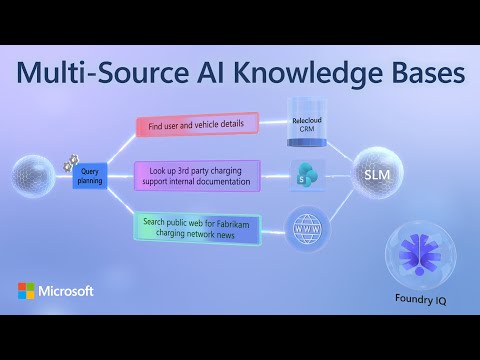
Foundry IQ: Multi-Source AI Knowledge
Software Development Redmond, Washington
Foundry IQ powers grounded AI agents with Azure AI Search, SharePoint and OneLake for multi source KBs and query planning
Key insights
- Foundry IQ: The YouTube video explains that Foundry IQ is a unified grounding API in Microsoft Foundry that centralizes retrieval-augmented generation (RAG) workflows so agents get grounded answers from one place.
It lets teams reuse existing Azure AI Search assets and reduces engineering work to connect agents to enterprise knowledge. - Knowledge base design: The system uses reusable, topic-focused knowledge bases that multiple agents can share.
Agents call the knowledge base instead of querying each data store, simplifying integrations and governance. - Model Context Protocol (MCP) and orchestration: The video shows MCP as the tool that orchestrates retrieval across sources on behalf of agents.
MCP handles query routing so developers don’t embed retrieval logic into each agent. - Multi-source integration: Foundry IQ connects indexed and remote sources such as cloud storage, OneLake, SharePoint, Azure AI Search indexes, MCP servers, and the web, with support for up to ten sources per knowledge base.
This lets agents pull context from the full enterprise data landscape at once. - Azure Content Understanding and data prep: For indexed content, Foundry IQ auto-ingests, chunks, vectorizes, and performs layout-aware enrichment (tables, headers, figures) to improve retrieval quality.
Automatic pipelines reduce manual engineering for search-ready data. - Query planning and iterative retrieval: The engine decomposes queries into subqueries, runs keyword/vector/hybrid searches, applies semantic reranking, and synthesizes unified answers with source citations.
The video highlights that using iterative retrieval only when it helps saves tokens and development time and shows measured quality gains (about a 20‑point / 36% average improvement, with larger gains on multi-source reasoning).
Video Snapshot: What Microsoft Presented
The YouTube video by Microsoft introduces Foundry IQ, a new knowledge-layer service in Microsoft Foundry designed to simplify how AI agents access enterprise data. The presentation explains that Foundry IQ centralizes retrieval-augmented generation workflows behind a single grounding API, so developers do not have to orchestrate complex data retrieval manually. Moreover, the video highlights how this approach aims to deliver more accurate, context-rich responses by letting a knowledge base plan and execute retrieval across multiple systems.
In addition, presenters emphasize the ability to reuse existing Azure AI Search assets and to create topic-centric knowledge bases with minimal setup. They demonstrate how Foundry IQ can connect to both indexed stores and remote sources at once, orchestrating search, reranking, and synthesis. Consequently, organizations can share knowledge bases across agents and reduce duplicated engineering work.
How Foundry IQ Works
Foundry IQ uses an agentic retrieval engine that first decomposes a query into subqueries and then chooses the best retrieval technique for each part, such as vector, keyword, or hybrid search. Then, it applies semantic reranking to surface the most relevant results and synthesizes a unified answer that includes source references where appropriate. This model-driven planning happens within the knowledge base so agents only call a single API endpoint rather than querying multiple data platforms directly.
Furthermore, the system supports iterative retrieval, which it can apply selectively when additional passes improve results. As a result, developers can balance answer quality with token costs and latency, since iterative steps consume additional compute and API calls. Therefore, Foundry IQ gives teams control over reasoning effort while automating the orchestration that normally adds development complexity.
Integration Across Multiple Data Sources
The demo stresses multi-source connectivity, covering indexed content as well as remote repositories like Azure Blob Storage, Microsoft OneLake, SharePoint, and other MCP servers. Additionally, the video notes that up to ten different sources can be combined within a single knowledge base, enabling richer, cross-cutting answers that draw from distributed datasets. Consequently, organizations with fragmented data landscapes may find it easier to present coherent, grounded responses to users.
At the same time, Foundry IQ automates key parts of the indexing pipeline for supported sources: content ingestion, chunking, vectorization, and hybrid retrieval preparation. When enabled, layout-aware enrichment through Azure Content Understanding further improves retrieval by extracting tables, figures, and sections. However, automated indexing trades off custom tuning and control for speed, so teams may still need targeted fine-tuning for specialized content or strict governance requirements.
Benefits, Tradeoffs, and Performance
The video cites measurable gains: using Foundry IQ knowledge bases instead of brute-force searching across sources produced an average improvement of roughly 20 points, which the presenters equate to about a 36% boost in relevance scores. Moreover, the improvement grows significantly for queries that require synthesizing information from multiple sources, where medium-reasoning configurations showed much larger quality gains. Thus, the approach appears promising for complex enterprise queries that standard single-source RAG models struggle to handle.
Nevertheless, these benefits come with tradeoffs. Increasing reasoning effort tends to raise token consumption and latency, and iterative retrieval rounds can compound costs. On the other hand, limiting reasoning to only when it demonstrably helps can save resources but risks missing subtle cross-source relationships. Therefore, organizations must balance accuracy, cost, and responsiveness when selecting configuration defaults for production workloads.
Challenges and Practical Considerations
Operationally, integrating many data sources raises challenges around access control, data freshness, and compliance because each connected repository may have different governance rules. Moreover, while automatic pipelines reduce engineering overhead, they may obscure preprocessing decisions or require additional validation to ensure sensitive information is handled correctly. Accordingly, security teams should vet indexing policies and metadata handling before deploying knowledge bases broadly.
Finally, evaluating multi-source retrieval remains an ongoing concern: teams need robust metrics and regular testing to confirm that synthesized answers remain reliable as data evolves. Although the video mentions evaluation methods and improved metrics, real-world deployments will still face edge cases where manual oversight proves necessary. In short, Foundry IQ offers a compelling path to unify enterprise knowledge retrieval, but it requires careful configuration, governance, and measurement to deliver consistent, cost-effective results.
Related Links

Keywords
Foundry IQ, Multi-source AI knowledge base, AI knowledge base integration, Knowledge graph federation, Enterprise knowledge management AI, Semantic search for knowledge bases, AI-driven knowledge consolidation, Secure multi-source knowledge base