- All of Microsoft
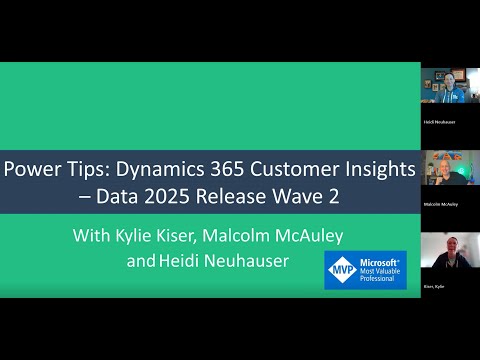
Customer Insights: 2025 Wave 2 Highlights
Microsoft MVP | User Adoption, Dynamics 365 + Power Platform Expert at Reenhanced
Microsoft tips on Customer Insights ground agent and Power Platform to target audiences with journey signals
Key insights
- AI & Copilot: The release adds AI-driven tools and Copilot capabilities that automate data exploration and surface intelligent insights.
These features reduce manual work and speed up decision making during the Oct 2025–Mar 2026 rollout. - Data governance: Microsoft strengthens enterprise-grade controls so organizations keep clear control over customer data and compliance.
Governance aligns with Azure standards to support security and regulatory needs. - Data unification: Improved unification merges data from many systems into a single, rich customer profile for better segmentation.
Real-time orchestration lets teams act on unified profiles immediately. - Low-code tools: A simplified user experience and low-code building blocks let citizen developers create data-connected apps and engagement portals faster.
These tools reduce development time and broaden who can build customer solutions. - Customer journey orchestration: Enhanced journey features include real-time pausing/resuming, improved lead management, and new communication channels for timely personalization.
Teams can deliver more relevant experiences across marketing, sales, and service. - Ground agent & journey signals: New ground agent capabilities and journey signals help identify and target the right audience using behavioral signals.
Video highlights show the ground agent at 0:30 and audience targeting from signals at 2:30.
Video overview
The YouTube video by Heidi Neuhauser [MVP] titled Power Tips: Customer Insights: Data 2025 Release Wave 2 summarizes upcoming features for Microsoft Dynamics between October 2025 and March 2026. In addition, the short runtime highlights practical points such as a ground agent in insights and how to target audiences from journey signals. Consequently, the clip aims to give practitioners a quick sense of what changes to expect and how those changes map to real-world customer data workflows.
- 0:00 Intro
- 0:30 Ground agent in insights
- 2:30 Target right audience from signals in journeys
Key innovations in the release
The release emphasizes several broad goals: unify customer data, add AI-driven insight tools, and make orchestration more real time. Moreover, Microsoft positions this update to strengthen the platform as a full-featured customer data platform, commonly referred to as a CDP, to drive marketing, sales, and service outcomes. As a result, organizations should expect features that reduce manual data work and help turn profiles into action faster.
Notably, the update bundles improvements across governance, user experience, and engagement channels so that teams can work with consistent, trusted data. In addition, the wave brings specific capabilities to pause and resume journeys and to better manage lead flows. Therefore, businesses that rely on timely interactions can hope for fewer gaps between insight and action.
AI and Copilot enhancements
A major theme in the video is the expansion of AI and Copilot capabilities to automate exploration and surface recommendations. Consequently, the platform intends to help users generate insights without deep technical effort, which can speed decision cycles and reduce reliance on data teams. Moreover, automation aims to free staff from repetitive tasks so they can focus on strategy and creative work.
However, these benefits carry tradeoffs. For instance, while AI can accelerate analysis, organizations may need stronger review processes to validate automated suggestions and avoid biased or inappropriate outcomes. In practice, teams must balance speed with governance and set up guardrails to review Copilot outputs before applying them to sensitive customer interactions.
Data unification and governance
The update also focuses on improving how data is unified from different systems to build richer customer profiles. In particular, enhanced matching and orchestration make it easier to merge records and maintain a single customer view across touchpoints. As a result, marketers and service agents can act on more complete and timely information, reducing errors that arise from fragmented data.
Still, better unification requires careful planning around privacy and compliance, especially for large enterprises. Therefore, Microsoft reinforces governance controls aligned with Azure DataCenter standards so organizations can limit access, manage consent, and track lineage. Consequently, teams must weigh the benefit of unified insights against the operational effort needed to enforce policies and keep data secure.
Experience, low-code tools, and developer tradeoffs
The wave adds simplified interfaces and Developer Tools to empower business users and Citizen Developers to build experiences without heavy coding. Moreover, these tools aim to shorten development cycles for data-connected apps and engagement portals, enabling teams to test ideas rapidly. Hence, organizations gain agility, particularly where small teams need to stand up campaigns or dashboards quickly.
On the other hand, relying heavily on low-code solutions can create governance and maintainability challenges over time. For example, citizen-built components may diverge in standards or lack documentation, which places future burden on IT. Therefore, teams should pair low-code freedom with clear policies, version control, and oversight to ensure long-term stability and reuse.
Customer journeys, engagement, and practical challenges
The video highlights more robust journey orchestration, including real-time signals to pause, resume, and retarget interactions based on customer behavior. Consequently, organizations can react faster to context, improving personalization and relevance in outreach. In addition, expanded channel support and lead management tools help keep cross-team workflows aligned.
Still, implementing real-time journeys introduces complexity in data latency and system integration. Therefore, firms need to assess whether their event streams and backend systems can support immediate decisioning without overloading infrastructure. Ultimately, teams must balance the desire for instant personalization with the cost and operational work required to maintain high-volume, low-latency pipelines.
Final perspective
Overall, Heidi Neuhauser’s video presents the 2025 Release Wave 2 for Dynamics CRM as a practical step toward a unified, AI-driven customer platform. Furthermore, the update promises faster insights, stronger governance, and more accessible development tools, which together can help teams move from data to action more quickly. Yet, organizations should plan for the tradeoffs in automation, governance, and integration to fully realize the benefits.
In short, the release offers meaningful capabilities for businesses ready to invest in governance and modern data pipelines, while reminding practitioners that speed and simplicity must be balanced with oversight and technical readiness. Consequently, teams that combine the new features with clear policies and integration checks will likely extract the most reliable value from the wave.
.jpeg?w=700&output=webp)
Keywords
Customer Insights 2025, Dynamics 365 Customer Insights, Data 2025 Release Wave 2, Customer data platform updates, Power Tips Customer Insights, CDP 2025 features, Wave 2 release notes, Customer insights best practices