Zero Trust AI Agents: Security Playbook
Software Development Redmond, Washington
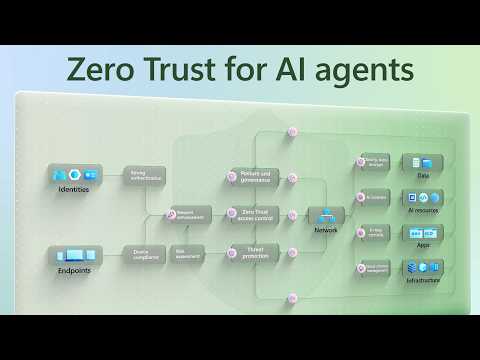
Zero Trust for AI agents using Entra Agent ID, Conditional Access, Sentinel and Purview to govern identities and data
Key insights
- Zero Trust for AI: This YouTube video explains Microsoft’s framework that treats every AI agent as untrusted by default and verifies each request before it reaches sensitive systems.
It applies proven Zero Trust ideas across identity, tools, and data to reduce risk from autonomous agents. - Entra Agent ID and Conditional Access: Assign each agent a managed identity and evaluate every authorization in real time.
Use scoped Access Packages so agents get only the permissions needed for each task and for the shortest time. - Least-privilege and tool control: Govern your tool catalog like a software supply chain so unapproved tools can’t run.
Approved servers and APIs sit behind management gates to limit lateral movement and reduce blast radius. - Data governance and protection: Apply DLP and sensitivity labels to restrict what agents can access and ensure labels inherit to generated content.
Data Access Governance maps who or what can reach data before a prompt runs, preventing leaks and misuse. - Runtime observability and logging: Log agent plans, tool calls, API access, and data lookups into Microsoft Sentinel for continuous anomaly detection and audit trails.
These records support faster incident response and clearer accountability for agent actions. - Threats and practical steps: The approach defends against issues like prompt injection, data poisoning, and agent hijacking by combining identity, access checks, and runtime controls.
Operational steps: treat agents as managed entities, log activity, enforce conditional access, and apply data labels and risk monitoring.
Overview of the Video and Its Purpose
The YouTube video, published by Microsoft and presented by Jeremy Chapman, explains how to apply Zero Trust principles to AI agents across identity, tools, and data. It walks through concepts such as managed agent identities, runtime observability, and data governance, while demonstrating concrete platform controls. Moreover, the video frames these controls as an extension of existing enterprise security practices rather than a separate product, which helps viewers see practical alignment with current investments.
Core Components Highlighted
First, the presenter emphasizes assigning each AI agent a unique identity using Entra Agent ID and scoping access with Access Packages, so that agents receive only the permissions they need for specific tasks. Then, he shows how to enforce real-time evaluation of authorization using Conditional Access, which applies the same risk signals used for human users to non-human actors. Finally, the video underscores logging and monitoring through Microsoft Sentinel and governance through Purview to ensure visibility and auditability across agent interactions.
How Controls Fit Together
According to the video, organizations should treat agent tools and catalogs like a software supply chain, thereby preventing unapproved tools from running and locking approved servers behind API management. In addition, runtime safeguards such as the AI Gateway Prompt Shield protect language models and agents from prompt injection and similar attacks without requiring code changes. Consequently, these layered controls aim to reduce the risk of data exfiltration and agent hijacking while preserving operational continuity.
Practical Implementation Steps
The presenter outlines concrete steps including agent identity provisioning, scoping of permissions, and continuous logging of tool calls, API access, and data lookups for anomaly detection. He also demonstrates how Purview sensitivity labels and data loss prevention rules can auto-inherit to agent outputs, ensuring that derived content remains protected. Moreover, the video stresses integrating these measures across managed, self-hosted, and shadow agents to avoid gaps that attackers might exploit.
Tradeoffs: Security, Usability, and Cost
Balancing stricter controls with developer agility and user experience presents clear tradeoffs, as tighter enforcement can slow workflows and require more frequent access approvals. However, the video argues that scoping agents to “just enough access” reduces blast radius and long-term remediation costs, even though it may increase initial operational overhead. Therefore, teams must weigh the upfront investment in identity management and observability against the potential cost of breaches and data loss.
Challenges and Operational Considerations
Several challenges emerge when applying Zero Trust to AI agents, including discovery of shadow agents, policy complexity, and the risk of false positives in anomaly detection that can disrupt services. Furthermore, mapping data access precisely before prompts execute requires disciplined governance and accurate data classification, which can be labor-intensive. In addition, organizations must guard against supply chain risks by governing catalogs and servers, yet doing so may limit experimentation unless a clear approval path exists.
Monitoring, Response, and Continuous Improvement
Visibility remains central, so the video recommends logging every agent action into centralized analytics to enable continuous anomaly detection and incident response. At the same time, excessive telemetry can overwhelm teams, so the guidance suggests prioritizing high-value signals and automating risk scoring where possible with Purview Insider Risk Management. Consequently, this approach supports faster investigations and the ability to revoke access when warranted without manual bottlenecks.
Governance and Supply Chain Controls
The presenter positions the managed catalog of agent tools as a software supply chain that requires approval gates and API management protections to prevent unauthorized execution. Likewise, sensitivity labels and data access governance must map what each agent can access ahead of runtime to reduce surprise exposures. As a result, governance becomes a proactive process that complements reactive monitoring to keep agent behavior within policy boundaries.
Final Assessment and Next Steps
Overall, the video by Microsoft provides a pragmatic blueprint for extending Zero Trust to AI agents, blending identity, conditional access, observability, and data governance into a cohesive strategy. While implementation demands effort, particularly around identity lifecycle and policy tuning, the payoff is reduced risk and clearer audit trails for automated decision makers. Therefore, organizations should treat this work as part of their broader security modernization rather than an optional add-on.
Conclusion
In conclusion, the video presents a clear, actionable path to apply Zero Trust to autonomous AI agents, emphasizing that agents require the same scrutiny and controls as human users. Furthermore, it highlights that success depends on balancing strict controls with operational needs, investing in observability, and governing the agent ecosystem proactively. Consequently, organizations that adopt these practices can better manage AI risks while enabling safe, scaled automation.

Keywords
Zero Trust AI security, Zero Trust for AI agents, AI agent security best practices, Zero Trust architecture for AI, secure AI agents, Zero Trust model for autonomous agents, AI agent access control, Zero Trust cybersecurity for AI