Work IQ: Personalize Your Copilot AI
Work IQ personalizes Microsoft Copilot for SharePoint and Purview governance, modernizing the Microsoft digital workplace
Key insights
- Work IQ
Microsoft’s intelligence layer that personalizes Microsoft 365 Copilot and AI agents by using work signals to make answers context-aware and relevant to your job. - Three layers
Work IQ uses Data, Memory, and Inference: it unifies files and communications, keeps persistent memory of people and teams, and combines models and tools to reason and act. - Organizational understanding
Instead of only retrieving documents, Work IQ builds a real-time model of roles, relationships, priorities, and collaboration patterns to ground responses in how work truly happens. - Benefits
Users get more personalized responses, stronger grounding in real work data, deeper business context, and more useful custom agents that act on company information. - Work IQ APIs
Microsoft opened the APIs to developers and IT teams to build enterprise agents; the service becomes generally available on June 16, 2026, with billing via Copilot Credits and flexible plans. - Enterprise governance
Work IQ is built for scale and security, letting organizations apply controls and policies so agents operate within enterprise rules and compliance requirements.
Video Overview: Introducing a new intelligence layer
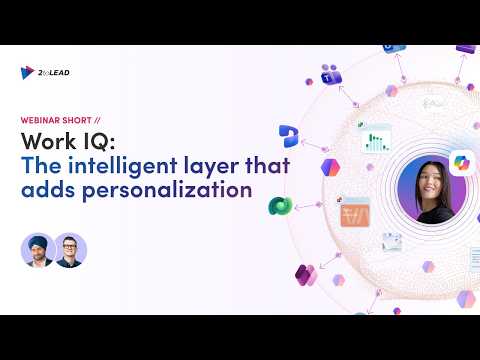
The YouTube clip from 2toLead highlights Microsoft’s new intelligence layer called Work IQ and explains how it upgrades Microsoft 365 Copilot and AI agents to be more personalized and context-aware. The short webinar excerpt comes from a session titled "M365Conf 2026 Recap: What SharePoint, Copilot, and AI Agents Means to Your Digital Workplace," and it focuses on how the layer grounds AI responses in real organizational data. Importantly, the clip frames Work IQ as a shift from simple document retrieval toward a deeper model of how work flows across people, files, meetings, and systems. As a result, viewers can see how Microsoft aims to make AI answers more relevant to everyday tasks.
How Work IQ works in practical terms
According to the presentation, Work IQ builds a semantic map by linking signals from email, calendar events, chats, files, and business systems into three integrated layers: Data, Memory, and Inference. Data unifies sources across Microsoft 365 so agents can find the information they need, while Memory maintains a persistent, evolving understanding of people, teams, and preferences. Then, Inference combines models, skills, and tools to reason and act on that context, which helps Copilot generate grounded outputs without long manual prompts. Consequently, the video argues that agents become faster and more practical for real work because they can use these built-in context signals rather than relying only on user-supplied references.
Benefits and practical tradeoffs
The clip highlights several clear benefits, including more personalized responses, deeper business context, and better grounding in an organization’s own data, which make AI outputs more actionable. However, the presenters also imply tradeoffs: for instance, tighter personalization often increases demands on governance and privacy controls, while richer context can raise integration complexity across systems. Moreover, while real-time organizational understanding can improve speed and relevance, it may also introduce new failure modes if data is inconsistent or incomplete. Therefore, organizations must balance the gains in productivity against the additional investment needed in data hygiene and policy design.
Developer and IT implications
The video draws attention to the new Work IQ APIs that Microsoft says will be generally available on June 16, 2026, enabling developers and administrators to build enterprise agents that tap the same intelligence layer powering Copilot. In turn, this opens opportunities for custom agents that understand company roles, projects, and collaboration patterns, but it also brings operational choices about deployment, billing, and scale. For example, the clip mentions that Microsoft will bill some API usage through Copilot Credits, which shifts cost planning toward consumption models and requires finance and IT to coordinate. Consequently, teams will need to weigh the benefits of deeper integration against ongoing costs and the learning curve for secure, compliant implementations.
Challenges around governance and trust
The presenters make clear that governance, security, and compliance are central concerns when you let AI access sensitive workplace signals, and they stress the need for controls that keep organizational data safe while enabling useful personalization. Yet, balancing transparency and utility proves difficult: adding more context helps accuracy but also reveals more metadata about who did what, when, and how, which can concern both users and compliance teams. In addition, AI memory that preserves user preferences can improve productivity over time, but it demands careful lifecycle policies so memories remain current and auditable. Therefore, the video underscores that strong governance frameworks and clear policies must accompany technical deployment to sustain user trust.
Looking ahead: adoption and operational questions
Finally, the clip positions Work IQ as a foundational piece for Microsoft’s broader agent strategy, noting potential advantages in intelligence, speed, efficiency, scale, and security if organizations adopt the layer thoughtfully. Nevertheless, adopters face practical hurdles, including integrating across legacy systems, training users to trust the AI, and setting boundaries to avoid over-dependence on automated recommendations. Moreover, teams must monitor for bias, hallucination, or stale memory and create processes to correct errors when they appear. In short, while the video paints a compelling picture of smarter AI in the workplace, it also makes clear that success depends on deliberate governance, solid data practices, and cross-functional planning to manage tradeoffs effectively.

Keywords
Work IQ Copilot personalization, Copilot AI personalization, Personalized Copilot experience, Intelligent layers for Copilot, Work IQ features, Enterprise AI personalization, Microsoft Copilot customization, Copilot personalization tools