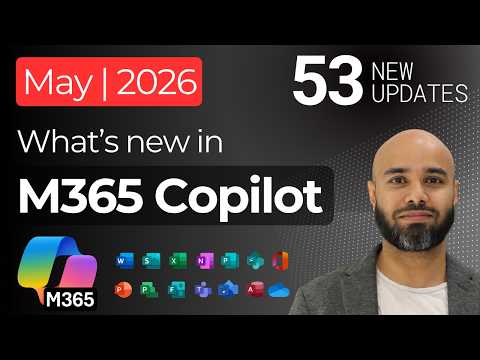
Microsoft 365 Copilot: 53 May Highlights
Modern Work Cloud Endpoint Technical Specialist
Microsoft Copilot adds federated connectors, GPT instant, Copilot Notebooks, Python in Excel and Teams delegation
Key insights
- Federated MCP Connectors
Copilot can now query partner systems live at prompt time using the Model Context Protocol (MCP), so answers reflect current source data instead of stale snapshots.
Supported partners include Canva, HubSpot, Linear, LSEG, Moody's and Notion, and access follows the user’s identity and permissions for better governance. - GPT-5.5 Instant and model choices
Copilot adds a faster conversational model, GPT-5.5 Instant, and gives tenants more model options (including third-party models) across Copilot surfaces to match speed, cost, or quality needs.
Admins control which models are available per app and tenant settings. - Copilot Notebooks enhancements
Notebooks now generate PowerPoint, Word and Excel content from notebook context, support mind maps and web links as references, and let you edit Copilot Pages conversationally for smoother drafting workflows.
These updates make notebook-driven content creation more direct and reusable across document types. - Plan mode and Python in Excel
Plan mode previews Copilot’s proposed spreadsheet edits before they run, so users can review and approve changes safely.
Python support in Copilot for Excel enables advanced data analysis and scripting directly inside the workbook. - Mobile app redesign and voice chat
The Copilot mobile app moves to a chat-first interface with visual updates and improved voice chat and voice notes for on-the-go interactions.
Design and usability changes aim to make Copilot feel faster and more natural on phones. - Copilot Studio, agents and governance
Studio expands agent features: submit agents to a store, schedule prompts, apply admin lifecycle rules, and share agents to Teams, plus support for remote MCP servers and SharePoint agents.
Microsoft also added enterprise controls—Purview DLP for prompts, watermarking of AI content, meeting-content deletion, and video recap/share controls—to help keep data and compliance under control.
Susanth Sutheesh’s recent YouTube video, titled "What's New in Microsoft 365 Copilot – May 2026," walks viewers through a sweeping set of updates. In total, the video covers 53 changes, with a clear focus on live integrations and richer authoring tools. The presentation emphasizes demonstration and walkthroughs, helping viewers see how features behave in real work scenarios. Consequently, the update reads as a major step in Microsoft’s effort to make Copilot a central, context-aware work layer.
What the update delivers
The most visible themes are live data access, expanded AI model options, and tighter application-level workflows. Specifically, the release spotlights Federated MCP Connectors, the arrival of GPT-5.5 Instant, expanded capabilities in Copilot Notebooks, and enhancements to Excel and the mobile experience. Moreover, the release bundles many smaller but practical improvements, such as call delegation in Teams and video recap features. Together, these items aim to speed work while keeping tools and content more connected.
Federated MCP Connectors: live access versus indexing
At the heart of the update is the move to federated MCP connectors that allow Copilot to query partner systems live at prompt time rather than rely solely on pre-indexed copies. Partners called out include Canva, HubSpot, Linear, LSEG, Moody’s, and Notion, which means answers can reflect the most recent data. However, this approach introduces tradeoffs: while freshness improves, live queries can add latency and make performance depend on the partner system’s availability.
Furthermore, the federated model raises governance and security questions that IT teams must address. On one hand, adhering to the user’s identity and permissions helps preserve access controls and reduces need for wide data replication. On the other hand, linking many external systems live increases the surface area for compliance review and operational monitoring. Therefore, organizations will need to balance the value of up-to-the-minute answers against the complexity of securing and monitoring live integrations.
Notebooks and model choices: speed, capability, and consistency
The May release expands Copilot Notebooks, enabling direct generation of PowerPoint, Word, and Excel artifacts from notebook content and offering new interaction modes like mind maps and web link references. Also, Microsoft surfaces additional model options in some places, including the new GPT-5.5 Instant and third-party choices such as Claude in selective contexts. These choices let teams pick the right balance between speed and depth of reasoning, yet they introduce a consistency challenge across an organization’s outputs.
In practice, different models may produce different tones, levels of hallucination risk, or response speeds, which means governance must include model selection standards. Moreover, content generated in notebooks that then flows into documents or slides heightens the need for review steps. For example, the notebook-driven workflows increase productivity, but teams should pair them with checks and not rely solely on raw outputs for critical decisions.
Excel, mobile and collaboration improvements
Excel receives notable AI-first updates with a new Plan mode that previews changes before applying them, and with Python in Excel integrated into Copilot workflows. These features make it easier to propose complex edits and automate analyses while giving users review control, which reduces the chance of unexpected spreadsheet changes. Meanwhile, the Copilot mobile experience shifts to a chat-first design and adds voice chat, improving on-the-go productivity and quick capture of ideas.
Collaboration also sees targeted upgrades, including Teams call delegation and video recap features that help hand off meetings and synthesize content. While delegation streamlines scheduling and roles, it also requires careful permission configuration to prevent unintended access. Similarly, mobile and voice capabilities increase convenience but call for enterprise policies on data capture and retention to remain compliant.
Governance, admin tools and risk tradeoffs
Microsoft’s May notes include new governance controls such as Purview DLP for Copilot prompts, watermarking for AI-generated content, and admin rules for agent lifecycle automation. These additions recognize that powerful AI features need matching governance, especially when Copilot can access live external data. That said, adding governance mechanisms can slow adoption if administrators and end users find controls cumbersome or unclear.
In addition, administrators must make decisions about capacity and cost models, such as the emphasis on prepaid capacity packs and tenant-level configurations for model access. Balancing cost, speed, and compliance becomes a core operational question; organizations will need to pilot responsibly and iterate policies to align flexibility with security and budget limits. Ultimately, the most successful deployments will combine technical controls with clear user training and monitoring.
Practical choices for organizations
For teams planning to adopt these updates, the sensible path is to start small and measure outcomes. First, pilot federated connectors for a limited set of partner systems and observe latency, reliability, and governance impacts while collecting user feedback. Then, evaluate model options in scenarios that matter most and set standards for which model to use in each context to preserve output consistency.
Finally, provide users with clear review workflows—especially for spreadsheet automation from Plan mode and notebook-generated documents—and align admin policies on data protection and capacity. In short, Microsoft’s May update delivers notable productivity potential, but realizing that potential requires careful tradeoffs between agility, security, and cost.
The video by Susanth Sutheesh offers a thorough walkthrough of all items, making it a useful starting point for technical teams and business leaders who want to evaluate the update in detail. Overall, the release marks a significant step toward a more connected and context-aware Copilot, even as it raises practical governance and performance questions that organizations must address.

Keywords
Microsoft 365 Copilot May 2026 updates, Copilot new features May 2026, Federated MCP connectors, Microsoft 365 Copilot 53 updates, Copilot security and governance 2026, Microsoft Copilot roadmap May 2026, Copilot integration with Microsoft 365 apps, Copilot licensing and admin controls