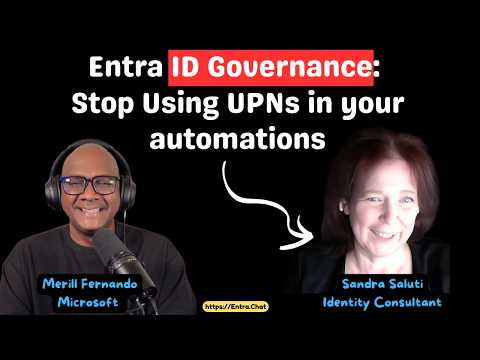
Entra: ID Governance Consultant Tips
Product Manager @ Microsoft 👉 Sign up to Entra.News my weekly newsletter on all things Microsoft Entra | Creator of cmd.ms & idPowerToys.com
Microsoft Entra ID governance guide use Object ID for automation avoid hybrid join name change wipes use Access Packages
Key insights
- Object ID: Use the immutable Azure AD Object ID for automation anchors, not mutable fields like UPN or email.
Relying on presentation data breaks workflows when names or addresses change, so map and store the Object ID in scripts and provisioning rules. - Marriage Bug: Simple name changes can break hybrid joins and trigger accidental device wipes or identity mismatches.
Prevent this by basing device and user links on immutable identifiers, validating AD sync rules, and testing rename scenarios before rollout. - HR interviews: The most valuable governance work happens before scripting—interview HR and stakeholders to document hire, change, and exit processes.
Create clear process flow diagrams first, then translate them into automated provisioning and access policies. - Lifecycle synchronization: Contractors and rehires often lose access for ~48 hours because source systems and Entra sync on different cadences.
Close the rehire gap by aligning sync timing, using reliable source attributes, and adding reconciliation checks for critical roles. - Directory Extensions: Store governance metadata in directory extensions rather than Exchange-specific attributes for greater consistency across applications.
Exchange attributes tie data to mail systems and can cause gaps; directory extensions persist and work better for cross-system access decisions. - Access Packages: Replace nested groups with access packages, run regular guest access reviews, and delegate approvals to resource owners.
Use access packages to onboard external users, automate expiry, and keep entitlement reviews focused and auditable.
Introduction: A Practical Take on Entra ID Governance
In a recent YouTube video produced by Merill Fernando, identity governance consultant Sandra Saluti makes a clear case that Microsoft Entra ID governance is more than a compliance checkbox; it is the foundation for secure and scalable identity management. The episode moves quickly from marketing language to the practical “gotchas” that break real-world deployments, and it offers concrete examples professionals can act on. Consequently, the video is useful for IT leaders, identity engineers, and compliance teams who must balance security, usability, and operational cost.
The Golden Rule of Automation
Saluti stresses one unavoidable rule: stop using presentation data like UPNs or email addresses as the anchor for automated processes because those values change. Instead, she recommends using the Object ID as the only immutable truth, since it remains constant across renames and mergers. This shift affects provisioning, deprovisioning, and access reviews, and it reduces accidental breaks when user-facing attributes are edited.
However, this approach introduces tradeoffs. For example, relying on Object ID means integrating identity sources more tightly, which can increase initial complexity and require mapping work or backfilling historical records. Yet, compared with the operational risk of laptops being incorrectly wiped or access being misapplied, Saluti argues the upfront investment produces lower long-term costs and fewer incidents.
The "Marriage Bug" and Hybrid Join Risks
One concrete story in the video, dubbed the “Marriage Bug,” illustrates how a simple name change can cascade into hybrid join failures and unintended device wipes. Saluti explains that when display names or UPNs are treated as identifiers, synchronization rules and device ownership logic can misfire during lifecycle events. As a result, organizations can experience sudden access loss or device encryption actions that disrupt users and support teams.
To reduce this risk, the video recommends tightening mapping rules, using immutable identifiers for device and user links, and testing lifecycle changes in isolated environments. Yet there is a balance to strike: stricter rules can delay legitimate changes and add administrative steps, so teams must weigh user impact against the severity of potential automation failures.
The Unsexy, High-Impact Work of Governance
Saluti emphasizes that identity governance is less about writing clever PowerShell and more about asking the right questions early, especially of HR and business stakeholders. She advises creating process flow diagrams before touching the portal so that automation aligns with real organizational practices and exception flows. In practice, this means identity teams should interview HR, legal, and managers to capture hire, rehire, and contractor scenarios.
That approach has tradeoffs: spending time on interviews delays technical progress, but it prevents repeated rework and risky ad-hoc fixes later. The episode argues that documentation and stakeholder alignment create systems that scale and make audits and reviews manageable, even if they slow the initial rollout.
Where to Store Identity Metadata: Directory Extensions vs Exchange Attributes
Another technical focus in the video is where to place identity metadata for reliable governance. Saluti compares Directory Extensions and Exchange Attributes, noting that each has pros and cons depending on the organization’s architecture and sync pattern. Directory Extensions often offer a centralized place for custom attributes, while Exchange attributes may be familiar to administrators but can suffer from caching or replication delays.
Choosing the right storage involves tradeoffs around performance, consistency, and operational overhead. For instance, Directory Extensions may require schema planning and careful sync configuration, whereas Exchange attributes can be quicker to adopt but less predictable across hybrid environments. The video recommends running small pilots and documenting attribute lifecycles to reduce surprises in production.
Closing the Rehire Gap and Managing External Access
Saluti also addresses the common “rehire gap” where contractors lose access for roughly 48 hours during renewal cycles because lifecycle synchronization lags. She suggests automating rehire paths and improving the cadence between HR systems and the identity store to tighten that window. In practice, that may mean making tradeoffs between immediate access restoration and stricter verification steps to prevent privilege creep.
Finally, the video covers external user management through Access Packages and timely Guest Access Reviews, recommending that organizations replace deeply nested groups with purpose-built packages when possible. Although packages add upfront planning and governance rules, they simplify lifecycle management and reduce long-tail access risk, which is a substantial benefit for organizations that collaborate with many external partners.
Conclusion: Practical Governance Wins Over Tool-Only Thinking
Overall, the YouTube episode by Merill Fernando and insights from Sandra Saluti push a pragmatic message: good identity governance depends on people, process, and the correct technical anchors. While technical choices like using Object ID and selecting metadata storage matter, the bigger gains come from mapping processes, aligning stakeholders, and testing against real scenarios. Therefore, teams should budget time and resources for governance work up front, because that investment pays off by reducing costly outages and security incidents.

Keywords
Entra identity governance best practices, Microsoft Entra governance tips, Entra access reviews guide, Entra entitlement management strategies, Identity governance consultant insights Entra, Entra roles and permissions management, Entra identity lifecycle management, Entra conditional access governance