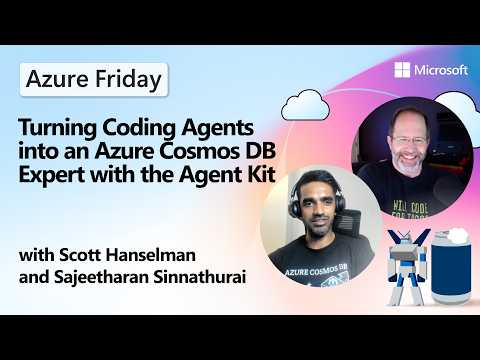
Agent Kit: Build Azure Cosmos DB Experts
Azure Cosmos DB Agent Kit enforces best practices, prevents partition key leaks, optimizes queries and SDK usage
Key insights
- Azure Cosmos DB Agent Kit turns AI coding assistants into Cosmos DB experts with a one-command install.
It activates automatically when you work on Cosmos DB code so developers get guidance without leaving their editor. - The kit enforces a large, curated rule set: 120+ rules organized into 12 categories.
Rules cover data modeling, partitioning, indexing, query patterns, vector and full-text search, and developer tooling. - It prevents costly production mistakes by flagging issues like a missing partition key filter or unsafe queries.
Examples in the demo include fixing a fan-out query and stopping tenant data leakage in a multi-tenant app. - SDK best practices and query recommendations help reduce request unit (RU) costs and improve performance.
Advice includes correct client initialization, retry logic, indexing choices, and practical query optimization tips. - The kit works with common AI pair-programmers and requires Node.js with npm/npx to install (it runs via the skills format).
Installation is a single command and the skill integrates into editors and CLIs that support Agent Skills. - Microsoft validated the release before GA with extensive testing: General Availability (GA) follows > 200+ automated tests.
It also guides infrastructure as code and deployment patterns for Terraform, Bicep, and container setups.
Video overview
The YouTube video from the author Microsoft Azure Developers features Scott Hanselman alongside Sajee demonstrating the new Azure Cosmos DB Agent Kit. In the segment they run a live demo showing how the kit injects domain-specific guidance into coding agents to catch costly mistakes before code reaches production. As a result, viewers see practical examples where the kit detects issues like missing partition key filters, insecure queries, and inefficient query patterns. Consequently, the video frames the kit as a practical tool for improving reliability and reducing cloud costs.
During the demo, the presenters use a multi-agent fitness coaching application to simulate real-world mistakes and fixes. For example, the kit flags a missing partition key filter that allowed member data to leak across tenants, and it recommends hierarchical partitioning to scale a multi-tenant workload. In addition, the tool identifies a fan-out query pattern that would have driven up request units (RUs) and suggests an alternative approach. Thus, the demonstration focuses on early detection and pragmatic remediation.
How the Agent Kit works
The kit is delivered as a set of domain rules in the Agent Skills format so that AI coding assistants can apply Cosmos DB expertise automatically. Developers install the skill with a single command such as npx skills add AzureCosmosDB/cosmosdb-agent-kit and then rely on tools that support the format to activate the skill when they edit or review Cosmos DB code. Once active, the kit runs more than one hundred practical checks across areas like data modeling, partitioning, indexing, and SDK usage. As a result, suggestions appear where developers already work, avoiding time-consuming context switches to documentation.
Moreover, the kit covers more than just code snippets; it extends guidance to infrastructure artifacts such as Terraform and Bicep, helping teams align runtime configuration with data design. It also flags common anti-patterns, for example advising against creating a new CosmosClient per request and pointing out SQL injection risks in raw query construction. The automated findings are accompanied by concrete recommendations, so teams can quickly implement fixes and measure the impact. Therefore, the kit acts as both a preventive reviewer and a practical teacher.
Benefits and tradeoffs
One clear benefit of the approach is time saved: teams receive curated, production-ready advice without leaving their editor or workflow. This immediate guidance can prevent high-cost mistakes such as cross-partition scans or unbounded fan-out queries, which often manifest as large RU bills in production. However, reliance on automated rules introduces tradeoffs: the kit’s recommendations may be conservative and can require tuning to match unique application constraints. Consequently, teams must balance following recommendations with validating them against their specific workload goals.
In addition, the kit’s broad rule set improves coverage but can increase noise when rules produce false positives or redundant alerts. For example, hierarchical partitioning scales well for many multi-tenant scenarios but adds design complexity and operational overhead compared with simpler keys. Likewise, aggressive indexing suggestions can improve query latency while increasing storage and RU costs. Thus, the right balance depends on each project’s priorities for latency, scalability, and cost.
Challenges and practical considerations
Integrating agent-driven guidance into existing CI/CD pipelines and team processes presents both technical and cultural challenges. Technically, teams must ensure agents run where they will see the full code and infra context so that suggestions are accurate rather than fragmentary. Culturally, developers need to treat the kit as an advisor rather than an oracle, since automated checks cannot substitute for contextual decision-making about tradeoffs between cost, latency, and complexity. Therefore, governance and review policies remain essential.
Another challenge is maintaining rule relevance as Cosmos DB features and best practices evolve. The kit mitigates this by organizing rules in categories and validating behavior through automated test iterations, but teams should still plan for periodic reviews and customizations. Security is another concern: while the kit can flag SQL injection and misuse of client objects, developers must validate fixes and monitor telemetry after deployment. In short, the kit reduces risk but does not remove the need for testing and observability.
Takeaway for developers
Overall, the YouTube demonstration convincingly shows how the Azure Cosmos DB Agent Kit speeds up the detection of costly design and query mistakes, pushes best practices into the developer workflow, and reduces the gap between documentation and implementation. For teams building multi-tenant or high-scale applications, the kit can find subtle issues such as missing partition filters and fan-out queries before they cause data leaks or expensive RU consumption. But importantly, teams should adopt the kit with an eye toward balancing automated advice against their own performance, cost, and complexity requirements.
Finally, the video makes a clear case for using agent-driven skills as accelerators rather than replacements for developer expertise. In practice, teams that combine the kit’s automated rules with solid staging tests, telemetry, and manual review will get the most value. Consequently, watching the demo provides a practical starting point for teams that want to try the tool and evaluate its impact on their Cosmos DB workloads.
Keywords
azure cosmos db agent kit, coding agents for cosmos db, agent kit azure cosmos db expert, autonomous agents cosmos db, ai agent cosmos db integration, developer guide azure cosmos db agents, optimize cosmos db with agents, building coding agents for cosmos db