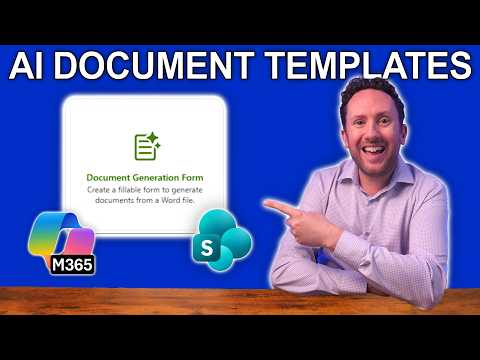
SharePoint: AI-Driven Structured Docs
Consultant at Bright Ideas Agency | Digital Transformation | Microsoft 365 | Modern Workplace
Structured Document Generation in SharePoint uses Copilot to auto-create form-driven templates for document automation
Key insights
- Structured Document Generation in SharePoint turns a Word template into a form-driven process that auto-creates finished documents from user submissions.
It speeds up consistent document output without manual editing. - Creators upload a template and use AI field detection to map placeholders, refine fields, and publish a form for others to fill.
End users complete the form and SharePoint merges values into the template to produce the document. - The AI suggests fields, maps inputs, and preserves layout, but it does not replace complex automation or full record systems.
Expect limits with conditional sections and filename customization, so test templates before production. - Best fit is the long tail of recurring team documents—simple contracts, offer letters, invoices, and standard reports that don’t need a formal system of record.
Avoid using it for large, mission‑critical documents tied to specialized record systems. - Governance and integration: generated files save to SharePoint libraries with captured metadata, retention labels, and permissions applied; outputs support Word and PDF and can trigger Power Automate flows.
- Copilot licensing quirk: creators typically need a Microsoft 365 Copilot license to build forms, while document generation for end users is handled by SharePoint storage and library settings.
Practical tip: plan target folders and metadata up front to avoid manual clean-up later.
Overview of the Video and the New Feature
In a concise walkthrough, Nick DeCourcy (Bright Ideas Agency) demonstrates Microsoft’s new preview feature, Structured Document Generation in SharePoint. He shows how the feature turns standard Word templates into form-driven processes so that users can generate finished documents without manual editing. Consequently, the presentation aims to separate marketing claims from real capabilities and to show where this tool actually adds value.
Furthermore, the video presents an end-to-end demo that covers creating a document generation form, editing the Word template, setting up fields and data types, configuring an output folder, and producing completed documents from form submissions. DeCourcy stresses practical scenarios and real limitations rather than offering pure promotional optimism. Therefore, the audience gains a balanced look at how this feature behaves in everyday Microsoft 365 contexts.
How Structured Document Generation Works
At a basic level, content managers upload a Word template into a chosen SharePoint library and use AI-assisted field detection to convert placeholders into form fields. Then creators refine those fields, add help text, and publish the form so end users can fill it out via a link and submit to produce a merged document. As a result, completed files populate a designated library along with metadata that supports standard governance controls.
Importantly, the AI primarily suggests fields and maps inputs to template locations; it does not replace careful template design or business rules. The merge preserves formatting and can output Word or PDF files, but conditional logic and advanced filename customization remain limited. Thus, the feature combines AI convenience with the need for manual template management in many cases.
Where It Fits in Microsoft 365 Workflows
DeCourcy compares this capability to existing tools like SharePoint Syntex content assembly and Power Automate document generation to clarify placement in the toolset. He suggests that while Microsoft markets the feature for contracts, invoices, and offer letters, it truly shines for recurring team documents that are important to be consistent but do not require a heavyweight system of record. Consequently, it fills a gap between ad-hoc templates and fully automated, developer-driven workflows.
Moreover, a licensing detail makes this option attractive: creators need a Microsoft 365 Copilot license to set up the forms, but document generation itself does not require additional per-document licensing, which can lower cost for some teams. Still, organizations should weigh this savings against the limitations and integration needs with existing systems. In short, the feature is a cost-effective option for many routine document needs but not a universal replacement for enterprise automation platforms.
Tradeoffs and Limitations
Despite clear benefits, the feature comes with practical tradeoffs. For example, it does not handle documents that belong to a complex system of record with deep lifecycle controls and custom metadata schemes, and conditional document sections and filename rules are currently constrained. Therefore, teams that must enforce detailed business logic or complex approval routing will likely still need Power Automate or custom development.
Additionally, access scope and governance are significant considerations: the tool is best for internal use and recurring, moderately important documents, but sensitive or high-value items may require tighter controls than a simple form-based generation process can provide. Consequently, organizations must balance ease of use against control and compliance requirements before wide rollout.
Adoption Challenges and Practical Recommendations
DeCourcy recommends a pragmatic rollout that begins with a pilot focused on the "long tail" of recurring documents such as team reports, standard memos, and simple contracts that do not require a system of record. Start by selecting a few high-volume templates, refine them for consistent field naming and metadata, and monitor how generated files land in SharePoint libraries to validate governance. By testing early, teams can learn how far the tool can go without needing additional automation layers.
Finally, successful adoption depends on clear ownership, template hygiene, and user training so that creators use templates consistently and end users understand form inputs. For organizations that already use Syntex or extensive Power Automate flows, this feature can reduce small manual tasks, but it should integrate into an overall document and compliance strategy. Thus, while Structured Document Generation promises faster, more consistent outputs, teams should weigh simplicity against flexibility and plan deployments accordingly.

Keywords
SharePoint AI document generation, Structured document generation SharePoint, AI document templates SharePoint, SharePoint document automation AI, Microsoft Syntex document generation, Metadata-driven document generation SharePoint, Power Automate SharePoint document generation, AI-powered document assembly SharePoint