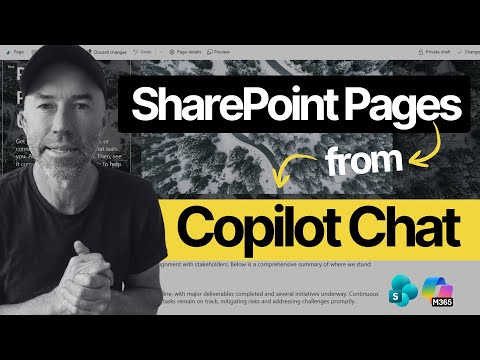
Copilot: Turn Chat Insights Into Action
A Microsoft MVP 𝗁𝖾𝗅𝗉𝗂𝗇𝗀 develop careers, scale and 𝗀𝗋𝗈𝗐 businesses 𝖻𝗒 𝖾𝗆𝗉𝗈𝗐𝖾𝗋𝗂𝗇𝗀 everyone 𝗍𝗈 𝖺𝖼𝗁𝗂𝖾𝗏𝖾 𝗆𝗈𝗋𝖾 𝗐𝗂𝗍𝗁 𝖬𝗂𝖼𝗋𝗈𝗌𝗈𝖿𝗍 𝟥𝟨𝟧
Microsoft Copilot and SharePoint automate workflows with Copilot agents to turn chat into compliant pages, no copy paste
Key insights
- Copilot agents: Chain a Compliance Agent and a SharePoint Page Agent so you can turn a chat into a published SharePoint page without copy/paste.
Use agents to move insights out of chat and into visible team content. - Compliance Agent: Pulls document status and metadata directly from source systems.
Use simple traffic‑light formatting (green/yellow/red) to surface status at a glance. - SharePoint Page Agent: Selects a site, drafts the page from chat content, and posts the draft into SharePoint for review.
Refine the draft in SharePoint and publish the final page without manual reformatting. - Workflow thinking: Focus on chaining steps, not single prompts, to automate end‑to‑end tasks.
This reduces manual handoffs, saves time, and keeps insights attached to real work artifacts. - Insight retention: Modern Copilot features keep context across tools — meeting prep, customer insights (like propensity to buy or lifetime value), and content from attachments (Word, Excel, PowerPoint, PDFs).
That makes chat insights actionable and easier to reuse in workflows. - Practical sequence: Build the conversation, run the Compliance Agent, apply traffic‑light formatting, invoke the SharePoint Page Agent, review in SharePoint, refine, then publish.
Follow these steps to move Copilot output from private chat into team‑visible pages.
In a clear, practical YouTube demonstration, Daniel Anderson [MVP] shows how to preserve and publish insights from Copilot chat by chaining intelligent agents to create live pages in SharePoint. The video frames this capability not as a tool demo alone but as a shift in how teams think about workflows, moving from single prompts to connected agents that carry context forward. As a result, viewers can see how a conversation in Copilot can flow directly into a published page without manual copy and paste, saving time and reducing errors. This article summarizes the key points of that walkthrough and examines the tradeoffs and challenges teams will face when adopting the approach.
What the Video Demonstrates
At the start, Daniel outlines the practical goal: turn chat insights into a visible team page so findings do not languish in chat transcripts. He then walks through a compact sequence that pairs a Compliance Agent with a SharePoint Page Agent, showing the end-to-end movement from data review to a published article. Importantly, the presenter highlights the workflow mindset—designing processes so each agent contributes a specific role, rather than relying on single, ad-hoc prompts. Consequently, the demo highlights how automation can be staged to preserve context and ensure visibility across teams.
Step-by-Step Workflow in the Demo
Daniel first uses the Compliance Agent to extract document status and indicate compliance concerns, and then applies traffic-light formatting to make status immediately scannable. Next, he invokes the SharePoint Page Agent, selects a site, and drafts a page directly from the chat output, showing how draft review happens inside the SharePoint interface. The flow includes iterative refinement with Copilot so the draft improves before publishing, and the video timestamps mark each stage for easy navigation. Thus, viewers see not just the how but the sequence that keeps the insight alive and visible to a broader group.
Technical Tradeoffs and Governance Concerns
While the chained-agent approach speeds publication, it also raises tradeoffs between automation and control that organizations must balance. On one hand, automating page creation reduces manual work and improves consistency; on the other hand, it increases the need for tight permissioning and review rules to avoid publishing sensitive or inaccurate content. Moreover, relying on agents to interpret compliance signals demands strong grounding in data sources and governance policies so the output reflects current rules accurately. Therefore, teams should pair these workflows with clear review gates and audit trails to maintain trust in the automated output.
Practical Challenges When Scaling
Daniel’s demo works smoothly in a controlled setting, but scaling this pattern introduces several operational challenges that merit attention. For example, site selection and template consistency across many teams require centralized patterns to prevent fragmentation, and configuring agent permissions at scale often needs coordination between IT and business owners. In addition, agent chaining can amplify errors if one agent misinterprets context, so teams must build checks that detect and correct drift in outputs over time. Consequently, organizations should pilot the approach, monitor results, and iterate governance and agent prompts to manage risk while reaping efficiency gains.
Implications for Teams and Next Steps
Ultimately, the video positions this capability as a practical step toward making AI-generated insights actionable rather than ephemeral. By turning chat outputs into published pages, teams can preserve institutional knowledge and make compliance status and key updates easier to discover. However, to succeed, teams will need to combine thoughtful workflow design, clear governance, and ongoing monitoring so automation enhances productivity without compromising accuracy or security. As Daniel emphasizes in the walkthrough, thinking in workflows—not single prompts—is the cultural shift that enables long-term value from these agent-driven automations.
In conclusion, the YouTube walkthrough by Daniel Anderson [MVP] provides a useful, field-tested look at how chained agents in Copilot and SharePoint can convert conversations into visible, useful artifacts for teams. The demonstration shows clear benefits in speed and visibility, but it also highlights the need for governance, iterative refinement, and careful scaling. For organizations considering similar patterns, the video offers a practical blueprint and a realistic view of the tradeoffs involved in making AI-driven workflows part of everyday work.

Keywords
save Copilot insights, preserve Copilot chat insights, export Copilot insights, manage Copilot insights, Microsoft Copilot tips, Copilot chat retention strategies, Copilot insights workflow, turn Copilot insights into action