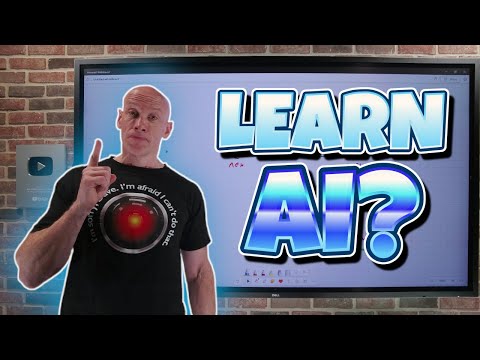
Microsoft Copilot: Should You Learn AI?
Principal Cloud Solutions Architect
Wondering if you should learn AI? Explore Azure learning paths, certification, DevOps, PowerShell and GitHub mentoring.
Key insights
- Should you learn AI?: The video’s short answer is yes — AI works as a digital collaborator that boosts human skills and creates new roles, not just replaces tasks.
Learning AI helps you solve problems faster and stay relevant in most industries. - Core Microsoft tools: Microsoft centers on generative AI through Copilot, Azure OpenAI, Microsoft Fabric and emerging AI agents that automate workflows, write code, and summarize complex data.
These tools integrate with everyday apps and developer platforms to speed work and reduce manual effort. - Practical innovations: Examples include Aurora for weather and flood forecasting and the Analog Optical Computer (AOC) for faster, more energy-efficient AI inference.
Such innovations show how AI can tackle climate, research and large-scale computing challenges. - Where to learn: Microsoft offers guided paths like the AI Learning Hub, hands-on lessons on Copilot+ PCs, and educator programs that provide free credentials and practical labs.
Start with interactive modules to build skills without needing high-end hardware. - Top benefits: Expect a clear productivity surge, faster project delivery, new career pathways through skills like repository intelligence, and better research outcomes as AI assists analysis.
Microsoft also highlights security and ethics safeguards to keep AI use responsible. - 2026 trends to watch: AI now focuses on partnership — AI amplifies human teams, businesses deploy safeguarded AI agents, and models offer context-aware code intelligence for smarter development.
Learning to work with these systems gives a clear advantage in the near future.
Introduction: Video Summary and Context
In a concise YouTube video titled "Should I learn AI? Quick video thinking about should you learn AI?", author John Savill's [MVP] explores whether learners and professionals should invest time in AI skills. He frames AI as a long-term shift rather than a passing trend and highlights Microsoft's 2026 positioning of AI as a partner that amplifies human work. Consequently, the video balances enthusiasm with practical guidance, inviting viewers to weigh benefits against real-world tradeoffs when deciding to learn AI.
What the Video Explains About Microsoft's 2026 AI Landscape
First, the video outlines the core Microsoft technologies shaping the new landscape, including generative AI tools such as Copilot, Azure AI services, Microsoft Fabric, and emerging AI agents. It explains that these tools move beyond simple answers to context-aware collaboration, where AI helps draft content, analyze repositories, and suggest next steps in workflows. Therefore, the message is clear: learning AI is about learning to work with these systems, not just learning models.
Next, the video cites practical innovations that show AI's reach, mentioning projects like Aurora for environmental forecasting and the Analog Optical Computer (AOC) for energy-efficient inference. In turn, these examples illustrate how AI now supports domains from climate science to software development. As a result, viewers can see that AI skills translate across sectors and that Microsoft emphasizes integrated, scalable platforms.
Benefits Highlighted and Practical Use Cases
Moreover, the video stresses clear benefits for individuals and teams, starting with productivity gains where tools like Copilot speed routine tasks such as summarizing meetings, drafting emails, and generating code snippets. It also highlights career advantages, because organizations increasingly value people who can pair domain expertise with AI literacy. Consequently, professionals who learn to combine human judgment with AI assistance stand to expand their impact and employability.
Additionally, the video points out how AI can accelerate research and innovation by synthesizing large datasets and suggesting hypotheses, while smart infrastructure advances reduce compute costs and energy use. However, it tempers that optimism by noting AI's effectiveness depends on data quality and context. Thus, the real-world payoffs require both tool fluency and sound data practices.
Tradeoffs and Challenges to Consider
Still, the video does not ignore the tradeoffs involved in embracing AI. For example, there is tension between rapid adoption and proper governance; organizations may gain speed but risk ethical lapses or security gaps if they skip guardrails. Similarly, the rise of AI agents raises questions about role boundaries, where automation helps but can also obscure accountability unless teams set clear rules.
Furthermore, the narrator discusses skills and ecosystem tradeoffs: learners must choose between general AI knowledge and deep vendor-specific skills, which can lead to lock-in if organizations standardize on one platform. In addition, compute and sustainability challenges persist, even with innovations like AOC, because large-scale AI still consumes significant resources. Therefore, balancing specialization, portability, and environmental impact remains a core challenge.
How to Start Learning and Practical Recommendations
Finally, the video offers a pragmatic starting point for viewers who decide to learn AI, recommending Microsoft learning paths and hands-on experiments with platforms that provide guided labs and on-device experiences. It advises combining foundational concepts—such as model behavior, data hygiene, and prompt design—with domain practice so skills remain relevant. Consequently, learners should mix theory with small projects to build confidence and real outcomes.
Moreover, the video encourages attention to governance and ethics alongside technical skills, recommending that learners also study bias mitigation and secure deployment practices. Although skills development takes time, the narrator reassures viewers that free credentials and structured learning paths lower the barrier to entry. Ultimately, the guidance centers on pragmatic, sustained learning rather than quick fixes.
Conclusion: A Balanced View for Potential Learners
In conclusion, John Savill's [MVP] frames learning AI as a practical and strategic choice, provided learners weigh benefits against the governance, sustainability, and specialization tradeoffs. He emphasizes partnership with AI rather than competition, advocating for skill sets that combine human judgment with tool fluency. Therefore, readers and viewers should focus on continuous learning, ethical practice, and hands-on experience to make AI a reliable collaborator in their work.

Keywords
should I learn AI, is AI worth learning, how to start learning AI, learn AI for beginners, best AI courses, AI career prospects, AI skills to learn, AI learning resources