Customer Insights - Data: Wave 1 Tips
Microsoft MVP | User Adoption, Dynamics 365 + Power Platform Expert at Reenhanced
Microsoft Customer Insights Data powers Copilot and AI agents with unified profiles and real-time activation
Key insights
- 2026 release wave 1 overview:
Summary of Microsoft's video and release plan for Dynamics 365 Customer Insights – Data, rolling out April–September 2026.
The update positions the product as an AI-powered customer data platform (CDP) that supplies trusted customer context for business workflows. - Agents and Copilot as a priority:
Customer Insights – Data will serve as a knowledge source for copilots and autonomous agents, letting teams surface profile data directly in workflows for faster, more accurate decisions. - Core platform tasks simplified:
The system still ingests data, unifies identities, enriches profiles, and activates insights in real time to drive actions across sales, marketing, and service. - Richer customer context and signals:
The release emphasizes behavioral signals and organizational context, enabling better segmentation, personalization, and campaign optimization. - Pipeline acceleration and lifecycle activation:
Features aim to improve lead quality, speed up qualification, and increase conversions by applying unified insights across the customer journey and connecting to Customer Insights – Journeys. - Integration and business benefits:
Microsoft signals closer ties with Microsoft Fabric as a data source, while the release promises better AI grounding, faster personalized actions, and stronger pipeline outcomes.
Overview: Video summary and context
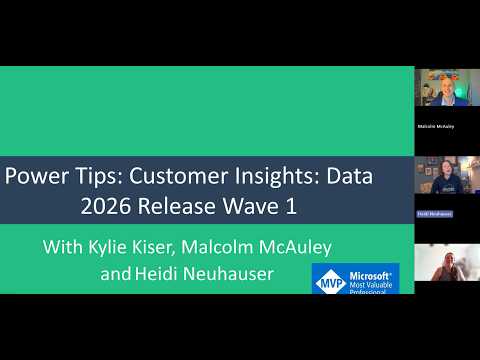
In a recent YouTube video, Heidi Neuhauser [MVP] explains Microsoft’s 2026 release wave 1 for Dynamics 365 Customer Insights – Data, and she highlights how the platform is being shaped as an AI-ready customer data foundation. The video covers planned rollouts between April 2026 and September 2026 and focuses on three core themes: agents and Copilot, richer customer context, and faster pipeline activation. Neuhauser frames the update as a shift from a passive data store to an active knowledge layer that supports real-time decision-making across marketing, sales, and service.
What the video shows is new
Heidi Neuhauser walks viewers through the main investments in the wave: enabling Customer Insights – Data as a trusted knowledge source for AI agents, improving behavioral and campaign signals, and connecting unified profiles to activation workflows. She explains that the platform will feed richer, near real-time customer context into copilots and autonomous agents so teams can surface insights where they work. Importantly, the video also mentions tighter alignment with Microsoft Fabric data, suggesting improved integration with Microsoft’s broader data services, though final availability and specifics depend on official release notes.
Practical benefits highlighted
Neuhauser emphasizes practical outcomes for businesses, such as quicker, more personalized actions in the flow of work and better lead qualification that supports pipeline growth. By unifying profiles and enriching them with behavioral signals and campaign performance, the platform aims to give marketing, sales, and service teams more confidence in their decisions. Moreover, the video explains that using Customer Insights – Data as the grounding layer for AI can reduce the chance of inaccurate recommendations by supplying a single, reliable customer view for agents and copilots to reference.
Tradeoffs to consider
While the video presents clear advantages, it also implicitly raises tradeoffs that organizations must weigh, including complexity, cost, and governance. For example, delivering real-time, unified profiles requires investment in data pipelines and processing, which can raise operational costs and add technical overhead. Likewise, tighter integration with AI experiences improves automation but increases the need for strict data privacy, clear access controls, and human oversight to avoid overreliance on automated decisions.
Challenges and risks explored
Neuhauser notes some practical challenges such as ensuring data quality across sources and mapping identities accurately to create trustworthy profiles, which remain core tasks even as AI capabilities improve. Another issue she touches on is balancing latency and freshness: real-time insights are valuable, yet they can drive higher compute and storage demands. The video also warns that integrating behavioral and campaign signals effectively requires alignment across teams, including marketing, sales, and IT, to avoid creating new silos or inconsistent customer experiences.
Implementation considerations
For teams planning adoption, the video recommends prioritizing clear use cases where unified customer context will change decisions or outcomes, such as lead scoring, personalized outreach, or service routing. Neuhauser suggests starting small with targeted pilot scenarios to measure impact and refine data flows, and then scaling integration with agents and copilots as confidence grows. She also points out that organizations relying on Microsoft Fabric should watch for the evolving integration, since tighter Microsoft Fabric links could simplify architecture for teams that already use Fabric as a data hub.
Balancing AI and human oversight
Throughout the video, Neuhauser stresses the need to pair automation with governance, arguing that copilots and agents must work under clear guardrails to be effective and trustworthy. This balance means defining review processes, audit trails, and fallback procedures when automated recommendations need human validation. Consequently, organizations must plan for training, policy updates, and monitoring to prevent drift and maintain customer trust as automated experiences scale.
Why this matters to organizations
By repositioning Customer Insights – Data as an AI-ready knowledge layer, Microsoft aims to make customer data actionable in real time and directly useful to revenue and service outcomes. The video makes a case that this approach can shorten the time between insight and action, which in turn can improve conversion rates and customer satisfaction. However, Heidi Neuhauser also makes clear that the benefits depend on solid data foundations, cross-team coordination, and careful governance.
Next steps and what to watch
Viewers are encouraged to follow official release notes for precise timelines, feature details, and licensing implications, since product availability can vary by region and tenant configuration. In the meantime, the video suggests focusing on readiness: assess current data quality, identify priority use cases for real-time insights, and plan pilots that test the interplay between Customer Insights – Data, copilots, and activation channels. These steps help teams capture benefits while managing cost and complexity.
Related resources
Conclusion
Heidi Neuhauser’s video provides a concise look at the 2026 release wave 1 for Customer Insights – Data, highlighting a clear strategic shift toward AI-led, real-time customer intelligence. While the release promises stronger personalization and faster activation, it also introduces tradeoffs around cost, integration, and governance that teams must address. Ultimately, organizations that plan pilots carefully and focus on data quality and oversight are best positioned to turn these platform enhancements into measurable business outcomes.

Keywords
Dynamics 365 Customer Insights 2026, Customer Insights Data 2026 release wave 1, Customer Insights Power Tips, Customer data platform 2026, Dynamics 365 release wave 1 2026, Customer Insights features 2026, CDP update 2026, Customer Insights best practices