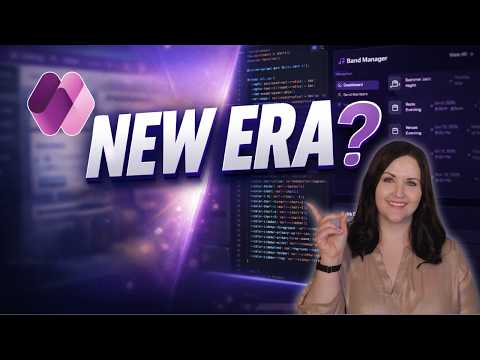
Overview of the Video and the New Experience
In a recent YouTube walkthrough, April Dunnam introduces a major preview feature at vibe.powerapps.com that proposes a fresh way to build full-code Power Apps with a single prompt. She demonstrates how the preview creates a new app type that combines a planning layer with an AI-driven builder to produce a data model, user stories, and a generated front-end built on Dataverse. Consequently, the video positions this experience as a bridge between conversational design and code-first development for enterprise scenarios, aimed at both business users and developers. Overall, the presentation makes the mechanics clear while emphasizing that the feature remains in preview and therefore subject to change.
Moreover, Dunnam walks viewers through practical steps such as enabling the preview, starting an app plan, testing functionality, fixing a bug, and then saving, publishing, and sharing the app. The demonstration highlights the roles of two core pieces: Plan Designer for defining data models and user stories, and an App Builder Agent for generating the front-end automatically. For editorial context, this coverage is useful because it frames the new toolset as more than a prototype generator; it is an end-to-end workflow that targets enterprise-ready outputs. Importantly, the video also calls out licensing and access nuances that teams must consider before adopting it broadly.
How Vibe Generates Apps
First, the process begins with a simple natural language prompt, such as describing an inventory or employee management scenario. Then, the system spins up a plan that includes a proposed data model and a set of user stories, while the AI agents work in parallel to produce a web app preview and the underlying application code. As shown in the video, users can toggle between app preview, a split view that exposes generated React code, and the plan or data editors to make adjustments. Therefore, the flow supports both low-friction prototyping and a path toward more technical refinement.
Next, Dunnam demonstrates editing and debugging: she uses inline prompts and manual edits to address a bug and then adds a new feature before publishing the app. The generated apps are built to authenticate users and operate within Power Platform environments, leveraging connectors and Dataverse for storage and integrations. Additionally, professionals can export, view, and edit generated code with common tools like VS Code and Power Apps CLI for further customization. Thus, the experience mixes AI assistance with standard developer tooling to maintain flexibility.
Benefits and Tradeoffs
One clear benefit is speed: teams can move from idea to a functioning prototype in minutes instead of days, which accelerates experimentation and stakeholder feedback. Moreover, the AI agents reduce repetitive tasks such as initial schema design and basic UI scaffolding, thereby freeing developers to focus on complex business logic and integrations. However, rapid generation brings tradeoffs in control and predictability, because AI-driven outputs may not align perfectly with existing coding standards or architectural constraints.
Consequently, organizations must weigh convenience against long-term maintainability. On the one hand, business users can deliver solutions faster and reduce backlog pressure; on the other hand, professional developers may inherit generated code that requires cleanup, refactoring, or alignment with governance policies. Therefore, teams should plan for code review, version control, and testing practices early when adopting this approach to avoid accumulating technical debt. In short, speed does not eliminate the need for disciplined software lifecycle practices.
Limitations and Governance Challenges
Dunnam stresses that the feature is in preview and has several notable limits: apps publish only to Dataverse, only one app is allowed per plan, and existing Canvas or Model-driven apps aren’t directly supported yet. Furthermore, the preview requires specific environment settings and roles, which can complicate initial access for some organizations. As a result, teams should not treat the preview as production-ready and must plan pilot projects to validate suitability for their use cases.
Additionally, governance and licensing present real challenges because generated apps can introduce new data schemas and access patterns at scale. Therefore, IT teams need to enforce environment-level policies, role-based security, and auditing to maintain compliance. Finally, debugging and integrating AI-generated applications with complex legacy systems can be time consuming, so realistic expectations and staged adoption will reduce disruption.
Practical Advice for Getting Started
To experiment safely, the video suggests enabling the preview in a non-default US-region environment and using a System Customizer role to explore the Plan Designer and app builder. Start with simple, low-risk use cases such as internal tools, prototypes, or proofs of concept to observe how generated schemas and UI components behave. Then, iterate by exporting code, reviewing the generated React, and applying standard development practices like version control and automated testing to mature the solution.
In conclusion, April Dunnam’s walkthrough makes vibe.powerapps.com easy to understand while highlighting both promise and precaution. While the feature can speed app delivery and democratize development, it also requires thoughtful adoption, governance, and developer involvement to ensure long-term value. Consequently, IT leaders and developers should pilot the preview now, assess tradeoffs, and prepare governance around data, security, and maintainability before scaling its use.
