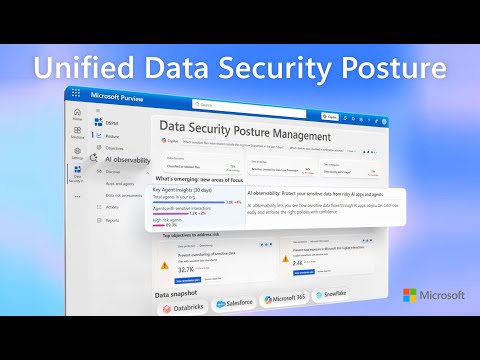
Microsoft Purview: Boost Data Security
Software Development Redmond, Washington
Microsoft Purview DSPM finds sensitive data across clouds, remediates high risk, stops oversharing and monitors AI
Key insights
-
Microsoft Purview now includes Data Security Posture Management (DSPM) to find, assess, and prioritize high-risk data across Microsoft and non-Microsoft services.
It gives a centralized view of sensitive files, risky user actions, and where to focus protection efforts. -
DSPM delivers cross-cloud monitoring, dynamic risk analytics, and on-demand scanning of repositories like SharePoint and OneDrive.
It also supports direct policy creation so teams can close gaps quickly and reduce manual work. -
The extension DSPM for AI tracks AI agents and apps that access data, detects sensitive content in prompts, and shows which policies apply.
This AI observability helps stop data exposure through AI workflows. -
DSPM uses machine learning via Adaptive Protection to prioritize critical risks and suggest targeted protections.
Teams can act on those suggestions to prevent oversharing and enforce DLP and insider-risk controls. -
Benefits include a unified security and governance view, real-time risk visibility, and actionable recommendations that speed remediation without blocking productivity.
Integration with automation and investigative tools helps scale response across large environments. -
DSPM began public preview in late May 2025 and reached general availability by September 2025, with updates for on-demand classification and new AI site support.
To get started, scan key data stores, apply recommended policies, and use role-based access controls to limit who can view AI-related findings.
Overview of the video
The YouTube video, produced by Microsoft, introduces the new Microsoft Purview Data Security Posture Management (DSPM) and its extension, DSPM for AI. The presenter, Talhah Mir, explains how the tools locate, assess, and prioritize high-risk data across both Microsoft and non-Microsoft services. Viewers are shown a brief walkthrough of the unified dashboard, core workflows, and practical scenarios where DSPM helps security teams focus remediation efforts without blocking everyday productivity.
The presentation is structured in short segments that cover the unified solution, daily use cases, preventing oversharing, AI observability, and deployment guidance. Consequently, the video aims to balance technical detail with operational guidance so IT teams can quickly decide whether to trial the tools. Importantly, the author frames DSPM as an integration layer that ties together existing Purview capabilities, rather than a standalone replacement for established controls.
Core capabilities highlighted
The video emphasizes that DSPM consolidates insights from Data Loss Prevention, Insider Risk Management, and Information Protection to give a single view of data risk. It tracks data state, correlates risk signals, and advises on policy changes, allowing administrators to create or update protections directly from recommendations. This centralized approach simplifies oversight and speeds up remediation by turning detection into action.
Another notable capability is automated prioritization via adaptive machine learning, which the presenter describes as a way to surface the most critical gaps first. The demo shows how teams can prevent oversharing by detecting improperly configured sharing links and applying corrective policies. At the same time, on-demand scanning of repositories such as SharePoint and OneDrive is presented as a practical step for fast discovery of sensitive content across the environment.
AI observability and the DSPM for AI extension
Of particular interest is the extension called DSPM for AI, which targets emerging risks created by AI agents and applications. The video demonstrates dashboards that show which AI agents are accessing sensitive data, what prompts contain sensitive content, and how policies map to those AI interactions. This visibility helps teams spot accidental data exposure through AI-driven workflows and respond with tailored policies.
Moreover, the integration with tools such as Security Copilot is shown as a way to use AI to investigate and remediate flagged incidents faster. However, the video also notes the difficulty of defining coverage for a rapidly changing AI landscape, and it recommends continuous reassessment of which AI sites and agents require monitoring. Thus, while DSPM for AI extends governance into new areas, maintaining accuracy and relevance requires ongoing attention.
Tradeoffs and operational challenges
The presenters discuss tradeoffs between centralized control and operational flexibility, pointing out that a unified platform reduces complexity but can introduce single points of administrative decision-making. For example, automated policy application speeds response but can generate false positives that disrupt users if thresholds are not tuned. Therefore, security teams must balance strict enforcement with business continuity to avoid hampering productivity.
Scaling the solution across hybrid and multi-cloud environments also presents challenges, especially when non-Microsoft services are involved. The video acknowledges integration hurdles and classification accuracy limits, noting that imperfect detections require human review and role-based access controls. Consequently, organizations should plan phased deployments and invest in tuning classifiers and review workflows to reduce friction and improve outcomes over time.
Adoption guidance and practical next steps
The video closes with pragmatic advice on getting DSPM working in an organization, urging teams to start with high-value data stores and prioritized risks. It suggests using the platform’s recommendations to create policies iteratively and to adopt role-based views to limit exposure for sensitive operational tasks. By piloting in a focused area, teams can refine automation rules, reduce false positives, and demonstrate early wins that justify broader rollout.
In summary, the Microsoft video presents DSPM and DSPM for AI as useful tools for modern data governance that bring visibility into data risk and AI interactions. Yet, as the presenter stresses, success depends on careful tuning, clear governance processes, and ongoing reassessment to balance security, accuracy, and user productivity. Therefore, organizations considering adoption should weigh the benefits of unified visibility against the operational work required to maintain accuracy and minimize disruption.

Keywords
Microsoft Purview DSPM, Data Security Posture Management, Microsoft Purview data security, Cloud data protection, Sensitive data discovery, Data governance and compliance, Data loss prevention Purview, DSPM best practices