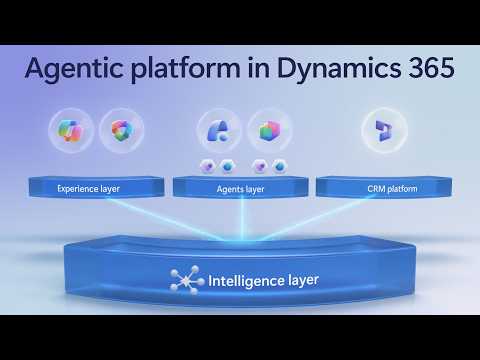
Dynamics 365: Agentic Platform Unveiled
Software Development Redmond, Washington
Dynamics CRM agents with Copilot Cowork automate CRM workflows, qualify leads, close cases and extend via Power Platform
Key insights
- Agentic platform turns Dynamics 365 from a passive "system of record" into a proactive system of action.
AI agents for Sales and Service sit inside Dynamics, Outlook, and Teams so users get the same intelligence across apps. - The platform uses the Model Context Protocol (MCP) and a unified data layer that combines CRM, email, and meeting data.
Agents read unstructured content, interpret intent, and act on trusted business signals. - Pre-built agents include the Sales Qualification Agent, Sales Close Agent, Data Entry Agent, Case Management Agent, and Quality Evaluation Agent.
They automate updates, auto-fill case descriptions, score quality, and recommend next-best actions. - Copilot Cowork automates repetitive meeting prep and follow-up tasks.
Hand it a prompt and it can update records, produce a presentation, and draft emails before your next meeting. - Benefits include accelerated deal velocity, less manual data entry, and real-time service quality scoring.
Agents surface prioritized actions and enrich CRM fields to keep teams focused on customers. - Organizations can customize and extend agents with the Power Platform, including Power Apps and Dataverse, or build skills in Copilot Studio.
This lets teams add rules, data sources, and tailored instructions for unique workflows.
Microsoft released a detailed YouTube video that demonstrates a new agentic platform inside Dynamics 365 for Sales and Service, and this article summarizes the key points for editorial review. The presentation, led by Eric Boocock, explains how role-specific AI agents can qualify leads, close cases, and prepare staff for renewals by working directly inside the apps they already use. Consequently, the video describes both the technical underpinnings and practical scenarios, while also showing live demonstrations and customization options.
What the video shows
The video opens by framing Dynamics 365 as a shift from a passive record system to an active system of action, where embedded agents assist users through every stage of customer engagement. Specifically, Microsoft showcases pre-built agents such as the Sales Agent and Service Agent that operate across Dynamics 365, Outlook, Teams, and Microsoft 365 Copilot. Moreover, the demos walk viewers through real workflows: sales qualification, opportunity handling, case management, quality evaluation, and Copilot Cowork assisting with repeated tasks.
How the agents work
Technically, the platform relies on a unified data layer that merges CRM records with productivity signals like emails and meeting notes, which allows agents to provide grounded answers. In addition, Microsoft emphasizes the role of the Model Context Protocol (MCP) to ensure agents understand context and act consistently across applications. As a result, agents can auto-fill case descriptions, surface next-best actions, and even draft emails or presentations based on prompts and calendar context.
Practical benefits for sales and service teams
First, the video highlights clear efficiency gains: agents reduce manual entry, accelerate deal velocity, and surface risks so sellers can focus on conversations that matter most. Second, service teams can use the Quality Evaluation Agent to standardize reviews and monitor performance in near real time, which helps managers identify coaching opportunities faster. Therefore, the overall promise is that automation and intelligence combine to lower administrative burden while improving decision-making.
Customization and extensibility
Importantly, Microsoft explains how organizations can extend these capabilities using familiar tools like Power Apps, Dataverse, and Copilot Studio to create custom skills and workflows. Furthermore, the platform’s MCP-based design is intended to let developers plug in business-specific logic and data sources so agents reflect local rules and compliance needs. Consequently, businesses can balance the convenience of out-of-the-box agents with tailored automation that respects their processes.
Tradeoffs and operational challenges
Despite the advances, the video candidly notes tradeoffs that teams must navigate, beginning with governance: tighter automation brings greater need for oversight to prevent errors or inappropriate actions. Also, data quality becomes critical because agents draw decisions from combined CRM and productivity data; poor or inconsistent records can reduce the value and increase risk. Therefore, organizations face a balancing act between speeding workflows and investing in data hygiene, change management, and monitoring.
Risk management and human oversight
Moreover, the demonstration stresses human-in-the-loop patterns for higher-risk tasks, which preserves accountability while enabling automation for low-risk work. In addition, administrators can configure agents’ permissions and review mechanisms so that sensitive actions require confirmation or supervisor approval. Thus, the platform supports graduated automation, allowing teams to ramp up agent autonomy as confidence and controls mature.
Performance and integration considerations
Performance depends on both the quality of the underlying models and the freshness of integrated data, so IT teams should plan for monitoring and capacity as usage grows. Likewise, integrating with existing systems can require mapping fields and establishing the right connectors, which adds upfront effort even though it pays off in reduced manual labor later. Consequently, teams must weigh initial integration costs against expected long-term efficiency gains.
What organizations should consider next
Finally, the video concludes by encouraging organizations to pilot the agents in targeted areas such as routine case handling or qualification of straightforward opportunities before broad rollout. Additionally, it recommends engaging business owners early to define success metrics and to set up feedback loops that improve agent behavior over time. By taking a staged approach, companies can reduce risk while unlocking measurable productivity benefits.
Summary
In summary, Microsoft’s YouTube presentation demonstrates a practical step toward embedding autonomous, role-aware AI into everyday CRM work, using a mix of pre-built agents and customizable extensions. While the platform promises faster deals, less admin, and consistent cross-app experiences, operational tradeoffs like governance, data quality, and integration effort require careful planning. Ultimately, the platform offers clear potential provided organizations invest in controls, testing, and phased adoption.

Keywords
Dynamics 365 agentic platform, agentic platform Dynamics 365 Sales, agentic platform Dynamics 365 Service, Dynamics 365 AI agents, AI agents for CRM, autonomous agents Dynamics 365, Dynamics 365 Sales AI platform, Microsoft agentic platform for service