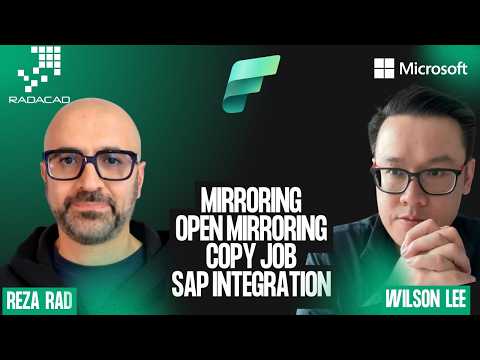
Microsoft Fabric Mirroring: SAP Copy Job
Founder | CEO @ RADACAD | Coach | Power BI Consultant | Author | Speaker | Regional Director | MVP
Microsoft Fabric mirroring Wilson Lee: licensing, open mirroring vs shortcut, Copy Job and SAP integration
Key insights
-
Interview context: Reza spoke with Wilson Lee from Microsoft about Microsoft Fabric mirroring and SAP integration—covering architecture, recent FabCon updates, differences from other approaches, and Copy Job usage.
-
What it is: Mirroring for SAP Datasphere continuously replicates SAP data into OneLake with a Zero-ETL approach, while Copy Job moves large datasets securely for operational uses; both aim to keep SAP and analytics stores in sync with low latency.
-
SAP coverage: the integration targets core SAP systems and cloud apps (examples include S/4HANA, ECC, BW, plus cloud apps like SuccessFactors and Ariba), so organizations can consolidate SAP and non‑SAP data in one platform.
-
How it differs from alternatives: Fabric mirroring creates a live, integrated copy inside Fabric; Open mirroring refers to external or non‑Fabric replication methods that may need extra tooling; a Shortcut is a metadata pointer to external data rather than a replicated copy—so shortcuts save storage but don’t provide a local replicated dataset.
-
Scale and operations: Copy Job supports petabyte-scale transfers with enterprise security and control, and it integrates with Fabric Data Factory and Fabric Data Agents to enable downstream AI and analytics on unified data.
-
Availability and licensing: features discussed are currently in preview and tied to Fabric’s licensing model; Wilson emphasized vendor-managed integration and recommended reviewing official Microsoft guidance for exact licensing and GA timing.
Introduction and Context
In a recent YouTube interview hosted by Reza Rad (RADACAD) [MVP], Microsoft product leader Wilson Lee explains new developments in Microsoft Fabric focused on mirroring and SAP integration. The discussion highlights the rise of direct connectivity between SAP systems and Fabric’s unified storage layer, known as OneLake, and outlines product updates announced at FabCon. Importantly, the interview clarifies how mirroring differs from other movement approaches such as shortcuts and open mirroring. Consequently, viewers gain practical context about when to choose each option and what to expect when deploying Fabric in SAP environments.
How Mirroring Works in Microsoft Fabric
Wilson Lee describes mirroring as a continuous, near-real-time replication mechanism that writes SAP data into OneLake without requiring a traditional extract-transform-load process. This approach maintains an operational copy of SAP data synchronized with the source, which supports analytics and AI scenarios directly on the mirrored data. Because the system reduces intermediate transformation steps, teams can shorten time-to-insight and simplify pipelines. However, mirroring still requires careful planning around connectivity, schema mapping, and change management to ensure consistent results.
SAP Coverage and the Zero-ETL Promise
The interview explains that Fabric’s SAP integration covers a broad set of SAP systems, including S/4HANA, ECC, BW, BW/4HANA and cloud applications like SuccessFactors and Ariba. By combining SAP’s native extraction capabilities with Fabric’s mirroring engine, Microsoft aims to deliver a Zero-ETL experience that minimizes manual transformation work and accelerates analytics readiness. As a result, organizations can bring SAP and non‑SAP data together in OneLake for unified reporting and AI-driven insights. Nevertheless, teams should expect to validate data semantics and governance policies because mirroring does not remove the need for data quality checks.
Copy Job Support and Enterprise Scalability
Beyond continuous mirroring, the interview highlights the Copy Job capability for bulk and scheduled transfers that handle petabyte-scale movement from SAP to Fabric. Copy Job offers control over large data migrations and complements mirroring by enabling secure, repeatable transfers for historical or bulk datasets. This two-pronged approach helps organizations balance immediacy and throughput when they harmonize large SAP estates with OneLake. Still, administrators must weigh network costs, transfer windows, and storage lifecycle policies when planning large-scale operations.
Licensing, Mirroring Types, and Practical Comparisons
Wilson Lee also covers licensing distinctions and how Microsoft’s mirroring differs from open mirroring and shortcuts. Open mirroring typically exposes data without deep product-level integration, whereas Fabric’s mirroring integrates with native SAP replication and Fabric governance tooling for a tighter operational fit. Shortcuts, on the other hand, reference external data rather than copying it, which reduces storage duplication but can introduce latency and operational dependencies. Therefore, organizations need to weigh licensing, performance, and governance when choosing between mirroring, shortcuts, or open approaches.
Tradeoffs and Operational Challenges
The interview does not shy away from tradeoffs: while Zero-ETL reduces pipeline complexity, it shifts emphasis to data governance, security, and schema drift management inside the unified layer. Teams will face challenges such as managing SAP schema changes, securing end-to-end replication channels, and coordinating access controls across Fabric tools like Fabric Data Agents. Moreover, near-real-time replication increases demands on network and infrastructure, and organizations must balance latency goals against cost and complexity. In short, the technology simplifies integration in many cases, but success still requires disciplined architecture, monitoring, and stakeholder alignment.
What This Means for Organizations
For companies with significant SAP footprints, the conversation suggests a pragmatic path to unify analytics and AI without rebuilding every pipeline from scratch. By using a mix of mirroring for continuous needs and Copy Job for large transfers, teams can optimize for both freshness and scale. However, leaders should plan for governance, cost management, and operational runbooks before full rollout. Ultimately, the interview by Reza Rad and insights from Wilson Lee provide a clear starting point for evaluation and pilot projects aimed at breaking down data silos.
Final Takeaway
The YouTube interview offers a concise, actionable look at how Microsoft Fabric aims to integrate SAP data into a single analytics fabric through mirroring and copy jobs. While the technology offers compelling benefits around speed and unification, it also introduces practical tradeoffs in governance, cost, and operational complexity. Consequently, organizations should approach adoption with a phased plan that tests performance, security, and data quality assumptions. Overall, the discussion is a useful resource for teams considering Fabric as part of their SAP modernization or analytics strategies.

Keywords
Microsoft Fabric mirroring, Fabric copy job tutorial, Microsoft Fabric SAP integration, SAP data replication with Fabric, Wilson Lee Microsoft interview, Fabric data mirroring best practices, Copy job SAP to Fabric, Microsoft Fabric ETL SAP