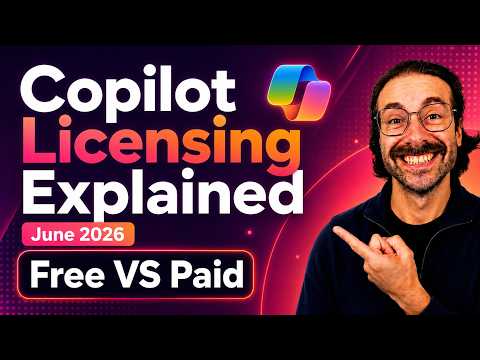
Microsoft 365 Copilot Buyers Guide
Microsoft expert demystifies Microsoft Copilot licensing, Copilot Chat and Excel restore tips for premium productivity
Key insights
-
Microsoft 365 Copilot is an add-on that requires an eligible Microsoft 365 or Office 365 base plan plus the Copilot license for each user.
Assign both licenses to a user for Copilot features to work. -
Microsoft shortened its SKU lineup in late 2025 and folded many role-specific products into the main Copilot offering — the video explains that retired role-based SKUs like Copilot for Sales, Service, and Finance are now included in the standard Copilot license.
Transitions from retired SKUs happen at renewal and Microsoft says there are no refunds for recently bought retired SKUs. -
The updated purchase model now includes a small-business edition called Microsoft 365 Copilot Business (for up to 300 users) and limited-time promotional pricing.
Promotions in 2026 apply to the first year and may include a short cancellation window with a prorated refund. -
Microsoft changed the consumption terms: the old “messages” unit is now called credits, and licensed Copilot users generally do not face extra usage charges.
Charges can apply for actions by non-licensed users, independent bots, or consumer-facing scenarios. -
Packaging updates roll out through mid-2026: Microsoft is adding more Copilot Chat and security/device-management features to M365 suites and introducing services such as Copilot Chat, Intune upgrades, and Microsoft Defender for Office 365.
Expect pricing and bundle changes to take effect around July 1, 2026. -
Practical takeaways from the video: procurement gets simpler with fewer Copilot SKUs, but admins should review renewals, check base-plan eligibility, and reassign licenses where needed.
If a Copilot button (for example in Excel) disappears, it often reflects licensing or packaging changes rather than a local bug.
Overview of the video and main takeaways
The YouTube video by Piggy Bank Accountant provides a clear, timely explanation of recent changes to Microsoft 365 Copilot licensing as of mid-2026. The presenter walks viewers through the evolving license landscape, including the retirement of certain role-based SKUs and the consolidation of features into core Copilot offerings. Consequently, the video aims to help both IT decision-makers and finance teams understand what they must change at renewal or when acquiring new seats.
Moreover, the video highlights how Microsoft is adjusting packaging for small and medium businesses alongside broader enterprise updates. It emphasizes differences between the main Microsoft 365 Copilot add-on, the SMB-focused Microsoft 365 Copilot Business edition, and new bundling of Copilot Chat features into base suites. As a result, viewers receive practical guidance on how these shifts affect procurement, deployment, and cost control.
Key licensing changes explained
First, the presenter summarizes the most significant shift: Microsoft retired separate role-based Copilot SKUs such as Copilot for Sales, Copilot for Service, and Copilot for Finance, folding those features into the main Microsoft 365 Copilot license. This consolidation means organizations purchasing the core Copilot add-on now get broader role-specific capabilities without buying multiple specialized SKUs. However, the video stresses that customers who recently bought retired SKUs should note Microsoft’s policy of no refunds and transitions only at renewal, which creates timing and budgeting tradeoffs.
Next, the video covers changes to agent development and usage billing: lightweight experiences from Copilot Studio are embedded into the Copilot license, while advanced agent work remains in the Studio product. In addition, the consumption model renamed “messages” to “credits,” and Microsoft clarified that licensed Copilot users will not incur per-message charges, while costs may apply for non-licensed users, independent bots, and consumer-facing scenarios. Consequently, organizations must balance expected usage patterns against license coverage to avoid unexpected bills.
Pricing, purchase paths and promotional details
The video reviews Microsoft’s public pricing posture for mid-2026, noting promotional rates for the SMB-focused Microsoft 365 Copilot Business edition that apply for a limited first-year period. It explains that promotional bundles and convenience SKUs are positioned for new commercial customers, while existing customers typically add Copilot as an add-on to qualifying base plans. Therefore, teams considering a purchase should weigh short-term promotional savings against longer-term renewal pricing and contractual commitments.
Additionally, the presenter describes the package updates Microsoft plans to roll out through July and August 2026, which add security and device-management capabilities to some suites. Those changes include components such as Defender features and expanded Intune capabilities, which can alter total cost of ownership when bundled. Thus, buyers must judge whether the improved security and management feature set justifies potential price changes after promotional periods end.
Tradeoffs for IT, procurement and finance teams
On one hand, consolidation simplifies procurement because fewer distinct Copilot SKUs reduce administrative overhead and the need to map features to specific roles. On the other hand, simplification can hide nuance: bundled licenses may include features some teams do not need, which creates potential inefficiencies and over-spend. Therefore, finance leaders should balance the value of broader capabilities against the cost of assigning Copilot to users who won’t use the features daily.
Moreover, there is a tradeoff between embedded lightweight agent tools and the power of advanced agent development in Copilot Studio. While embedding basic agent experiences lowers barriers for teams to create tailored workflows, complex use cases still require the Studio environment and possibly added expertise or partner support. Consequently, organizations must decide whether to invest in in-house development skills or plan for external help when advanced automation is required.
Deployment challenges and practical recommendations
The video points out practical challenges such as renewal timing, license audits, and user assignment that often cause confusion during transitions. Because retired SKUs remain non-refundable and transitions typically happen at renewal, administrators should inventory current Copilot assignments and align contract renewal dates to minimize disruption. In addition, pilot programs help highlight which user groups gain real productivity benefits versus those for whom basic chat enhancements suffice.
Finally, the presenter recommends concrete next steps: audit user roles and usage patterns, test pilot deployments that reflect real workflows, and model costs beyond promotional periods to reveal long-term impact. By doing so, organizations can weigh the benefits of richer role-based features, the risk of unexpected consumption charges for non-licensed scenarios, and the administrative cost of managing licenses at scale. Overall, Piggy Bank Accountant’s video provides a practical, balanced guide to help leaders navigate the evolving Copilot licensing landscape and make informed purchases.

Keywords
Microsoft 365 Copilot licensing 2026, Copilot pricing Microsoft 365, Microsoft Copilot license types, Copilot for Microsoft 365 enterprise licensing, Copilot add-on cost per user, Microsoft 365 Copilot subscription guide, Copilot licensing comparison, How to buy Microsoft 365 Copilot