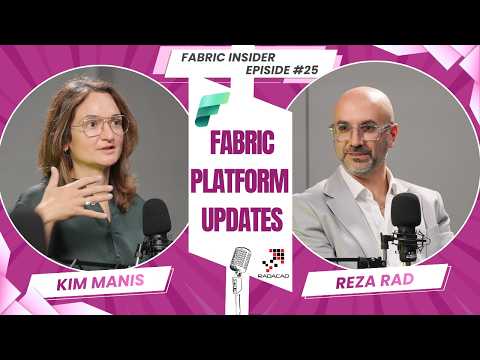
Microsoft Fabric updates and open questions
Founder | CEO @ RADACAD | Coach | Power BI Consultant | Author | Speaker | Regional Director | MVP
Reza Rad’s interview with Kim Manis surveys Fabric’s direction, but its description lists discussion topics rather than product announcements.
Key insights
- Reza Rad interviews Kim Manis, Microsoft’s CVP of Product for Microsoft Fabric and Power BI.
- The discussion includes Copilot in Fabric, Skills and MCP servers.
- Capacity management, governance, workspace monitoring and policies are among the topics.
- The episode asks whether deployment plans replace deployment pipelines but does not give an answer in its description.
Reza Rad of RADACAD recently published a 30-minute Fabric Insider interview with Kim Manis, Microsoft’s CVP of Product for Microsoft Fabric and Power BI. The episode covers questions about platform updates and Fabric’s future, including AI, capacity, governance and deployment. The available description is an agenda, not a transcript of the answers, so it identifies what the interview explores but does not establish which features changed or what Microsoft plans to do.
What's new
The episode’s focus is the range of issues Fabric builders and administrators face as the platform adds workloads and settings. Rad says he brought questions from the community to Manis, covering how Copilot in Fabric compares with Skills and MCP servers, and when a team might use each. The description does not summarize Manis’s response or name a newly released Copilot capability.
Other subjects include capacity management, simplifying the Fabric experience, the most- and least-used workloads, and which parts of Fabric may change most because of AI. The discussion also turns to career concerns for Power BI and Fabric developers. These are framed as questions for the interview, not conclusions or product commitments.
Why it matters
For Fabric administrators, the agenda highlights operational topics: capacity, governance, policies, and workspace monitoring. These areas affect how organizations manage workloads and understand activity across workspaces. However, the supplied material does not specify a new monitoring feature, a policy change, or a capacity-management improvement, so admins should treat the episode description as a guide to the conversation rather than an update they can implement.
For architects and BI leaders, the questions about deployment plans and deployment pipelines point to a practical planning concern: how teams organize and move project changes. The description asks whether deployment plans replace pipelines, but does not say that they do. It also does not explain the mechanics, requirements, or status of deployment plans.
For developers and makers, the Copilot, Skills and MCP discussion may help frame decisions about AI-assisted work. The episode also raises whether AI changes career prospects and what professionals should do. The supplied description offers no specific advice or comparison of these tools, so viewers seeking an answer will need the interview itself.
How it works
This is an interview and question-led discussion rather than a tutorial or release walkthrough. The description groups the conversation around product direction and day-to-day concerns; it does not provide step-by-step instructions, demonstrations, or configuration details. A useful way to approach it is to match the listed questions to your role:
- Developers: listen for the comparison of Copilot in Fabric with Skills and MCP servers, and the discussion of AI and job security.
- Administrators: focus on capacity management, governance, policies, and workspace monitoring.
- Architects and BI leaders: listen for the questions about workload growth, simplifying the experience, and deployment plans.
The description names Workspace Monitoring as a subject, but does not say what it exposes or how to use it. Likewise, it mentions policies without listing policy types or explaining how they are applied. The episode may address those details, but they cannot be verified from the provided material.
Limitations and open questions
The main limitation is that the supplied content gives a topic outline, not the interview transcript or a detailed recap of its answers. It does not identify specific platform updates, rollout stages, licensing requirements, availability, or settings. Claims about what Microsoft has shipped or intends to ship would go beyond what this material supports.
Several questions remain open from the description alone: how Copilot differs from Skills and MCP servers in practice; what capacity-management changes were discussed; which workloads are used most or least; what governance improvements exist; and how deployment plans relate to deployment pipelines. The description also does not state whether any feature is in preview or generally available. Readers should consult the full video for the responses, and verify operational details before making deployment or governance decisions.
Sources
Frequently asked questions
Does the episode announce specific Fabric features?
The supplied description lists discussion topics but does not identify specific feature announcements or changes.
Does a deployment plan replace deployment pipelines?
The episode description poses this as a question but does not provide the answer.
Who is the interview intended for?
The description names Fabric and Power BI developers, Fabric administrators, architects, BI leaders, and people building with Fabric.