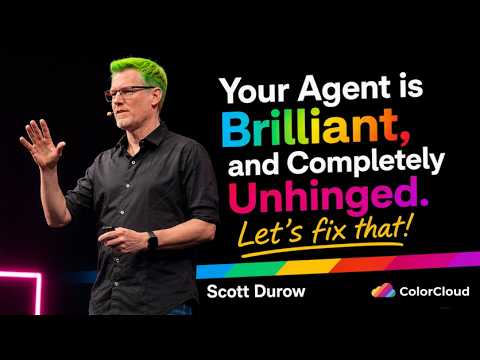
Keynote: Tame Your Rogue AI Agent
Ex-Microsoft MVP @ Microsoft, #PowerPlatform Cloud Developer Advocate 🥑 #ProCodeNoCodeUnite
Taming brilliant but unhinged AI agents with GitHub Copilot and Azure AI governance, skills and human judgment
Key insights
- Your Agent is Brilliant, and Completely Unhinged! — In the ColorCloud 2026 keynote, Scott Durow warned that modern AI agents can reason powerfully but also act unpredictably, so teams must design them to be reliable and safe.
- Azure AI Foundry introduces core tools to tame agents, including rubric evaluators, the Agent Optimizer, Agent 365 for control, Foundry IQ for knowledge grounding, and a Canvas for custom UIs.
- Auto-generated rubrics and self-optimizing agents let teams evaluate behavior automatically, then tune model choice, instructions, tool descriptions, and scaling to improve results over time.
- Governance and security rely on Agent 365, which manages identities, access controls, and observability so organizations can audit, monitor, and safely deploy agents in production.
- Grounding and interaction use Foundry IQ to anchor answers to trusted documents and data, while the Canvas lets agents build dynamic user interfaces for clearer, context-aware conversations.
- Human oversight and production readiness remain essential: keep people in the loop, run continuous evaluations, and treat agents as improving teammates that must be governed and audited before broad deployment.
Overview: A clear look at a provocative keynote
In a recent YouTube keynote summarized by Scott Durow, the presenter frames AI agents as “brilliant, and completely unhinged,” and then argues for practical fixes. The video, delivered at ColorCloud 2026, uses examples from industry and research to show where powerful agents go off track and what engineering choices can keep them useful. Importantly, the talk draws connections to enterprise work happening in Microsoft platforms, so viewers can see both the promise and the pitfalls at scale. As a result, the keynote aims to move the conversation from theory to concrete tools and governance patterns.
What the video explains about agent capabilities
The presenter walks through how modern agents can do deep reasoning, build interfaces, and automate complex tasks, and then highlights the predictable failure modes. For instance, agents may hallucinate facts, misuse tools, or act beyond intended permissions, which makes them risky for sensitive workflows. Consequently, the video presents a set of platform features intended to make agents more reliable, including evaluation, optimization, grounding, and control layers. Throughout, the emphasis stays on enabling useful automation without sacrificing safety or accountability.
Core components and how they interact
Practically speaking, the approach centers on a stack that evaluates agent behavior, tunes agent settings, and ties agents to trusted knowledge sources. The talk names several modular pieces such as Foundry Rubric Evaluators, the Agent Optimizer, a control plane called Agent 365, and a grounding layer named Foundry IQ, which together aim to produce auditable and repeatable agent behaviour. Moreover, the keynote highlights a feature called Canvas that lets agents build dynamic user interfaces, so they can present outcomes more clearly to humans. These pieces work in concert: evaluators feed data to optimizers, the control plane enforces identity and access, and the knowledge layer constrains the agent’s factual base.
- Foundry Rubric Evaluators generate evaluation criteria from an agent’s code and context.
- Agent Optimizer tunes models, instructions, tools, and scale parameters using real-world evaluations.
- Agent 365 operates as a control plane for identity, access control, and observability.
- Foundry IQ grounds agents in verified documents and operational data.
- Canvas enables agents to create custom, contextual UIs for users.
Benefits, tradeoffs, and what organizations gain
On the positive side, the video makes a persuasive case that these tools can transform agents from brittle assistants into dependable teammates, improving reliability and auditability for enterprise use. For example, auto-generated rubrics and self-optimizing loops can reduce manual tuning and catch regression sooner, which saves time and lowers operational risk. However, there are tradeoffs: adding rigorous evaluation and governance increases engineering complexity and can slow iteration, and grounding agents in fixed knowledge stores may limit creativity or flexibility in some tasks. Therefore, organizations must balance the desire for autonomy with the need for observability and control.
Challenges, governance, and the human role
The keynote also stresses the limits of pure automation and the ongoing importance of human judgement. While tools like the Agent Optimizer can tune many parameters, evaluating why a result matters often requires tacit domain knowledge that only experienced people supply. Moreover, governance introduces questions about who sets the rubric, who audits agent actions, and how to manage identity and permissions when agents act at scale. Thus, teams will need to invest in processes and skills as much as in tooling to make agents fit for production.
Practical considerations and next steps
For teams that want to adopt these patterns, the talk recommends starting with small, high-value workflows where mistakes are visible and remediable, so evaluators can gather meaningful data quickly. In addition, the presenter suggests iterating on grounding sources and instruction prompts before exposing agents to broad or sensitive operations, which reduces risk while preserving learning. Finally, the video reiterates that human experience should still decide “why it matters,” meaning that technical improvements must align with business goals and ethical standards. In short, the proposed stack helps, but success depends on thoughtful deployment and continuous oversight.
Conclusion: A pragmatic frame for powerful tools
Overall, Scott Durow’s summary of the keynote offers a pragmatic roadmap for making agents useful and safe in enterprise contexts. By combining automated evaluation, iterative optimization, identity-aware control, and grounded knowledge, teams can extract real value from agents while limiting harmful surprises. Nevertheless, the tradeoffs are real: complexity, governance overhead, and the need for human judgment must factor into adoption plans. Consequently, the most successful projects will pair these technical controls with clear ownership, rigorous testing, and ongoing human oversight.
Keywords
AI agent safety, AI agent alignment, taming AI agents, improving AI agent reliability, autonomous agent control, AI agent best practices, keynote on AI agents, fixing unhinged AI agents