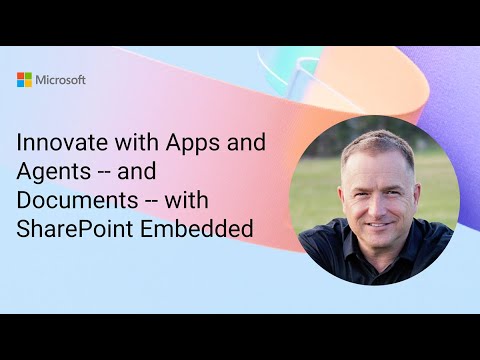
SharePoint Embedded: Apps, Agents & Docs
Software Development Redmond, Washington
Microsoft SharePoint Embedded on Azure powers AI apps with documents, Office coauthoring, Copilot, compliance and search
Key insights
- SharePoint Embedded is an API-first, Azure-delivered service that embeds Microsoft 365 document features into custom apps.
Documents act as the "secret sauce" for AI apps by providing the content AI agents reason over. - Key capabilities include Office co-authoring, Copilot integration, enterprise search, compliance controls, versioning, and dedicated file storage containers for app-managed content.
These features let apps inherit Microsoft 365 security and collaboration by design. - SharePoint Embedded Agents use Retrieval-Augmented Generation (RAG) and the Retrieval API to reason over and summarize documents, power conversational workflows, and surface contextual insights.
Developers can customize prompts, limit search scope, and scale usage under a consumption-based billing model. - Developer tools include a GA Visual Studio Code extension and an SDK that speed up prototyping, testing, and deployment of SPE integrations and custom agents straight from the IDE.
This cuts friction for building document-aware apps and agents. - Governance and administration gained new controls like default filtering by sensitivity labels and PowerShell cmdlets to manage container membership and owners.
These tools help enforce compliance while keeping admin workflows efficient. - When to choose SPE vs SharePoint Online: pick SharePoint Embedded for API-first, app-managed document experiences and tight AI integration; choose SharePoint Online for full end-user sites and classic SharePoint scenarios.
Both support real-time co-authoring and robust versioning for collaboration.
Microsoft 365 published a demo video that highlights how documents can power modern AI applications by using SharePoint Embedded, an API-first SharePoint deployed as an Azure service. The recording comes from a Microsoft 365 & Power Platform community call and features Reid Carlberg demonstrating practical scenarios for developers and administrators. Overall, the presentation stresses that documents are the “secret sauce” for AI apps and shows how to combine storage, search, collaboration, and AI in one integrated stack.
Demo Overview and Key Capabilities
The video opens by positioning SharePoint Embedded as a file and document platform that developers can embed into custom apps and agents, rather than relying on a full SharePoint UI. Reid demonstrates how embedded containers provide file storage, co-authoring, search, and compliance features in a programmatic way, so apps inherit Microsoft 365 capabilities without rebuilding them. Consequently, teams can focus on app experiences while relying on the platform for security and versioning.
Next, the demo highlights the ability to connect AI features such as Copilot and retrieval-based agents directly to document containers, making it easier to reason over and summarize content. The talk shows practical flows where an agent uses the Retrieval API to find document passages, then synthesizes answers or summaries with contextual awareness. As a result, applications can deliver richer, document-aware conversational experiences that stay grounded in stored content.
AI Agents, RAG, and Copilot Integration
Reid introduces SharePoint Embedded Agents that combine Retrieval-Augmented Generation (RAG) techniques with containerized document access to deliver question answering and summarization. He emphasizes that agents can be tuned with custom prompts and search scopes, which improves relevance while limiting unnecessary exposure to unrelated data. Thus, developers gain control over the balance between broad retrieval and focused, secure responses.
However, the demo also addresses the tradeoffs inherent in RAG-style systems, including the risk of hallucinations and the performance cost of large-scale retrieval. Reid points to built-in guardrails and native Copilot integration as mitigation layers, yet he notes that fine-tuning search indexes and tuning prompts remain essential. Therefore, teams must invest in evaluation and monitoring to keep agent output trustworthy and cost-effective.
Developer Tooling and Governance
To accelerate development, Microsoft announced the general availability of a Visual Studio Code extension for SharePoint Embedded that streamlines prototyping and deployment workflows. The demo shows how the extension enables developers to create sample apps, configure containers, and test agent interactions directly from their IDE, which reduces friction for proof-of-concept work. Consequently, organizations can shorten development cycles and iterate faster on document-centric features.
On the governance side, the session covers new controls such as default filtering by sensitivity labels and PowerShell cmdlets to manage container membership and owners. These capabilities help administrators enforce data classification policies and automate operational tasks, but they also introduce complexity in policy design and maintenance. Thus, administrators must balance strict controls for compliance with practical rules that do not hinder productivity.
Choosing SharePoint Embedded vs SharePoint Online
The presenter directly compares SharePoint Embedded with traditional SharePoint Online, advising teams to weigh integration needs against out-of-the-box UI functionality. If an application requires an API-first, programmatic approach with minimal user-facing SharePoint surfaces, embedded containers often win for simplicity and control. Conversely, organizations that need the full user interface and site experiences might prefer SharePoint Online to avoid custom UI work.
Moreover, the video outlines cost and operational tradeoffs: embedded agents use a consumption billing model which offers flexible scaling, while full SharePoint Online may align with existing licensing models and user expectations. Consequently, teams must forecast usage patterns and governance needs to select the right path and avoid unexpected costs or administrative overhead. In short, the decision hinges on whether control and API access or integrated user experiences matter more for the project.
Operational Challenges and Best Practices
Finally, the demo acknowledges practical challenges such as ensuring search relevance, securing sensitive content, and monitoring agent behavior in production. Reid recommends continuous testing of prompt strategies, routine review of sensitivity label policies, and use of telemetry to detect drift or misleading agent outputs. By adopting these practices, teams can reduce the risks of deploying document-aware AI while maximizing utility.
In conclusion, the Microsoft demo provides a clear, developer-focused view of how documents enable AI-driven apps through SharePoint Embedded, while candidly discussing tradeoffs and governance needs. Therefore, organizations evaluating document-centric AI should pilot small, instrumented use cases, measure both cost and accuracy, and iteratively improve controls to strike a balance between innovation and compliance.

Keywords
SharePoint Embedded, SharePoint app development, SharePoint agents AI, embedded SharePoint documents, document automation in SharePoint, SharePoint integrations with apps, Microsoft 365 SharePoint solutions, SharePoint developer best practices