Azure OpenAI: Shape Model Behavior
Principal Cloud Solutions Architect
Microsoft expert guide to model behavior with Azure AI covering context engineering, fine tuning, LoRA, RAG, embeddings
Key insights
- Model architecture and parameters: The video explains that a model’s behavior depends on its parameters, hidden layers, and layer dimensions.
More parameters can increase capacity, but design and data matter more than size alone. - Embeddings and tokenization: Embeddings map tokens to numeric vectors so the model can measure meaning and similarity.
Good embeddings help search, clustering, and retrieval-augmented workflows. - Training phases and methods: Distinguish pretraining from later stages like supervised fine-tuning and reinforcement learning (RLHF).
Each phase changes how the model answers and what it prioritizes. - Prompts, system messages, and shot learning: Prompt wording, the system prompt, and examples (zero/one/few-shot) guide tone and output style.
Clear instructions and representative examples produce more reliable responses. - Context engineering and RAG (retrieval-augmented generation): Injecting external documents via retrieval expands the model’s factual base.
Chunk documents, manage token windows, and verify sources to reduce hallucination. - Fine-tuning and LoRA trade-offs and combos: Full fine-tuning adapts the whole model; LoRA offers lightweight adaptation with fewer resources.
Combine retrieval, prompts, and LoRA or fine-tuning to change behavior while testing safety and performance.
Overview
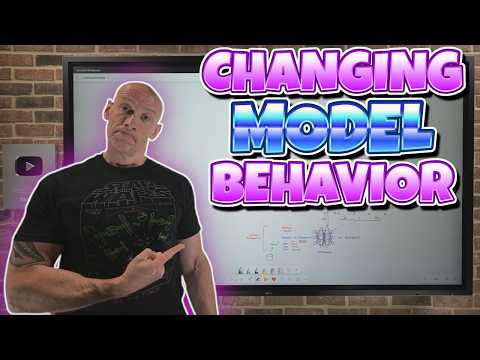
In a clear and practical YouTube presentation, John Savill's MVP walks viewers through techniques to change the behavior of large language models. The video breaks the topic into approachable sections, and it uses a whiteboard to visualize concepts such as parameters, embeddings, and training phases. As a result, the presentation is suitable for practitioners who want a conceptual map before diving into experiments or production work.
Moreover, the author balances basic explanations with hands-on guidance, covering both prompt-level and model-level interventions. The material moves from fundamentals to specific methods like context engineering, fine-tuning, and LoRA, and then discusses how to combine those methods. Therefore, the piece serves as a compact primer for teams planning to tune model outputs for real applications.
Fundamentals: Models, Parameters, and Embeddings
First, Savill explains what a model is in practical terms and why parameters matter for behavior and performance. He outlines how parameters and hidden layers form the neural structure that produces responses, and he explains embeddings as numerical representations that ground text in vector space. In this way, the video gives viewers the vocabulary needed to compare different intervention strategies effectively.
Next, the presentation briefly covers the training phase and how weights change during learning, which helps explain why post-training methods vary in effectiveness. The clear distinction between pre-training, fine-tuning, and inference frames later discussions about cost, data needs, and technical risk. Consequently, viewers can see why not every method suits every use case.
Prompting and Context Engineering
Then the video turns to techniques that operate at inference time, beginning with prompts and context windows. Savill demonstrates how carefully written prompts, examples, and a strong system prompt can steer behavior without touching model weights, which keeps costs low and iteration fast. However, he also notes limits: prompt methods can be brittle, sensitive to phrasing, and sometimes fail with longer or more complex tasks.
Furthermore, the discussion covers zero-, one-, and few-shot approaches and shows when to prefer each based on the task and available examples. By contrast, relying solely on context can increase latency and token costs when large amounts of data must be included, so teams must weigh short-term convenience against operational overhead. Thus, context engineering is powerful but not a universal solution.
Fine-tuning, LoRA and Model Editing
Subsequently, Savill explains model-level edits including standard fine-tuning and parameter-efficient approaches like LoRA. He describes how fine-tuning adjusts many weights to embed new behavior permanently, which improves consistency and performance for specific tasks. On the other hand, full fine-tuning requires labeled data, compute, and validation, so it brings higher upfront cost and governance requirements.
In contrast, LoRA reduces cost by injecting low-rank adapters, making updates faster and easier to manage across multiple behaviors. Still, it can introduce compatibility issues and requires careful testing to avoid degrading baseline capabilities. Therefore, teams must trade off flexibility, cost, and risk when choosing between full fine-tuning and adapter-based methods.
RAG, Retrieval, and Combining Technologies
The video also covers retrieval-augmented generation, or RAG, as a way to provide models with up-to-date or proprietary context without changing the model itself. Savill shows how RAG can reduce hallucinations for factual tasks by grounding responses in retrieved documents, although it adds architectural complexity and storage considerations. Thus, while RAG improves factual accuracy, it demands integration work and ongoing maintenance.
Importantly, the author emphasizes that most real systems combine techniques: prompts to set tone, retrieval to ground facts, and adapters or fine-tuning for persistent behavior changes. He points out that combining approaches often yields the best balance of cost, latency, and control, but it also increases testing surface and operational burden. Hence, teams should plan for experiment, monitoring, and rollback strategies when mixing methods.
Tradeoffs, Challenges, and Practical Recommendations
Finally, Savill highlights the tradeoffs organizations face when changing model behavior, including cost, latency, robustness, and safety. He suggests starting with prompt and retrieval methods for rapid iteration, and then moving to LoRA or fine-tuning as requirements for consistency and scale grow. Along the way, he stresses the need for human-in-the-loop validation and clear logging to detect regressions or unexpected harms.
In closing, the video gives a pragmatic roadmap: understand the model basics, choose the least invasive method that meets requirements, and combine techniques when necessary while managing operational complexity. Ultimately, the presentation equips engineers and product teams to make informed tradeoffs and to plan experiments that balance performance, cost, and risk in production systems.

Keywords
change model behavior, context engineering techniques, fine-tuning models tutorial, prompt engineering best practices, instruction tuning methods, RLHF guide, model alignment strategies, customizing AI models