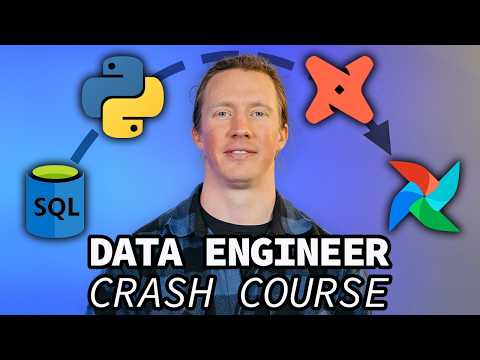
Data Engineer Roadmap: 90-Day Plan
What's up, Data Nerds! I'm Luke, a data analyst, and I make videos about tech and skills for data science.
Free data engineer course: learn ETL/ELT, storage, orchestration, SQL, Python, Excel and Power BI with Azure-ready skills
Key insights
-
Based on a data engineering crash-course video, this summary explains what a Data Engineer does and why the role matters.
Data engineers ingest raw data, build reliable pipelines, and prepare data so analysts and models can use it. -
Choose the right storage for each use case: Data Lake for raw files, Data Warehouse for structured analytics, and Lakehouse when you need both together.
Each option affects cost, query speed, and how you design transformations. -
Understand how data moves: use batch processing for periodic loads and streaming for real-time needs; pick ETL when you transform before loading and ELT when you transform after loading.
This choice drives tool selection, latency, and operational complexity. -
Microsoft-focused tools simplify the pipeline: Microsoft Fabric offers a unified SaaS experience, while services like Synapse Analytics, Data Factory, Dataflows Gen2, and Notebooks handle storage, ingestion, and transformation.
Use these to connect ingestion, processing, and visualization with less infrastructure setup. -
Orchestrate and maintain pipelines with Orchestration tools and modern practices: schedule workflows, monitor jobs, and apply CI/CD with Git-based workflows; tools like Airflow or Fabric pipelines manage dependencies and retries.
Good orchestration improves reliability and reduces manual fixes. -
Build practical skills: learn SQL, Python, PySpark, and KQL, plus version control and terminal basics; follow hands-on labs and small projects to get real experience.
Aim for applied problems, sample datasets, and a certification path to validate your skills.
Video at a glance
Luke Barousse's video, titled "How I Would Learn to be a Data Engineer," walks viewers through a practical roadmap for entering the field. He timestamps each section so learners can jump to topics like the role of a Data Engineer, storage patterns, ingestion methods, transformation practices, and orchestration. The presentation mixes conceptual guidance with tool-focused recommendations and a clear emphasis on hands-on learning.
Barousse also highlights foundational skills such as SQL, Python, and basic software engineering workflows like Git and the command line, while noting industry trends. Furthermore, he outlines the lifecycle of data projects from storage through serving, and closes with advice on how to prioritize study time. Therefore, the video functions as both a syllabus and a strategy session for new and transitioning data professionals.
Core concepts covered
The video defines what a data engineer does and contrasts common approaches such as ETL versus ELT, and batch versus streaming ingestion. Barousse explains why those distinctions matter for downstream analytics, and he frames each choice in terms of latency, cost, and operational complexity. Consequently, viewers receive a balanced introduction to when to prefer one approach over another.
He also explains storage architectures, comparing data lakes, warehouses, and lakehouses and outlining practical tradeoffs. For instance, a raw data lake can be cheap and flexible but requires more governance, whereas a warehouse offers query performance at higher cost. Thus, the video encourages learners to weigh agility against manageability when designing pipelines.
Tools and architecture highlighted
Barousse names a range of tools across ingestion, transformation, orchestration, and serving layers, and he remarks on their common use cases. He discusses modern SaaS and PaaS platforms alongside open-source options, and he notes how platforms like Azure and Microsoft Fabric integrate ingestion, compute, governance, and visualization. As a result, the audience can compare managed services that reduce ops overhead with self-hosted stacks that offer fine-grained control.
The video also touches on orchestration with examples such as Airflow and emphasizes the role of DataOps practices like CI/CD for pipelines. Barousse stresses that picking a scheduler involves tradeoffs between flexibility, monitoring, and team familiarity. Therefore, choosing tools should reflect both technical needs and the organization’s capacity to maintain them over time.
Learning path and practical recommendations
Barousse lays out a stepwise learning path that begins with command-line basics, then moves into querying with SQL and scripting with Python, followed by hands-on work in ingestion and transformation. He advises learners to practice with real datasets and to build end-to-end projects that combine ingestion, modeling, and reporting. This applied approach, he argues, reveals the gaps that theoretical study alone cannot fill.
He also recommends certifications and guided modules to structure study, yet he warns that certificates should complement rather than replace real-world practice. Thus, the video suggests balancing credential goals with portfolio-building work that employers can evaluate. In this way, learners can both validate their knowledge and show tangible results.
Tradeoffs, challenges, and final takeaways
Throughout the video, Barousse highlights tradeoffs like cost versus performance, centralization versus flexibility, and manual control versus managed convenience. He stresses that scaling systems brings new burdens: more data volume raises the need for partitioning, monitoring, and governance, and streaming solutions demand robust observability and retry logic. Consequently, the transition from prototypes to production requires different skills and team processes.
He also points out human and organizational challenges, including knowledge sharing, cross-team communication, and the need for repeatable processes to prevent technical debt. To address these issues, Barousse recommends adopting DataOps practices, investing in documentation, and building simple automation around testing and deployment. In the end, his message is pragmatic: learning data engineering means mastering tools and understanding when tradeoffs matter.
Overall, Luke Barousse’s video delivers a clear, structured roadmap that blends conceptual clarity with actionable steps. For readers seeking a focused introduction to data engineering, the content provides useful checkpoints and realistic expectations about the work. Therefore, new learners can use the guidance to prioritize skills, choose tools, and plan practical projects that demonstrate their competence.

Keywords
data engineer roadmap, how to become a data engineer, learn data engineering online, data engineering skills and tools, data engineering for beginners, data engineer interview questions, data engineering projects portfolio, data engineering tutorials