Power Apps: Quick Guide to Collections
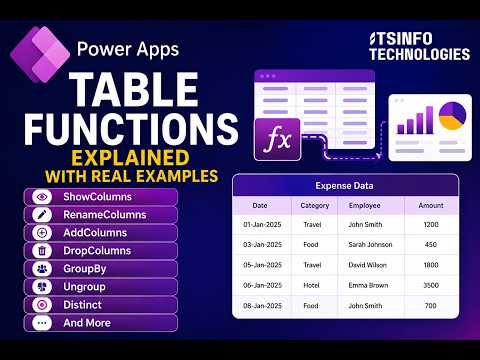
Microsoft expert Power Apps guide ShowColumns RenameColumns AddColumns DropColumns GroupBy for clean data shaping
Key insights
- Power Apps table functions: Power Apps offers ShowColumns, DropColumns, RenameColumns, AddColumns, and GroupBy to reshape in-memory tables (collections).
These functions return a new, modified table and do not change the original collection or the connected data source. - ShowColumns: Use it to pick only the fields you need, for example Product, Region, and Revenue.
This reduces data sent to galleries and dropdowns and keeps control formulas simple. - DropColumns: Remove unwanted or sensitive fields (for example Quantity) while keeping other columns intact.
Use it when most columns should remain and you only need to exclude a few. - RenameColumns: Change a column name for clearer display or to match control expectations (syntax: RenameColumns(Table, "OldName", "NewName")).
The renamed column appears only in the returned table and helps create cleaner labels for users. - AddColumns and GroupBy: Use AddColumns to create computed fields (for example totals or flags).
Use GroupBy to group records into nested tables for summaries and combine it with AddColumns to compute counts or aggregates per group. - Best practices: Prefer ShowColumns when you know the exact output, and use DropColumns to quickly hide a few fields.
Chain these functions to shape data for galleries, forms, and reports, and store results with ClearCollect when you need a reusable transformed table.
Video Overview: What TSInfo Technologies Demonstrates
The recent YouTube tutorial from TSInfo Technologies walks viewers through key table functions in Power Apps, focusing on ShowColumns, DropColumns, RenameColumns, AddColumns, and GroupBy. The presenter uses clear, step-by-step examples to show how these functions reshape in-memory collections and other tables without changing the original data source. Consequently, the video emphasizes practical scenarios such as preparing data for galleries, forms, and charts, while pointing out that these formulas return modified tables rather than permanently altering the underlying collection. Overall, the tutorial aims to help makers understand when to transform data in the app layer and how those choices affect presentation and performance.
Key Functions and Their Roles
The video breaks down the role of each function so viewers can pick the right tool for a given task. For example, ShowColumns selects and returns only specified fields, which is useful when a control needs a small, explicit set of columns. By contrast, DropColumns removes unwanted fields and is handy when most columns are kept but a few must be excluded. Meanwhile, RenameColumns and AddColumns alter the shape and labels of returned tables so apps can present data in a clearer or more meaningful way, and GroupBy aggregates records for summaries and grouped displays.
Practical Examples Highlighted
In the demonstrations, the author creates a sample collection and then shows how each function modifies its returned table for different UI needs. For instance, they use ShowColumns to feed a gallery only the fields that the control requires, reducing clutter and making formulas easier to read. They also illustrate building a public-facing collection by applying DropColumns to remove internal fields before binding the results to a control. These examples make the functions tangible and reveal how small formula changes can simplify screens and improve maintainability.
Comparisons and Tradeoffs
When choosing between ShowColumns and DropColumns, the video explains the tradeoff between explicit inclusion and minimal exclusion. Using ShowColumns forces you to list exactly the fields you want, which increases clarity and reduces accidental exposure of sensitive data, but it can be tedious when many fields are required. Conversely, DropColumns is quicker when only a couple of fields need removal, yet it risks leaving unexpected columns if the collection changes later. Thus, developers must balance clarity, maintenance overhead, and the chance of exposing unintended fields when they pick one approach over the other.
Advanced Reshaping: Renaming, Adding and Grouping
The tutorial also covers how RenameColumns and AddColumns help adapt backend data to user-facing labels and calculated values, which improves UX without touching the data source. However, the author cautions that these transformations increase formula complexity and can obscure where a value originates if overused, so teams should document naming conventions and column provenance. Meanwhile, GroupBy offers a way to build summary views, but grouping often requires additional steps to present nested results in galleries or charts. Therefore, developers should weigh the value of a summarized view against the extra effort required to flatten or expand grouped data for display.
Performance Considerations and Delegation
Throughout the video, the presenter notes performance and delegation limitations that affect how these functions behave with large or remote data sources. Specifically, many table-shaping functions operate on in-memory collections and therefore avoid delegation to server-side queries, which can create bottlenecks when working with big datasets. As a result, the author recommends using local collections for client-side shaping only when the record counts remain reasonable, and pre-filtering or pre-aggregating data at the source when possible. In short, makers must balance responsiveness, data volume, and the cost of moving work between the client and server.
Common Pitfalls and How to Avoid Them
The video flags several pitfalls that can trip up newer makers, including accidentally relying on modified tables as if they updated the original collection, and forgetting to keep column names consistent across screens. To avoid these issues, the presenter suggests naming transformed tables clearly and using consistent naming patterns for renamed fields. Additionally, the tutorial warns against over-complicating formulas with nested transformations, recommending instead that developers break steps into intermediate collections for easier debugging. These practical tips aim to reduce surprises during development and make apps easier to maintain.
Practical Takeaways for Developers
For makers and teams, the core takeaway is to use these functions intentionally: pick ShowColumns when clarity and explicit contracts matter, choose DropColumns for quick exclusion tasks, and apply RenameColumns, AddColumns, and GroupBy to adapt data for reporting and UI needs. Moreover, maintainers should document transformations and test performance with realistic data sizes to find the right balance between client-side flexibility and server-side efficiency. Ultimately, the video from TSInfo Technologies provides a practical foundation that helps developers make informed tradeoffs and build cleaner, more predictable canvas apps.
Conclusion
The tutorial offers a compact, example-led guide to the most commonly used collection functions in Power Apps, while also highlighting tradeoffs and potential hazards. By combining clear demonstrations with tips on performance and maintainability, it helps viewers decide when to reshape data in the app versus handling it at the source. Consequently, the video serves as a useful refresher for experienced makers and a solid starting point for newcomers who want to master table shaping in Power Fx. For editorial purposes, the piece underscores practical steps and considerations that teams can adopt immediately in real projects.
Keywords
Power Apps collection functions, ShowColumns Power Apps example, RenameColumns Power Apps tutorial, GroupBy Power Apps examples, DropColumns Power Apps guide, Power Apps collections tutorial, Power Apps data manipulation, Power Apps collection examples