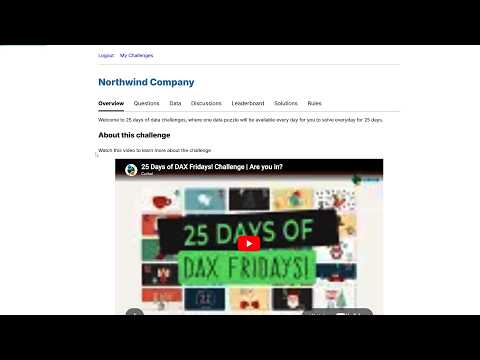
25d Days Challenge Platform: First Look
Microsoft expert preview of a challenge platform seeking feedback with Power BI pbix downloads Excel DAX courses
Key insights
- Microsoft challenge platforms: These are short, structured learning programs that release tasks on a schedule to help people build real skills quickly.
They focus on practice instead of long reads and work well for cloud and Power Platform topics. - 25 Days of Serverless / archived: One well-known example ran daily December tasks and community submissions, but that repository is now read-only.
This means the specific 25-day repo is useful for reference but not for active participation. - Daily tasks and submission workflows: Challenges typically publish a new task each day and ask learners to complete and submit work through the platform’s process.
Older programs used GitHub for submissions; current practice routes learners to the official challenge experience and support channels. - Gamification and hands-on learning: The model uses points, progress tracking, and social sharing to keep learners engaged while emphasizing applied practice.
This approach improves skill retention and motivates regular participation. - Microsoft Learn Challenges and credentials: Microsoft is moving toward a centralized challenge hub that links challenges with learning paths, badges, and certification incentives.
That centralization makes it easier to find active programs and see how challenges fit into broader skill plans. - Recommendation and clarity: The concept works well, but many 25-day examples are archived, which confuses first-time users.
For better impact, keep active repos current, provide clear submission steps and sample files, and highlight credential pathways so learners know the next steps.
Video snapshot: Curbal's first look
In a recent YouTube piece, Curbal offers a hands-on first look at a 25-day challenge platform framed around short, daily tasks for practical skill building. The presenter walks viewers through the concept, highlights downloadable report files, and invites community engagement while explaining how the program ties into broader learning goals. Importantly, the video frames the experience as a practical companion to regular study rather than a standalone certification pathway.
What the platform promises
According to the video, the format centers on daily exercises that are short and focused so learners can make steady progress without a large daily time commitment. Moreover, the host points out that downloadable resources, notably pbix files for hands-on practice with Power BI, are provided to help learners apply concepts immediately. As a result, viewers can reproduce the steps locally and experiment with report-building techniques while following the daily challenges.
Benefits and tradeoffs
The video emphasizes several clear benefits, such as increased engagement through gamification and the social element of sharing progress with peers, which often sustains momentum better than self-study alone. However, Curbal also implicitly highlights tradeoffs: short daily tasks increase breadth but may limit depth, and while many learners gain practical exposure quickly, some may still need longer projects to master complex concepts. Therefore, the challenge format works well for consistent practice but should be paired with deeper study for long-term mastery.
How it fits with Microsoft learning
Curbal situates the challenge model within the wider Microsoft learning ecosystem, noting that Microsoft has used similar formats such as seasonal repositories and centralized challenge hubs to promote hands-on skill growth. Yet, she also notes that some older, seasonal repositories are now archived and read-only, which creates uncertainty about continuity unless learners follow the central challenge portals. Consequently, the best approach for learners is to monitor official challenge listings while using archived materials as supplementary practice.
Community and submission mechanics
The video discusses community-driven mechanics, where participants often submit solutions or show progress publicly to receive feedback and encouragement, which improves motivation and helps surface practical tips. In contrast, archived challenge formats sometimes relied on GitHub workflows or community threads that require more technical familiarity, and this can be a barrier for newcomers. Thus, the tradeoff becomes clear: open submission systems foster transparency and peer review, but they can raise the entry bar unless organizers provide clear, beginner-friendly instructions.
Challenges and implementation concerns
Curbal also raises pragmatic concerns about how challenge platforms are maintained, including keeping content up to date and ensuring compatibility with evolving tools and services. Moreover, verifying that tasks remain relevant when product features change requires ongoing effort from curators and community contributors. As a result, organizers must balance the cost of continuous updates against the value of long-term learner access, and learners should check for current status before investing time.
Practical advice for learners
The presenter recommends combining daily challenge work with periodic, deeper projects so that short exercises build into substantial portfolio pieces over time. Additionally, learners should use the provided pbix practice files as templates rather than fixed answers, experimenting and adapting them to their own datasets and goals. This approach helps move learners from replication to problem-solving, which is essential for real-world analytics work.
What organizers should consider
For those planning or running similar challenges, the video suggests making submission paths simple, documenting expectations clearly, and offering varying difficulty levels to keep a broad audience engaged. Furthermore, tying challenges to credentials or visible badges can increase participation, but organizers must avoid relying solely on incentives without ensuring educational quality. Therefore, the design should balance motivation, accessibility, and measurable learning outcomes.
What to watch next
Curbal signals that the centralized challenge experience remains the most reliable place to find active programs and that archived repositories are useful but limited in scope. Moving forward, viewers are advised to keep an eye on official learning hubs for new challenge announcements while using community content for supplemental practice. Ultimately, combining structured challenges with independent projects and community feedback appears to be the most effective path for sustained skill growth.
Conclusion
Overall, Curbal's video provides a clear, practical introduction to the 25-day challenge concept and highlights both the strengths and limitations of this learning format. While the model boosts engagement and provides ready-made practice materials, it requires careful maintenance and complementary deeper learning to deliver long-term impact. Therefore, learners and organizers alike should treat daily challenges as one valuable tool among several for building applied technical skills.
Keywords
25d days challenge platform,25d challenge review,25d platform first look,25d days user feedback,25d challenge features,25d days tutorial,25d challenge how it works,25d platform pros and cons