Microsoft Fabric: Data Integration & ETL
Founder | CEO @ RADACAD | Coach | Power BI Consultant | Author | Speaker | Regional Director | MVP
Microsoft Fabric guide to data integration and migration from ADF Synapse SSIS to Fabric Data Factory AI ETL future
Key insights
- Microsoft Fabric: A unified analytics platform that combines data ingestion, transformation, orchestration, and BI in one workspace.
It reduces tool sprawl and lets teams land data, transform with Dataflows or Notebooks, and analyze without switching systems. - Migration Path: Fabric supports mounting and conversion for Azure Data Factory and tools like Synapse and SSIS to minimize rework.
Organizations can move pipelines incrementally and keep existing logic while modernizing to Fabric Data Factory. - Data Integration Components: Key pieces are Dataflows (low-code transforms), Pipelines (orchestration), Copy Job and Mirroring (fast ingestion and replication), plus support for Apache Airflow and DBT where needed.
Use each tool for the right scenario: Dataflows for transform, Pipelines or Airflow for complex orchestration, and Copy Job for bulk loads. - SCD Type 2 & MCP Servers: Fabric simplifies common patterns such as SCD Type 2 via Copy Job features.
MCP Servers help run Data Factory, Power Query, and Dataflow workloads reliably and at scale. - AI Impact on ETL: AI and Copilot speed development with code suggestions, error checks, and migration assessments, reducing repetitive ETL work.
ETL roles will shift toward design, governance, and higher-value tasks that use AI as an assistant. - When and How to Migrate: Start migration when you need unified governance, faster delivery, or lower operational overhead.
Adopt an incremental approach: assess current assets, use automated assessments, migrate non-critical pipelines first, then move complex workloads after testing.
Episode Snapshot: Conversation on Microsoft Fabric
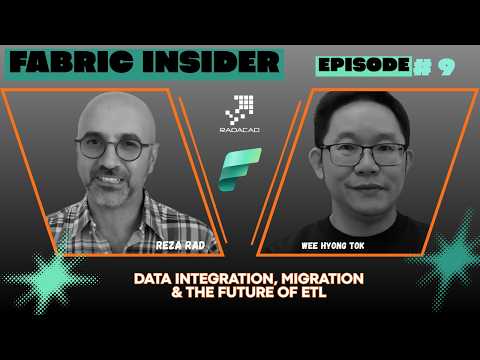
In a recent episode of the Fabric Insider series, host Reza Rad (RADACAD) [MVP] interviews Wee Hyong Tok, a Principal Product Manager at Microsoft, about the evolving landscape of data integration in Microsoft Fabric. The video frames the discussion around whether traditional ETL is ending and what practical migration paths exist from tools such as ADF, Synapse, and SSIS. Moreover, the conversation explores how AI is reshaping developer roles and the capabilities of the platform in 2026. Consequently, the episode serves both as an update and a practical guide for teams planning migrations.
Reza asks focused questions about specific Fabric features including Dataflows, Pipelines, Copy Job, and Mirroring, and the guest responds with product direction and real-world scenarios. The discussion also covers integrations like Apache Airflow and DBT, which many teams already use today. Importantly, Wee Hyong Tok highlights where Fabric aims to simplify ingestion and transformation while supporting hybrid environments. Therefore the episode tries to balance aspirational product goals and pragmatic migration realities.
For readers and practitioners, the episode offers concrete takeaways about timing and strategy for migration. Reza and his guest emphasize iterative migration rather than a single big-bang move in many cases. They also urge teams to evaluate costs, governance, and operational impacts as part of any transition plan. As a result, the guidance is both technical and strategic.
Core Integration Capabilities in Fabric
The video makes clear that Fabric consolidates multiple integration patterns within a unified platform. For example, Dataflows Gen2 and Pipelines support both low-code and code-first workflows, while Copy Job and Mirroring address high-volume ingestion and replication scenarios. Furthermore, Fabric brings native orchestration and storage primitives together to reduce friction between landing, transforming, and serving data. Consequently, teams can often shorten development cycles and reduce tool sprawl.
However, the episode also notes important tradeoffs in choosing which Fabric tool to use for a given workload. For routine, schema-driven ingestion, Copy Job can be highly efficient and reduce custom code, whereas complex transformations may still require Notebooks or external frameworks. Meanwhile, Fabric’s support for orchestrators like Apache Airflow preserves investment in workflow patterns that some teams prefer. Therefore, the platform aims to be flexible while guiding users toward simpler, integrated options where appropriate.
Performance and scalability also receive attention during the interview, especially for analytic workloads. The guest explains how Fabric’s native compute and storage layers optimize common patterns like SCD and incremental loads. At the same time, teams must still evaluate cost and runtime behavior to avoid surprise bills or resource contention. Thus, operational design remains a key consideration despite the platform’s managed benefits.
Migration Paths: Lift-and-Shift vs. Re-architect
Reza and Wee Hyong discuss migration paths from ADF, Synapse, and SSIS, and they emphasize that different approaches suit different organizational needs. A straightforward “mount” of existing artifacts into Fabric can preserve current investments and speed initial onboarding. In contrast, re-architecting pipelines to use Fabric-native primitives can deliver long-term simplicity and lower maintenance costs. Therefore, teams must weigh upfront migration speed against future operational benefits.
The interview outlines practical tradeoffs between lift-and-shift and full rewrite strategies. Lift-and-shift reduces immediate risk and keeps systems running, while rework enables cost optimizations and tighter integration with Fabric features such as Dataflows and Copilot. In addition, the guest recommends incremental validation and automated assessment to catch compatibility issues early. Consequently, a phased approach often offers the best balance of risk and reward.
SSIS migration also receives concrete guidance in the video, where ease varies by package complexity. Simple packages often migrate with minimal changes, while packages with heavy custom code or third-party components require more effort. Moreover, data governance, network topology, and identity integration can complicate migrations in hybrid environments. Thus, preparation and testing are crucial to a smooth transition.
Timing is another factor highlighted as critical when planning migration. Reza and the guest advise aligning migration windows with business cycles and avoiding peak periods. They also recommend testing performance and cost models before moving production workloads. As a result, organizations can reduce downtime and operational surprises.
AI’s Role and the Future of ETL Development
One of the most compelling themes in the episode is AI’s impact on data integration work. Fabric’s integration with AI Copilot and intelligent code generation can accelerate routine development tasks, flag errors, and suggest optimizations. Consequently, developers can focus more on data modeling and value-added tasks rather than repetitive glue code. Yet, the guest warns that AI is an augmentation tool rather than a full replacement for experienced engineers.
Furthermore, the conversation explores whether ETL as a discrete role will disappear. While some manual ETL tasks may vanish due to automation and features like Copy Job and simplified SCD handling, advanced integration work will still demand human judgment. Tasks such as complex orchestration, performance tuning, and governance policy design will remain important. Therefore, teams and professionals should plan to upskill toward architecture and data product ownership roles.
Finally, the episode notes that AI introduces both opportunity and governance challenges. Automated code and suggestions must be audited for compliance and data privacy, and organizations need guardrails to prevent costly mistakes. In addition, AI-driven changes can complicate observability if teams do not maintain clear testing and monitoring practices. Thus, blending AI speed with disciplined operations becomes a priority.
Operational Challenges and Next Steps
Throughout the interview, operational concerns surface repeatedly, from cost control to monitoring and security. Fabric offers managed services that reduce some operational burden, yet teams still need robust observability and governance frameworks. Migration assessments, pilot projects, and staged rollouts can help uncover hidden challenges early in the process. Consequently, governance and SRE-style practices remain essential.
Looking ahead, Reza and Wee Hyong flag upcoming features and continued integration with third-party tools like DBT and orchestration frameworks. They also stress community feedback and iterative improvements as Fabric matures. For practitioners, that means staying informed and testing new features in non-production environments. Ultimately, the episode provides a pragmatic roadmap for teams balancing innovation, risk, and cost.
In summary, the YouTube episode hosted by Reza Rad (RADACAD) [MVP] delivers a balanced view of Microsoft Fabric’s data integration story in 2026. It combines product detail, migration guidance, and career-focused insight about AI’s influence, helping both technical and strategic readers plan next steps. For teams evaluating a move to Fabric, the advice favors incremental migration, careful testing, and an emphasis on governance. Therefore, the episode is a useful resource for anyone shaping a modern data integration strategy.

Keywords
Microsoft Fabric data integration, Microsoft Fabric ETL migration, Data migration best practices, Future of ETL, Fabric Insider Episode 9, Wee Hyong Tok Microsoft Fabric, Modern data pipelines, Lakehouse integration Microsoft Fabric