Fabric: Apps & Rayfin Deep Dive
Founder | CEO @ RADACAD | Coach | Power BI Consultant | Author | Speaker | Regional Director | MVP
Microsoft Fabric deep dive: Fabric Apps and Rayfin, TypeScript frontends, Power BI integration, deployment and pricing
Key insights
- Fabric Apps: A new Microsoft Fabric workload that lets developers build native data applications inside a Fabric tenant.
It delivers a managed backend-as-a-service so apps inherit existing security, governance, and semantic models. - Rayfin SDK & CLI: An open-source toolset that scaffolds projects and auto-provisions the backend (SQL database, GraphQL API, Entra ID authentication, and static hosting).
Deployment can run from a single CLI command to speed delivery and reduce infrastructure work. - TypeScript-first modeling: Developers define data models and app logic in TypeScript; Rayfin converts those definitions into SQL schemas and GraphQL endpoints.
This code-first approach gives richer developer tooling and app logic than building visual reports alone. - Security & governance: Fabric Apps connect to published semantic models and run under the same permissions and DAX-based access controls as Power BI content.
Entra ID authentication and tenant-native hosting simplify compliance for enterprise use. - Agentic development & productivity: Rayfin targets automated workflows where AI coding agents or copilots can scaffold, deploy, and troubleshoot apps via the CLI.
Teams can move from prototype to production far faster than with hand-rolled infrastructure. - Use cases, templates & roadmap: Supports internal and external-facing apps, custom visual libraries (Vega, D3), and reusable templates you can customize.
The feature set is expanding after its preview announcement at Build 2026; a firm GA date was not confirmed in the episode.
Episode overview
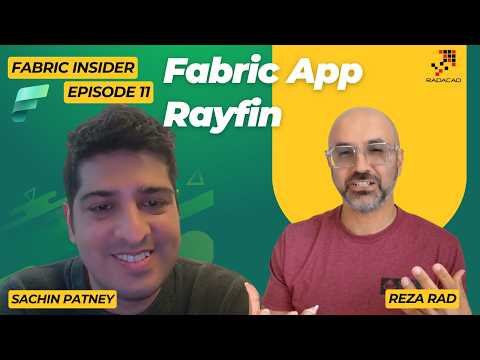
In a recent episode of the Fabric Insider series, Reza Rad (RADACAD) [MVP] interviewed Sachin Patney, Microsoft’s product manager for Fabric Apps and Rayfin. The discussion combined high-level context with a live demo, aiming to clarify what a Fabric App is and how Rayfin reshapes app development inside Microsoft Fabric. Consequently, viewers received both conceptual framing and concrete steps for building and deploying data-driven web applications.
Moreover, the episode focused on practical questions many teams face, such as why the frontend relies on TypeScript instead of Power BI reports and how authentication and governance work. The live demonstration showed scaffolding, local iteration, and a one-command deployment, illustrating the end-to-end flow. Overall, the interview framed Rayfin as a bridge from data platform to application runtime.
What are Fabric Apps and Rayfin?
Fabric Apps is introduced as a new workload that allows developers to build native data applications directly inside a Fabric tenant, while Rayfin is the open-source SDK and CLI that automates backend creation. Instead of manually provisioning servers, developers define data models in TypeScript, and Rayfin generates APIs, database schema, and hosting artifacts. Therefore, the approach aims to simplify the developer experience by turning a multi-step infrastructure process into a unified workflow.
In addition, Rayfin integrates with Fabric’s existing assets, so applications can query published semantic models using DAX and respect the same permissions as Power BI artifacts. Authentication is handled through Entra ID, and the runtime provisions a SQL database plus a GraphQL API as part of deployment. As a result, apps benefit from built-in governance and security while running natively inside the tenant.
How development and deployment work
The episode emphasized a code-first pattern where teams scaffold projects using the Rayfin CLI and iterate locally before deployment. In practice, developers create a project from a template, model their data in TypeScript, and then run a simple deploy command—commonly referenced as npx rayfin up—to provision backend services. This one-command approach streamlines deployments and reduces the overhead of configuring cloud services manually.
Furthermore, Rayfin auto-generates a GraphQL endpoint, maps type definitions to a SQL schema, and configures static hosting for the frontend, enabling rapid delivery of full-stack apps. The demo highlighted how visualization libraries such as Vega or D3.js can be used alongside semantic models when Power BI visuals do not fit the need. Thus, teams gain flexibility to choose richer or more interactive frontends while still leveraging Fabric semantics for data and access control.
Governance, deployment scope, and pricing
The interview made clear that apps deployed via Rayfin inherit tenant-level governance, which helps organizations enforce permissions and data lineage consistently. Consequently, organizations can expect apps to follow the same security posture as semantic models and Power BI content, which simplifies compliance efforts. At the same time, Sachin discussed pricing considerations and whether Fabric Apps will support external-facing deployments and custom domains, noting that these areas are part of the product conversation and roadmap.
While some specifics about commercial pricing and GA timing remain subject to change, the overall positioning is that Fabric-hosted apps will align with enterprise governance and tenant billing models. This approach balances operational simplicity against the need for predictable cost visibility and centralized control. Therefore, organizations should evaluate both expected usage and governance requirements before committing to production workloads.
Tradeoffs and practical challenges
The video also explored important tradeoffs between speed and control: Rayfin’s managed backend accelerates delivery, but it abstracts away infrastructure details that some teams may want to control. Thus, teams trade deep customization for faster time to market, and they must decide whether the convenience of automatic provisioning outweighs the need for bespoke infrastructure. Additionally, relying on TypeScript and code-first patterns requires developer skills that differ from report-driven Power BI workflows, creating a learning curve for analytics teams.
Moreover, the agentic design—built to let AI coding agents scaffold and deploy apps—raises testability and debugging questions, particularly for error handling and security operations. While automation can reduce routine tasks, teams must put guardrails in place to detect misconfigurations and ensure observability. Finally, considerations such as vendor lock-in, migration paths, and scaling behavior under high traffic remain practical concerns that organizations should weigh as they experiment with the new model.
Roadmap, wider impact, and next steps
Sachin and Reza discussed future capabilities and the path to General Availability, signaling active development and feedback-driven improvements. As Rayfin and Fabric Apps evolve, Microsoft appears focused on supporting templates, custom templates, and broader hosting scenarios to meet enterprise needs. Therefore, teams should monitor the roadmap and pilot early to understand real-world constraints and benefits.
In conclusion, the episode provides a useful primer for technical and product leaders evaluating a move from analytics-only solutions to data-native applications within Fabric. By combining a managed backend, tenant governance, and TypeScript-led workflows, Microsoft aims to reduce friction for app delivery while introducing new choices and responsibilities for development teams. Consequently, organizations considering Fabric Apps should balance speed, control, and skills readiness as they plan pilots and production rollouts.

Keywords
Microsoft Fabric Apps, Fabric Apps deep dive, Rayfin Microsoft Fabric, Sachin Patney interview, Fabric Insider episode 11, Microsoft Fabric tutorial, Fabric Apps best practices, Rayfin data integration