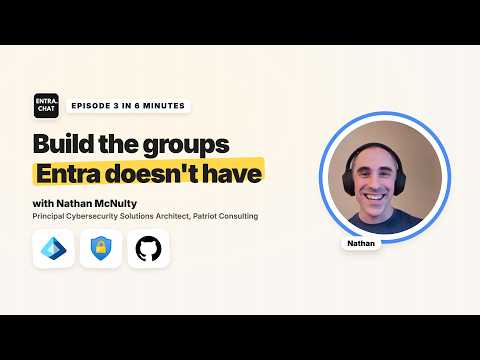
Microsoft Entra operational groups for access control
Product Manager @ Microsoft 👉 Sign up to Entra.News my weekly newsletter on all things Microsoft Entra | Creator of cmd.ms & idPowerToys.com
Merill Fernando features Nathan's operational groups approach for classifying users by authentication methods and automating Entra controls.
Key insights
- Operational groups classify users by authentication methods.
- The approach aims to add granular security control without manual work.
- The video also mentions authentication methods migration strategies.
- Extension attributes are part of the discussion.
- The workflow uses automation groups and runbooks instead of server-based scripts.
Merill Fernando recently published a video featuring Nathan's approach to operational groups in Microsoft Entra. The main takeaway is straightforward: use automation to classify users by authentication methods so you can apply more granular security controls without doing the work by hand. The video also points to supporting Microsoft documentation and a GitHub script repository, which suggests this is meant as a practical operational pattern rather than a purely theoretical idea.
The description frames the work as part of a broader shift toward cloud automation. It mentions authentication methods migration strategies, extension attributes, and runbooks, and it says this model replaces traditional server-based scripts. For readers managing identity in Microsoft Entra, that makes the topic relevant even if they are not looking for a new product feature. It is about how to structure identity operations more cleanly.
What's new
The central idea in the video is the use of operational groups as a classification and control layer. Rather than treating groups only as a static list of users, the approach uses them to reflect how users authenticate and how they should be managed. That gives the group a specific operational role instead of a general membership role.
The source material says Nathan's technique helps classify users by authentication methods. That matters because authentication method is a useful signal for identity operations: it can help separate populations during migration, security enforcement, or rollout work. The video description also mentions extension attributes, which implies that user metadata may be part of the way the classification is maintained.
The supporting links point to Microsoft Entra authentication methods management, administrative units, and restricted management administrative units. Those references show the context the video is working in: identity governance and administrative scoping, not just ad hoc scripting. The GitHub link to operational groups scripts suggests there is code behind the pattern, but the description does not spell out the full implementation.
Why it matters
For admins, this is about making Microsoft Entra administration more structured. If you need to manage users by authentication method or apply different controls to different populations, operational groups can reduce repetitive work. That can be useful when a tenant has mixed authentication states or when identity changes need to be handled in a controlled way.
For security teams, the appeal is granular control. The source material specifically says the technique helps classify users by authentication methods, which can support tighter policy decisions than broad manual grouping. In practice, that could help teams separate users who need migration support from users who already meet a target authentication state.
For platform teams and automation-focused makers, the video is also a reminder that modern cloud automation can replace older server-based scripts. That matters because identity operations often need repeatability and consistency. A runbook-based approach is easier to maintain than manual user-by-user changes, especially when the same logic has to run again and again.
How it works
The source material does not give a full step-by-step walkthrough, but it does show the main building blocks used in the approach. The video description highlights automation groups and runbooks, which indicates an automated process runs to keep the groups up to date.
Based on the published description, the flow appears to work like this:
- Use Microsoft Entra user data as the source of truth.
- Classify users by authentication methods.
- Use extension attributes as part of the data model.
- Populate or update operational groups through automation groups and runbooks.
- Use the resulting groups to apply granular security controls.
The description also links to Microsoft documentation on authentication methods management, administrative units, and restricted management administrative units. That suggests the approach sits alongside Entra features used to scope administration and manage identity state. However, the description itself does not explain whether the groups are used directly for authorization, for administrative boundaries, or for both.
The GitHub repository linked in the material is another clue that the pattern is script-driven. The description says the scripts are used for operational groups, but it does not list their exact tasks. So readers can infer the pattern is operational and automated, while still needing the repository or the linked documentation for implementation details.
Limitations and open questions
The source material is brief, so several details remain unclear. It does not spell out the exact automation logic, the naming rules for operational groups, or the conditions used to classify each user. It also does not say whether the process runs on a schedule, on change, or through another trigger.
We also cannot verify from the material alone whether this is an official Microsoft feature or a community pattern shown by Nathan. The wording in the description presents it as Nathan's technique, and the linked documentation supports the surrounding Entra concepts, but the video text does not claim a product announcement.
Licensing, tenant prerequisites, and production readiness are also not covered. The description mentions Microsoft documentation, but it does not state whether all of the referenced capabilities are available in every tenant or whether any parts are preview-only. For readers deciding whether to adopt the pattern, those missing details are important and need confirmation from the linked docs or the repository.
Sources
- Merill Fernando YouTube video
- Operational groups scripts on GitHub
- Microsoft Entra authentication methods management
- Microsoft Entra administrative units
- Restricted management administrative units
Frequently asked questions
What are operational groups in this video?
They are groups used to classify users by authentication methods so security controls can be applied more precisely. The description frames them as an automation-driven operational model rather than a manual list.
Does the video explain how to build them?
Not in detail. The material mentions automation groups, runbooks, and extension attributes, but it does not provide the full implementation steps.
Is this an official Microsoft Entra feature?
The source material does not say that. It presents Nathan's technique and links to supporting documentation, but it does not confirm an official feature announcement.
What replaces older scripting approaches?
The description says modern cloud automation replaces traditional server-based scripts. It does not specify the exact platform or orchestration pattern beyond automation groups and runbooks.