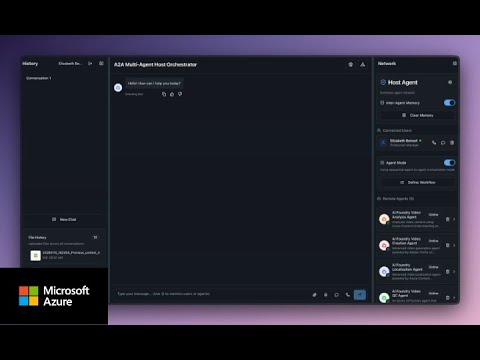
Copilot: Campaigns to Localized Videos
AI agents power campaign workflows from video analysis and editing to localization with Azure Video Indexer and Purview
Key insights
- Agentic Workflows: A YouTube video overview explains chains of AI agents that turn a high-level business intent into finished work, with planner agents setting goals, worker agents doing tasks, and orchestrators coordinating handoffs.
- Platforms: Microsoft tools like Copilot Studio and Foundry provide visual builders, multi-agent pipelines, and integrations with business systems to run and monitor these workflows.
- Campaign-to-Video Pipeline: Agents can analyze market data, draft scripts, create clips, run quality checks, and produce localized video versions with subtitles or dubbing for global audiences.
- Advantages: Firms get faster launches, fewer manual handoffs, consistent outputs, and better scalability while keeping costs predictable through managed tooling.
- Governance & Observability: The workflow includes audit logs, admin controls, and agent-to-agent authentication to track actions, enforce policies, and measure performance and cost.
- Practical Considerations: Teams should use templates, memory stores, and human review points to ensure quality, handle edge cases, and align outputs to brand and legal rules.
Overview of the Video
The YouTube video from Microsoft Azure showcases an emerging approach called the End-to-End Agentic Workflow, which connects high-level human intent to fully automated campaign and localized video production. In clear steps, the video walks viewers through how multiple AI agents collaborate to analyze footage, create clips, perform quality control, edit content, and add localization features such as subtitles and dubbing. Moreover, it emphasizes governance and auditability so teams can monitor agent actions and maintain compliance while scaling operations. Overall, the presentation frames agentic systems as a way to move from manual handoffs to coordinated machine-driven pipelines.
How the Multi-Agent Pipeline Operates
According to the video, the system relies on distinct agent roles: planners set goals, worker agents execute tasks, and orchestrators coordinate sequences across tools and data sources. These agents communicate through structured protocols, with agent-to-agent integrations enabling direct handoffs and authenticated calls, which helps preserve context across steps. The demonstrative pipeline combines components like long-term memory, content tools, and streaming updates so that agents can retrieve past decisions and produce consistent outputs. In practice, the result is a visual, traceable flow from campaign brief to finished, localized video assets.
The video highlights platforms such as Copilot Studio and Foundry as the environments where teams build and debug these workflows, while underlying services in Azure provide compute, storage, and integrations. Developers can open YAML templates or use visual builders to inspect step-by-step execution and to stream logs in real time for immediate troubleshooting. Furthermore, the system supports integrations with business data sources so agents can tailor content to market signals or audience segments. This connectivity helps maintain relevance and speed when producing many localized versions of the same campaign.
Advantages Demonstrated
The video frames several clear benefits for media and marketing teams, starting with faster time-to-value as nontechnical users can trigger complex workflows without deep engineering work. It also shows reduced errors by standardizing evaluation criteria and minimizing repeated manual handoffs, which often introduce inconsistencies in quality or messaging. Additionally, the architecture supports scaling: administrators gain visibility into usage, costs, and performance, which enables more confident rollouts across departments or regions. As a result, the technology aims to shift human teams toward oversight and strategy rather than repetitive execution.
Cost efficiency is another theme, since the demonstrator emphasizes managed memory and optimized agent-to-agent calls that reduce redundant processing. The video suggests that paying primarily for model calls and shared services can lower overhead compared with bespoke pipelines built for each campaign. Finally, localization becomes more tractable: the agents handle subtitles, translation checks, and voice alignment so content teams can reach global audiences faster. Together, these advantages present a compelling case for enterprises that need both speed and scale.
Tradeoffs and Technical Challenges
Despite the appeal, the video acknowledges tradeoffs around control, accuracy, and governance that organizations must manage carefully. For example, increasing autonomy speeds execution but raises risks in creative fidelity, tone, and cultural nuance during localization, so human review remains essential for sensitive markets. Moreover, the complexity of multi-agent systems can cause debugging challenges when unexpected behaviors emerge, requiring clear observability and testing practices. Therefore, teams must balance automation with checkpoints that allow experts to intervene when needed.
Security and privacy also pose important constraints, especially when agents access proprietary content or personal data to tailor campaigns. The presenters stress the need for authenticated agent interactions and role-based controls to limit exposure, but implementing robust governance requires effort and cross-functional coordination. Performance and cost management present another set of tradeoffs: while shared services reduce duplication, large-scale localization still incurs compute and review costs that organizations must budget for. In short, scaling agentic workflows demands attention to process, policy, and infrastructure.
Implications for Media Teams and Next Steps
For editorial and production teams, the video outlines a path to reclaim time for strategy by automating repetitive production tasks, yet it also calls for new skills in workflow design and oversight. Teams should invest in clear evaluation criteria, sample audits, and pilot projects to understand how agents handle creative decisions and where human judgment remains crucial. The presentation encourages phased adoption, starting with narrow, measurable use cases and expanding as governance and confidence grow.
Ultimately, the YouTube demonstration positions agentic workflows as a maturing set of tools that can accelerate campaign delivery and broaden global reach, provided organizations plan for the tradeoffs in control, cost, and compliance. As a next step, media leaders should assess which parts of their pipeline most benefit from automation and build governance around those areas first. By doing so, they can harness the speed and scale shown in the video while keeping creative quality and audience trust front and center.

Keywords
agentic workflow, campaign creation workflow, end-to-end marketing automation, localized video production, AI-driven campaign management, multilingual video localization, creative automation platform, cross-channel campaign optimization