Azure IoT Edge: Bring AI to Devices
Embed intelligence into physical systems with Microsoft Azure adaptive cloud, small Linux edge, Foundry Local, Azure IoT
Key insights
- What Physical AI means: Microsoft connects AI models, sensor data, simulation, digital twins, and cloud/edge infrastructure so machines can perceive, reason, and act in the real world.
This moves software from generating answers to operating inside physical systems. - Core architecture: Sensors and OT systems collect data, edge layers handle low-latency processing, Fabric unifies analytics, digital twins and simulation model environments, and AI agents enable closed-loop control back to machines.
Each layer supports reliable, timed actions in industrial settings. - Platform components: Azure provides cloud scale for deployment, Microsoft Foundry hosts Physical AI operations, Microsoft Fabric manages unified data and analytics, and Azure IoT services enable device connectivity and edge operations.
Foundry Local supports disconnected or sovereign environments. - Partner and tooling integration: Microsoft is integrating with NVIDIA Omniverse for physics-based digital twins and released an Azure Physical AI toolchain repository to standardize pipelines for data, simulation, and model training.
This links live operational data to physically accurate simulations. - Enterprise pipelines: New emphasis on repeatable pipelines to build, train, simulate, and operate models across assets and twins at enterprise scale.
These pipelines add governance, security, and scalability for regulated industries. - Practical benefits: Real-time operational awareness, faster decision-making, safer testing via simulation, scalable deployment across cloud and edge, and flexibility for industrial or offline sites.
These advantages target manufacturing, logistics, energy, and robotics use cases.
Video overview
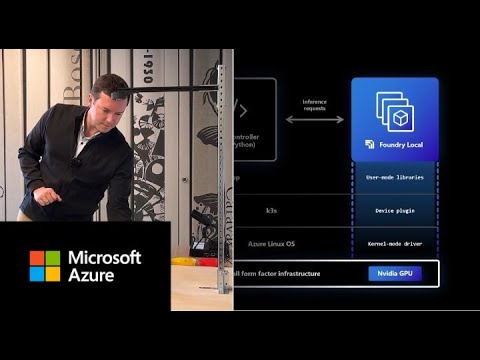
The YouTube video published by Microsoft Azure outlines how the company plans to embed intelligence into physical systems. It shows how an adaptive cloud approach combines small form factor Linux infrastructure, Foundry Local, and Azure IoT Operations to bring AI closer to machines and industrial assets. Moreover, the video highlights partnerships with vendors such as NVIDIA Omniverse to tie simulation and digital models to live operations. As a result, Microsoft frames this work as a shift from software that only informs to software that can perceive, reason, and act in the real world.
The presentation emphasizes practical scenarios, including manufacturing, logistics, energy, and robotics, where integrating sensors, simulation, and AI can improve outcomes. It also introduces a public toolchain and blueprint for building repeatable pipelines that span cloud training and edge deployment. Importantly, the video positions Microsoft Foundry and Microsoft Fabric as core elements for scaling these systems while keeping governance and security in focus. Therefore, the message is that enterprises can move from dashboards to coordinated actions across assets.
Defining Physical AI
Physical AI, as described in the video, means connecting AI models with sensor streams, simulation, and control systems so machines can act in physical environments. In this view, systems combine perception, reasoning, and control to respond autonomously or assist human operators, and the approach echoes prior research in cyber-physical systems and embodied AI. Consequently, the emphasis is not only on analytics but on closed-loop operations that send reliable commands back to equipment. This shift raises the bar on timing, safety, and integration.
Furthermore, the video explains that digital twins and physics-aware simulation play a central role in validating decisions before they affect real assets. By using accurate virtual replicas, teams can test updates, tune models, and reduce risk prior to deployment in live facilities. At the same time, the presenters stress the need for clear interfaces between operational technology and cloud-native services. Thus, the concept balances modeling fidelity with practical deployment mechanics.
Azure’s technical approach
The video outlines a layered architecture that starts with sensors and OT systems capturing telemetry, continues with edge compute for low-latency processing, and leverages cloud services for analytics and model training. Specifically, Azure IoT Hub and Azure IoT Operations provide device connectivity and lifecycle management, while Microsoft Fabric unifies analytics and streaming intelligence. Additionally, Foundry Local and small form factor Linux appliances enable operation in disconnected or sovereign environments. Together, these layers aim to keep critical functions local when speed or compliance matters.
The video also previews a public repository and an integration blueprint that link cloud services with NVIDIA libraries and simulation tools. According to the presentation, this toolchain supports building, training, and simulating models before rolling them into production pipelines. Consequently, enterprises can iterate faster and maintain reproducible workflows across cloud and edge. However, the approach demands careful orchestration among software, hardware, and partner components.
Benefits and tradeoffs
According to the video, the primary benefits include improved real-time operational awareness, faster decision-making, and more reliable simulation-driven testing. For example, connecting live telemetry to physically accurate twins makes it easier to predict failures and optimize processes before making real changes. Moreover, the stack supports enterprise governance and scale, which is critical for regulated industries. Nonetheless, organizations must weigh these benefits against added complexity and cost.
Specifically, deploying Physical AI brings tradeoffs in latency, reliability, and vendor dependency. While edge compute reduces response time, it increases the number of managed devices and firmware updates. Likewise, relying on partner ecosystems such as NVIDIA Omniverse can accelerate development but may create tighter coupling to specific toolchains. Therefore, teams must balance performance and flexibility while planning for maintenance, security, and lifecycle operations.
Challenges and operational realities
The video acknowledges several practical challenges, including data quality, governance, and validation of models that interact with real hardware. For instance, ensuring that a model’s simulation matches physical behavior requires continuous calibration and careful testing to avoid unsafe actions. In addition, latency and network reliability can force tradeoffs between local autonomy and centralized control. Consequently, system architects must design for fail-safe behaviors and clear handoff rules between humans and machines.
Moreover, integrating OT and IT teams remains a cultural and technical hurdle. The video suggests that Foundry and Azure tools can reduce integration work, but organizations still face change management, upskilling, and compliance reviews. Finally, cost management and monitoring become more complex when models, simulations, and edge devices all consume resources. Thus, while the approach promises measurable gains, it also requires disciplined operational practices and cross-functional coordination.
Outlook for adopters
In summary, the Microsoft Azure video presents a coherent vision for embedding AI into physical systems by combining sensors, simulation, edge compute, and cloud services. It offers a clear path for enterprises that need faster decisions and safer rollouts, while also showcasing reusable toolchains and partner integrations. Yet, the narrative is candid about the realistic tradeoffs: greater capability comes with higher integration effort, governance demands, and operational complexity. Therefore, organizations should pilot carefully, validate models extensively, and plan for long-term support.
For editorial readers, the video positions Physical AI as an evolutionary step in industrial software rather than a flip-the-switch solution. Accordingly, companies that pair a measured adoption strategy with strong cross-team processes may capture competitive advantages faster. At the same time, those that underestimate the integration and governance work risk costly rework. Ultimately, the technology looks promising, but success will depend on disciplined engineering and clear operational ownership.

Keywords
embedded intelligence for physical systems, edge AI for physical systems, intelligent cyber-physical systems, industrial IoT intelligence, AI-enabled robotics and automation, intelligent control systems for devices, autonomous system integration, real-time machine learning for embedded devices