Sentinel vs Splunk & QRadar: Switch Now
Microsoft MVP | Author | Speaker | YouTuber
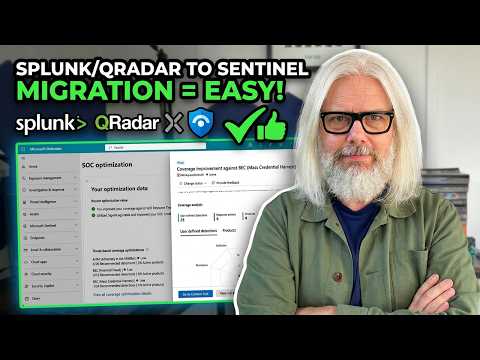
Microsoft expert demo: migrate Splunk and QRadar to Microsoft Sentinel via Unified SecOps SOC Optimization
Key insights
- Unified SecOps migration tool: Microsoft added a new migration tool under SOC Optimization at security.microsoft.com that simplifies moving from Splunk and QRadar to Microsoft Sentinel.
It was shown in the video using QRadar as the example and helps plan and automate migration steps. - Intent-based mapping and analytics rules: The tool analyzes existing detections and custom rules, then recommends equivalent Sentinel analytics rules and data connectors from the Content Hub.
This mapping focuses on intent, not just syntax, to preserve detection coverage. - Migration acceleration and support: The experience speeds up migrations and reduces manual effort, with Microsoft offering eligibility-based support programs to assist complex moves.
Teams can expect fewer manual conversions and faster time to value. - Cost efficiency and free ingestion for Microsoft data: Sentinel ingests native Microsoft signals (Azure AD, Microsoft 365, Defender) at no ingestion charge, helping reduce licensing costs for Microsoft-centric environments.
Non‑Microsoft data still incurs charges but overall cost often drops versus legacy SIEMs. - AI-driven operations: Sentinel integrates Copilot for Security and other AI features for natural-language queries, automated incident summaries, and improved threat hunting.
These AI capabilities help analysts investigate faster and reduce routine work. - Kusto Query Language (KQL), ASIM, and automation tools: Sentinel stores logs in an Azure data lake, uses KQL for queries, supports the ASIM data model for normalization, and automates responses with Logic Apps playbooks and UEBA.
These components deliver scalable searching, consistent telemetry, and automated incident response.
Introduction
In a recent video, Peter Rising [MVP] demonstrated a new migration feature inside the Unified SecOps area of the Microsoft security portal. He showed how the tool, found under SOC Optimization, can simplify moving alerting and analytics from legacy SIEMs into Microsoft Sentinel. Furthermore, the demo used QRadar as a concrete example to illustrate the workflow. Consequently, the video frames the new capability as a practical step for organizations considering a migration.
What the Video Demonstrates
During the walkthrough, Rising highlights an AI-assisted migration experience that analyzes existing detections and recommends equivalent analytics for Microsoft Sentinel. He takes viewers through connector selection, rule mapping, and validation steps, and emphasizes the automation that speeds up routine tasks. Moreover, the demonstration shows how the tool surfaces mapping suggestions for custom rules instead of only offering simple syntax conversions. As a result, viewers get a sense of how much manual effort the tool could remove during an initial migration phase.
Benefits Emphasized
The video presents several clear advantages, beginning with potential cost reductions when moving log ingestion for Microsoft-native telemetry into Microsoft Sentinel. Rising also stresses faster deployment and less infrastructure to manage because the service is cloud-native within Azure. Additionally, integration with generative features such as Copilot for security investigations can streamline analyst workflows. Therefore, organizations already invested in Microsoft products may find these synergies especially compelling.
Balancing Tradeoffs
However, the video also implies important tradeoffs that require attention. While automation speeds migration, custom detections often need detailed review to preserve intent and accuracy, and fully automated translations may miss edge cases. Furthermore, gaining the full benefits of Microsoft Sentinel usually requires learning KQL and adjusting operational playbooks, which introduces training and transition costs. Thus, decision-makers must weigh immediate savings against the effort needed to retrain teams and validate rules.
Technical Challenges Highlighted
Rising points out several technical challenges that commonly arise during SIEM migrations. Data normalization and mapping across different schemas can be complex, especially when custom parsers or enriched fields exist in the source platform. Moreover, maintaining forensic detail and ensuring retention policies meet compliance needs requires careful planning. Consequently, technical teams should treat the migration as a phased project with targeted validation steps rather than a single cutover event.
Rule Fidelity and Validation
One core challenge discussed is preserving the fidelity of existing detection logic. Although the migration tool proposes intent-based mappings, complex correlation rules and bespoke logic often need manual rework to achieve equivalent behavior. Therefore, organizations should plan thorough testing and red-team exercises to confirm that migrated analytics detect the same classes of threats. In turn, such validation reduces false positives and builds confidence in the new environment.
Organizational and Skill Considerations
The video also addresses the human side of migration, noting that toolsets and processes change as much as technology. Security analysts will likely need training in KQL, investigation graphs, and orchestration via Logic Apps or other playbooks. Additionally, operations teams must update runbooks and incident response procedures to reflect the new signal sources and automation paths. Therefore, leaders should budget time for training and for cross-team collaboration during the transition.
Operational Tradeoffs
Operationally, the migration may reduce infrastructure overhead while shifting costs to cloud consumption and platform licensing. This model improves scalability but introduces new budget patterns and monitoring needs. Moreover, organizations must plan for ongoing optimization because over-ingestion or poorly tuned analytics can raise cloud costs. Accordingly, continuous governance and cost controls remain critical after migration.
When to Pilot and When to Wait
Rising’s practical recommendation is to pilot the migration on a subset of detections and data sources to validate mapping quality and analyst workflows. Pilots help teams build repeatable processes and uncover dataset quirks that automated tools might miss. Conversely, environments with heavy customization, proprietary parsers, or strict compliance constraints may require a longer, more cautious migration timeline. Thus, the right approach depends on both technical complexity and organizational readiness.
Comparing Alternatives
While the video makes a case for moving away from Splunk and QRadar, it also implicitly acknowledges their strengths in customization and compliance reporting respectively. Splunk remains powerful for environments demanding deep, vendor-agnostic customization and a mature app ecosystem, whereas QRadar can suit organizations focused on certain compliance frameworks. Therefore, the choice should reflect existing skills, vendor relationships, and long-term strategy rather than short-term cost alone.
Practical Next Steps
For organizations interested in exploring the migration, the sensible next step is to assemble a small cross-functional team to run a focused proof of concept. This team should include security engineers, compliance leads, and platform owners to evaluate detection parity and operational fit. Additionally, teams should document acceptance criteria, test cases, and rollback plans to reduce migration risk. In doing so, organizations can make an evidence-based decision about broader adoption.
Conclusion
Peter Rising’s video provides a clear, hands-on look at a new Microsoft migration tool that aims to simplify moves from legacy SIEMs into Microsoft Sentinel. Although the tool promises time savings and closer integration for Microsoft-centric environments, it does not eliminate the need for careful validation, training, and governance. Ultimately, teams that balance the platform benefits with structured pilots and rule-by-rule validation will be best positioned to capture the advantages while managing risk. Therefore, the migration should proceed thoughtfully, with both technical and organizational factors in mind.

Keywords
migrate Splunk to Microsoft Sentinel, migrate QRadar to Microsoft Sentinel, Microsoft Sentinel vs Splunk, Microsoft Sentinel vs QRadar, move from Splunk to Sentinel cost savings, Sentinel SIEM migration guide, Splunk alternative Microsoft Sentinel, Microsoft Sentinel integration setup