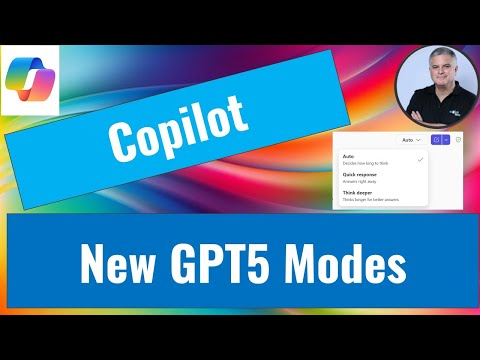
Copilot Chat: Quick & Deep GPT-5 Modes
M365 Adoption Lead | 2X Microsoft MVP |Copilot | SharePoint Online | Microsoft Teams |Microsoft 365| at CloudEdge
Microsoft three sixty five Copilot Chat gains GPT five Auto Quick and Think Deeper modes global December rollout
Key insights
- GPT-5: Powers Copilot Chat with stronger reasoning and clearer dialogue.
It routes work to the right sub-model so simple requests stay fast and complex tasks get deeper compute. - Modes: Users pick how Copilot balances speed and depth.
Options include Auto, Quick Response, Think Deeper, Smart, Study & Learn, and Search to fit different needs. - Quick Response: Gives immediate, concise answers for straightforward questions.
It uses a high-throughput path to prioritize speed over extended reasoning. - Think Deeper: Spends more processing time (about 10 seconds) to reason through complex, multi-step problems.
Copilot can share its chain-of-thought during this mode for transparency. - Smart mode: Chooses the best approach automatically, blending quick replies and deeper thinking when needed.
This mode works well for nuanced tasks that need context-aware judgment. - Rollout: General availability began December 4, 2025 and is expected to finish by December 8, 2025.
Microsoft will roll the update worldwide as part of the Microsoft 365 Copilot experience.
Video summary and context
In a recent YouTube video, Ami Diamond [MVP], a male Microsoft 365 expert, demonstrated the latest updates to Copilot Chat driven by GPT-5. He walked viewers through a new mode selector that aims to give users explicit control over how quickly and deeply the assistant responds. Consequently, the video frames the change as a move from one-size-fits-all replies to selectable behavior that fits different tasks.
What the new modes offer
Diamond highlighted three primary modes: Auto, Quick Response, and Think Deeper, each tuned for different needs. Auto defaults to letting Copilot choose the processing depth, while Quick Response prioritizes speed for straightforward questions, and Think Deeper allows extra reasoning time for complex problems. He also explained additional labels like Smart mode, Study and Learn mode, and Search mode that aim to refine responses further for context, education, and up-to-date web results.
How real-time model routing works
According to the video, the core innovation behind the update is real-time model routing, which dynamically picks an internal model profile to match each prompt. This approach prevents the system from using heavy computation for trivial queries and reserves deeper thinking for multi-step or creative tasks. As a result, users should see faster replies for simple queries and more thoughtful answers when complexity demands it.
Rollout timeline and availability
Diamond noted that Microsoft plans a global General Availability rollout beginning December 4, 2025, and expects to complete it by December 8, 2025. Therefore, organizations and individual users can anticipate the new mode selector and GPT-5 enhancements within that window. However, he also cautioned that staged deployments and tenant-level policies might delay access for some enterprise environments.
Tradeoffs between speed, depth, and transparency
The video made clear that balancing speed and depth requires tradeoffs: faster modes reduce latency but can miss nuance, while deeper reasoning improves quality at the cost of time and compute. Moreover, Think Deeper exposes internal chain-of-thought in some workflows, which increases transparency but can raise privacy and disclosure concerns for sensitive prompts. Thus, organizations must weigh response quality against operational cost and information control when choosing default modes.
Challenges for adoption and governance
Diamond also explored practical challenges, including user education, interface complexity, and enterprise governance. For instance, if too many modes confuse users, they may default to a single setting that does not suit all tasks, thereby negating the benefit of choice. In addition, IT teams will need clear policies to manage data retention, auditing, and compliance when the assistant exposes intermediate reasoning or pulls live web data.
Technical and operational considerations
From a technical perspective, dynamic routing can reduce wasted compute but increases system complexity, which raises testing and reliability demands. Furthermore, integrating live web search in Search mode helps keep answers current, yet it also increases dependence on external sources and the risk of citing inaccurate information. Therefore, Microsoft and customers must maintain monitoring and validation to prevent hallucinations and ensure citation quality.
Implications for users and teams
For everyday users, the change promises more relevant interactions because the assistant adapts to task needs instead of offering a single response style. For knowledge workers and teams, the ability to select or rely on automatic routing can improve productivity when paired with clear guidance on when to choose each mode. Consequently, successful rollout will depend on training, default settings, and feedback loops that surface when a mode underperforms.
Security and privacy tradeoffs
Diamond emphasized that modes exposing more reasoning or web sources can complicate privacy controls and data governance. While transparency can help users trust the assistant, it may surface sensitive prompt material or intermediate data that organizations would rather keep private. Thus, security teams will need to examine the tradeoff between explainability and exposure, and they may restrict certain modes for regulated data.
What to watch next
As the December rollout approaches, administrators should test the new modes in controlled environments and develop guidelines that match their risk tolerance. Meanwhile, users can experiment with Quick Response for routine tasks and reserve Think Deeper for complex problems that benefit from extra reasoning time. Overall, the update signals a notable step toward more flexible and context-aware AI in Microsoft 365.
Conclusion
Ami Diamond [MVP] presented the update as a practical evolution: smarter routing with user-facing controls that aim to improve both speed and quality. Yet, as the video made clear, success will depend on managing tradeoffs across performance, cost, privacy, and usability. Ultimately, organizations that plan, test, and educate users will be best positioned to benefit from these new Copilot Chat capabilities when they roll out globally.

Keywords
Copilot Chat GPT-5, GPT-5 modes, Copilot quick response mode, GPT-5 think deeper mode, Microsoft Copilot GPT5 features, AI chat fast responses, GPT-5 deep thinking mode, Copilot Chat update 2025