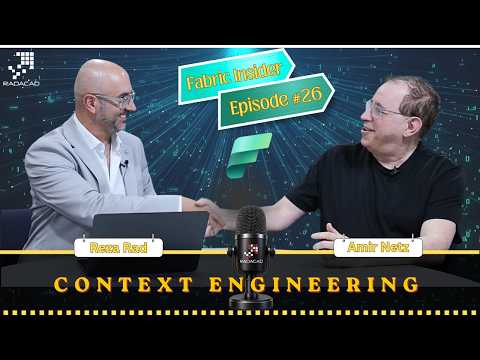
Microsoft Fabric context engineering for AI agents
Founder | CEO @ RADACAD | Coach | Power BI Consultant | Author | Speaker | Regional Director | MVP
Microsoft Fabric context engineering gives agents business data, processes and policies so they can act in ways that fit an organization.
Key insights
- Context engineering gives an agent a fuller picture of the business, its objectives, policies and current situation.
- It differs from spec engineering, which defines detailed requirements for an agent to generate code.
- Amir Netz describes Work IQ, Fabric IQ and Foundry IQ as different parts of the broader Microsoft IQ context picture.
- The discussion does not specify a Fabric setting, licensing requirement or rollout date for context engineering.
Microsoft Fabric context engineering is the work of giving AI agents the business context they need to understand a situation and choose an appropriate action. It matters to Fabric developers, data engineers, architects and BI leaders building or planning AI agents for business tasks. Reza Rad (RADACAD) [MVP] discusses the concept with Amir Netz, Microsoft’s CTO of Fabric, in a YouTube interview.
What it does
Context engineering is not simply writing a more detailed instruction for an AI model. It means assembling the information that helps an agent understand the organization, the task, the current circumstances and the rules that apply. The aim is for an agent to act in a way that fits its assigned role rather than respond only to a short prompt.
Netz distinguishes context engineering from what he calls spec engineering. Spec engineering is about creating a thorough specification that an agent can use to generate code. Context engineering applies more broadly: it gives an agent the context to perform a role, whether that role involves coding, customer service or sales. The two ideas can complement each other, but they answer different questions: what should be built, and what does the agent need to understand to do its job?
For example, an agent acting as a salesperson needs to understand a company’s products, customers and value proposition. A customer-service agent needs context that helps it represent the company. The interview does not lay out a formal implementation framework, but it makes the central requirement clear: an agent needs a sufficiently complete picture of its business environment to reason and act appropriately.
Who it is for and what you need
The concept is relevant to Fabric and Power BI developers, data engineers and architects, as well as BI leaders planning AI use. It is also relevant to people responsible for deciding what information and policies an agent should use. These roles are identified in the episode description as the intended audience for the wider Fabric discussion.
The discussion does not name a specific Fabric license, capacity, preview program, tenant setting or minimum product version for context engineering. It presents context engineering as an approach to building and guiding agents, not as a named Fabric configuration that readers can switch on. No regional availability or rollout details are provided.
For teams considering the approach, the practical prerequisite implied by Netz’s explanation is to know what the agent’s role entails and what it must understand to perform that role. That includes the organization’s goals, how work is done, relevant policies and the current business situation. The interview does not provide a checklist for collecting or governing those materials.
How it works
Netz describes context as the information that helps an agent understand its world: the business, its people, its objectives and the situation at hand. He connects that idea to Microsoft IQ, which he describes as a larger picture assembled from several context-oriented components. In his account, each component contributes a different kind of understanding.
- Identify the agent’s role. Decide what work the agent is expected to do, such as serving customers or supporting sales. The context required depends on the role.
- Supply organizational context. Give the agent information about the business, its team, objectives, practices and applicable policies. Netz emphasizes that an agent should understand “how we do things around here.”
- Include relevant business conditions. The agent also needs to understand what is happening in the business now, so it can assess the situation rather than rely only on general knowledge.
- Connect the context to action. The goal is for the agent to use that understanding to reason about what to do and, where appropriate, take action in the role it has been given.
Netz names Work IQ as the part concerned with understanding how a team works, drawing on examples such as email, documents, chats and schedules. He describes Foundry IQ as providing knowledge bases that document internal processes and explain how an organization works. Fabric IQ, in his description, contributes the picture of what is happening in the business through structured data.
These are descriptions from the interview, not a technical setup guide. The discussion does not give menu paths, configuration steps, or instructions for connecting a particular data source to an agent. It does, however, position Fabric IQ alongside work and process context: the agent’s understanding comes from more than one kind of information.
Limitations and open questions
Context engineering is a useful way to frame agent design, but the interview does not define a standard method for measuring whether an agent has enough context. It does not specify how to resolve conflicting information, control access to every context source, or determine when a human must review a proposed action. Those details matter to implementation, but are not covered in this segment.
The conversation also leaves a boundary between context engineering and code generation. Netz says that providing detailed specifications for agents to build software is better described as spec engineering. Context engineering concerns the broader background an agent needs for its role. Teams should not treat those labels as interchangeable based on the explanation given here.
There is no claim in the discussion that adopting context engineering guarantees accurate or safe outcomes. Nor does it describe a new Fabric feature with a release stage, license requirement or admin control. The Microsoft IQ components are discussed as a conceptual picture; exact product capabilities and availability are not established in the interview. The practical takeaway is to design the context around the job the agent must perform, while validating product details separately.
Sources
Frequently asked questions
What does context engineering mean for Microsoft Fabric AI agents?
It means giving an agent the business, team, policy and current-situation context it needs to understand its role and act appropriately. The interview presents it as an approach, not a specific Fabric setting.
How is context engineering different from spec engineering?
In Netz’s explanation, spec engineering provides detailed requirements for an agent to generate code. Context engineering supplies the broader background an agent needs for any role, including customer service or sales.
Do I need a particular Fabric license to use context engineering?
The discussion does not specify a license, capacity, preview status or configuration requirement for context engineering.