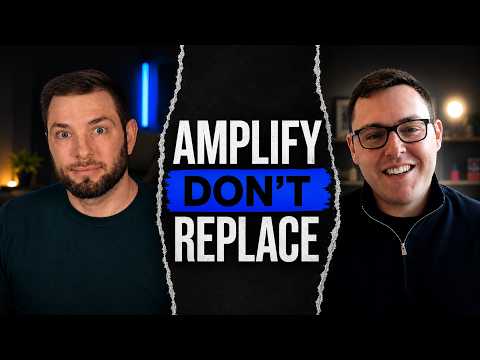
Microsoft Copilot: Authentic AI Work
Technical Specialist, Business Applications at Microsoft.
Microsoft Copilot Studio guide to authentic AI content and personal brand growth with Copilot agents and judgment
Key insights
- Authenticity: The episode argues the real skill is judgment — know what AI output to ignore.
Lead with your own perspective first, then use AI to expand or polish that voice. - Copilot: Use Copilot voice mode to brainstorm fast and capture ideas.
Always edit the results so the final post reflects your tone and viewpoint. - AI evals: Run quick AI evaluations on drafts to catch factual errors and "AI slop."
Iterate until accuracy and voice match your standards before publishing. - Agent boss: The agent boss model hands routine execution to agents while you set goals and guardrails.
This shifts creators toward strategy and judgment instead of manual tasks. - Personal-brand agent: Build a personal-brand agent in Copilot Studio to automate repetitive content tasks.
Train it on your writing rules so it amplifies your voice without replacing your thinking. - Prioritization: Prioritize what deserves your attention once AI reduces execution work.
Use agent mode in tools (like Word) and AI to turn photos, whiteboards, and slides into usable notes in minutes.
Introduction: From Video to Practical Playbook
This article reviews a blog post by Samuel Boulanger that summarizes a YouTube video featuring Microsoft product marketer Jack Rowbotham. The video, and Boulanger’s write-up, explain how to use AI tools for content creation while retaining an authentic voice, and they highlight a real-world workflow that delivered about 7.5 million impressions on LinkedIn. Moreover, the piece frames the conversation around the shift from raw prompt engineering to structured, agent-driven approaches inside Microsoft tools.
Importantly, Boulanger places Rowbotham’s experience—building a personal brand of roughly 90,000 followers while working full time—at the center of the discussion. Consequently, the write-up focuses on practical steps, not just theory, and it outlines how to protect human judgment as AI lowers the cost of content production. Finally, the report prepares readers to weigh tradeoffs between speed and authenticity as they adopt these tools.
Protecting Voice While Using AI
Boulanger emphasizes Rowbotham’s central rule: lead with your own perspective before you ever invoke an AI tool. In other words, sketch your thesis, your edge, or your personal takeaway first, and then use AI to expand, refine, or format that material rather than to originate it entirely. This approach reduces the risk of “AI slop,” a term Rowbotham uses to describe bland, generic output that erases personal nuance.
However, following this rule requires discipline and time, and that is a tradeoff. On one hand, creators can produce far more with AI; on the other, they must invest more judgment early in the process to avoid sounding generic. Thus, prioritization becomes essential: decide which pieces need your signature voice and which can use a more templated treatment.
The Agent Boss Model and Copilot Studio
The blog explains how Rowbotham demonstrates the evolving role of multi-agent systems and what he calls the Agent Boss model, where agents handle tasks but humans set strategy and constraints. Boulanger notes that Microsoft’s product stack—especially Copilot and the low-code ecosystem—enables these agent workflows and allows creators to build personal brand agents inside Copilot Studio. In turn, these agents can automate repetitive steps like drafting variants or turning slides into notes.
Yet, this model creates new governance and design challenges, which Boulanger highlights. For example, functioning agents require clear prompts, guardrails, and evaluation loops, and organizations must decide how much autonomy to grant them. Consequently, teams face the twin tasks of operationalizing agent behavior while keeping humans in the loop to validate important decisions.
Practical Workflow: Brainstorming, Evaluating, Iterating
Boulanger relays Rowbotham’s concrete workflow: brainstorm first, use Copilot in voice or agent mode to expand ideas, then run quick AI evaluations to check accuracy and tone. He also describes how Rowbotham runs small experiments on LinkedIn posts, measuring engagement and iterating based on feedback. This experimental and metrics-driven mindset helps creators learn what preserves authenticity and what drifts into generic AI copy.
Moreover, the article stresses simple habits that yield disproportionate gains, such as converting event photos, whiteboards, and slides into usable notes with AI in minutes. Still, turning raw outputs into publishable content requires human editing to ensure facts, context, and voice remain intact. Therefore, practical adoption balances automation for scale with human review for credibility.
Tradeoffs, Challenges, and the New Edge
Finally, Boulanger’s summary discusses the larger tradeoffs organizations and creators face when deploying these tools at scale. As AI removes execution barriers, judgment and prioritization become the new differentiators; however, scaling judgment across teams is harder than scaling automation. As a result, companies must invest in training, governance, and clear criteria for when to delegate work to agents.
In conclusion, the blog post frames the key challenge as cultural and procedural rather than purely technical: AI can accelerate content creation, but it cannot replace thoughtful perspective or credibility. Therefore, readers should treat the video’s tactics as a starting point, experimenting with agent-enabled workflows while protecting the distinct human voice that builds trust and sustained engagement.
Related tools

Keywords
authenticity in AI, AI authenticity, prompt engineering ethics, human-AI collaboration, Jack Rowbotham Microsoft, authentic AI content, ethical AI practices, AI for product marketing