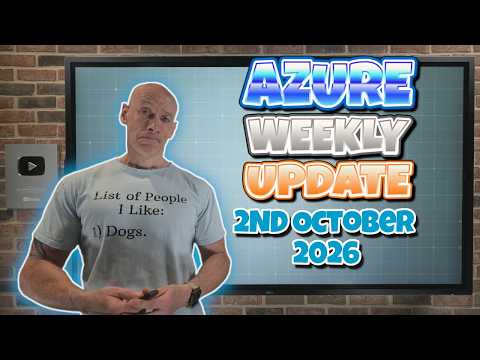
Azure Weekly: Oct 2 — Whats New
Principal Cloud Solutions Architect
Microsoft expert Azure update on retirements and innovations for IoT VMSS AKS Azure SQL Azure Arc NetApp Backup GPT
Key insights
- Azure Weekly summary: The video is a late‑September/early‑October 2026 roundup rather than a separate "2 Oct" issue, and it bundles platform changes, previews, and retirements into one update.
Watch this update to spot changes that may need action in your environment. - Retirements to note: Several services and VM SKUs were announced for removal (examples include IoT Central, Microsoft HPC Pack, and older D/Es/NV series SKUs), plus hosting changes for Azure Container Apps functions v1.
Start migration planning and set timelines to avoid service disruption. - Compute and containers: New features include VMSS automatic zone placement and availability of Lasv5/Laosv5 shapes; AKS Ubuntu 26.04 support landed for newer clusters.
Test workloads for compatibility and update deployment templates where needed. - Storage and backup: Azure Backup added preview support for Elastic SAN backup of Azure PostgreSQL flexible server/elastic cluster, while Azure NetApp Files gained SMB Entra Kerberos support plus cool access and large volume modes.
Review backup plans and SMB authentication flows before rolling changes into production. - Database platform: PostgreSQL got multiple updates — HorizonDB PostgreSQL 18, PostgreSQL LTRv2, cross‑tenant CMK support, Ultra Disk option, and a MySQL reader endpoint; Azure SQL added Dev Hub, vector DB features, and Hyperscale Serverless auto pause/resume.
Assess backup/restore and encryption configurations and update client drivers if required. - AI models and next steps: New models such as GPT‑6.1 Sol and Sonnet 5.5 appeared alongside model availability and Copilot notes.
Plan and test AI model usage, validate costs and compliance, and update runbooks to reflect retired services and new capabilities.
Overview of the video and source
The editorial team reviewed a recent YouTube video by John Savill's [MVP] that summarizes the weekly platform changes for Azure. The video functions as a compact roundup, highlighting new features, platform retirements, and several service-specific updates. Consequently, the presentation is useful for cloud engineers who need a quick digest of changes that may affect deployments and operations.
Moreover, the YouTube format organizes topics into short chapters that cover compute, serverless, containers, databases, AI, and migration tips. Therefore, the video serves as a practical pointer rather than exhaustive documentation, and viewers are encouraged to consult official product pages for implementation details. Despite that limitation, the video helps teams prioritize follow-up research.
Notable platform and Compute updates
The video lists multiple compute-focused announcements, including automatic zone placement for virtual machine scale sets and new VM series introductions and retirements. In addition, managed services such as Azure Kubernetes Service were noted for updates like support for newer Linux distributions, which influence image choices for clusters. As a result, teams that operate large, distributed workloads should evaluate whether these changes improve resilience or require testing for compatibility.
However, adopting new VM types or automatic zone placement brings tradeoffs between cost, performance, and operational complexity. For example, newer instance types may offer better price-to-performance ratios, yet they sometimes require updated drivers or orchestration settings. Therefore, organizations must balance the potential gains in efficiency against the testing and migration effort needed to maintain stability.
Data services, databases, and Storage changes
The video highlights a broad set of database and storage updates, such as enhancements for PostgreSQL (including long-term retention and tenant encryption options), an Ultra Disk option for PostgreSQL, and improved backup support for elastic database clusters. Additionally, files and SAN storage saw feature additions like Kerberos support for Azure NetApp Files and preview support for vaulted backup scenarios. These developments affect backup strategies, security controls, and I/O planning for stateful workloads.
Nevertheless, teams face tradeoffs when enabling advanced protections or encryption: stronger isolation and customer-managed keys often increase operational overhead and complicate disaster recovery. Meanwhile, storage performance features may raise costs while improving throughput, so architects must weigh budget constraints against service-level objectives. In short, careful capacity planning and security validation are essential when adopting these updates.
Retirements, migrations, and tradeoffs
The video also calls out retirements and migration signals, including the phased removal of older VM families, serverless hosting versions, and specialized packs. Consequently, organizations running legacy SKUs or runtime versions should inventory affected resources and plan migrations well before cutoff dates. Moreover, early action reduces the risk of unexpected service disruptions but may require downtime windows and testing resources.
Tradeoffs in migration planning typically involve balancing speed, cost, and risk. For instance, a lift-and-shift move may be faster but miss optimization opportunities, whereas refactoring workloads for newer platforms delivers longer-term benefits at the expense of immediate engineering effort. Therefore, teams should prioritize critical workloads, stage migrations, and apply automation to limit manual errors during transitions.
AI, tooling, and operational recommendations
The YouTube update mentions AI platform availability and model launches such as GPT-6.1 alongside tooling enhancements like SQL formatting helpers and migration pathways from hybrid management to native cloud services. These additions expand what is possible for application modernization, observability, and Developer productivity. As a result, organizations can accelerate new feature delivery but must ensure governance around model use, data handling, and costs.
Operationally, the video suggests a pragmatic approach: subscribe to weekly roundups, maintain an internal change log, and run targeted compatibility tests after major updates. Additionally, teams should combine automated testing with staged rollouts to balance velocity against reliability. Ultimately, this measured approach reduces surprises and helps teams capture the benefits of new features without compromising service levels.
Conclusion: practical next steps
In summary, John Savill's [MVP] delivers a concise weekly briefing that surfaces many actionable items across compute, storage, database, and AI domains. Therefore, the video is a helpful trigger for operational review, but it should complement—not replace—official documentation and formal change processes.
Finally, editorially we recommend that teams extract the chapters most relevant to their environments, prioritize migration or testing tasks, and assign owners for follow-up. By doing so, organizations can manage the tradeoffs between adopting new capabilities quickly and preserving production stability.

Keywords
Azure Weekly Update October 2026, Azure updates 2 October 2026, Azure October 2026 release notes, Azure AI services update October 2026, Azure security updates October 2026, Azure pricing updates October 2026, Azure governance compliance October 2026, Azure new features October 2026